
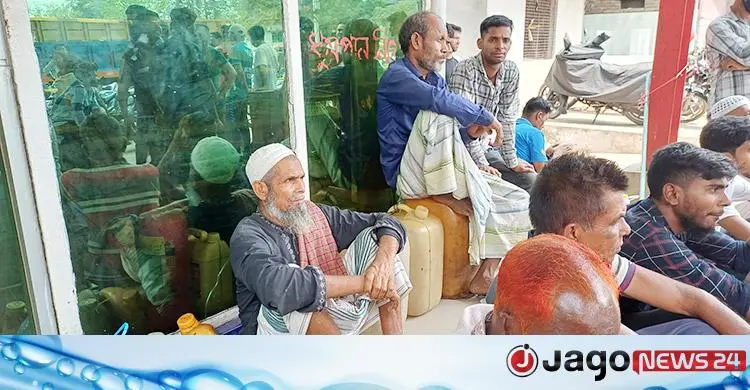
After an abnormal rise in fertiliser prices, farmers in Pabna are now being battered by a severe diesel shortage. At the height of the boro season, they cannot get enough fuel even after going from pump to pump. Forced to buy diesel at inflated prices on the open market to irrigate, thousands of farmers in the district are at their wits' end as production costs soar. Those concerned fear a slump in paddy yields.
Farmers complain that fertiliser prices have risen by up to Tk 1,000 a bag in some cases compared with last year. On top of this, the diesel crisis caused by the war in the Middle East has become "a blow on top of a blow" for them.
Farmers say fertiliser prices have risen sharply from last year, by as much as Tk 1,000 a bag for some types. Now a diesel crisis has been added. Many farmers go to filling stations with money and bottles and come back empty-handed. Some are forced to buy small amounts from village shops at Tk 50-60 above the price, but even this is not enough. So although seedlings are ready, many farmers cannot irrigate to prepare their land, and some who have transplanted cannot irrigate enough.
Costs outrun returns
Farmers Farooq, Hares and Ripon said at least 50 litres of fuel are needed to grow the paddy on one bigha, more in some places. Paddy fields need irrigation for about three months. At current diesel prices, irrigation costs Tk 5,000-6,000 a bigha. Buying the fuel at inflated prices from open-market shops would add Tk 2,500 to 3,000.
They said the total cost of bringing home the paddy from one bigha, including fertiliser, pesticide, weeding and harvest labour, is about Tk 20,000. Against that, paddy sells at Tk 1,000 to 1,200 a maund. A bigha yields 22-23 maunds; after engine and other costs, about 20 maunds are left, earning farmers roughly Tk 20,000.
Farmers claim they make no profit from paddy apart from the straw, and if costs rise there is nothing they can do but express their helplessness. They complain that, apart from words, nobody really thinks about them.
Nurul Islam, a farmer from Char Sadirajpur, told Jagonews that he needs 2 litres every other day, averaging a litre a day, and sometimes more depending on the soil. "For this fuel we have to sit at the pump for hours, and still we do not get it."
Alamin, a boro farmer from Char Sadipur who had come for fuel at a filling station in the Ananta Bazar area of Pabna town, said: "I pay Tk 50 in fare, sit for two to three hours and get 5-10 litres. Two days later I have to come and sit again. I do not get fuel as needed. You cannot farm like this."
Abdul Hakim, a farmer from Handial in Chatmohar upazila, said: "Last year I paid Tk 350 to have one bigha ploughed. This year, because of the diesel crisis, they are charging Tk 450, more in some places. Labour is also dearer. Unless paddy prices rise, it will be hard for farmers to survive."
Pumps overwhelmed
Filling station owners, however, say they are helpless. Sanjoy Kundu, manager of Messrs Highway Petrol Pump in the Ananta Bazar area of Pabna, told Jagonews that in normal times the station needed 4,000 litres of diesel a day, and at most 5,000 litres in the boro season. "But now whatever comes runs out quickly. It has become hard to know how much fuel would meet demand."
He said that in normal times some farmers came to them, but many did not; they collected diesel from local markets or dealers. "Now everyone is coming to us, which has increased the pressure on the pumps. Far from keeping stock, we cannot even finish serving everyone."
According to the district agriculture department, this year's boro target is 56,445 hectares, against which 56,285 hectares have been planted. Of this, 20,528 hectares of boro land are irrigated by diesel-powered machines. The department says farmers may face temporary hardship irrigating this land, but it will not have much effect on production.
Claiming that farmers' early hardship has largely eased, Md Jahangir Hossain Pramanik, deputy director of the Pabna Department of Agricultural Extension (DAE), told Jagonews that farmers' interests are being given top priority. Tag officers have been appointed at the pumps to make sure farmers get diesel properly.
He said all kinds of help would be given so that farmers can get diesel without hardship, and that the remaining problems would not have any major effect on production.
Source: Jagonews24. First published in Bengali on The Agro News.
Comments
(0)