
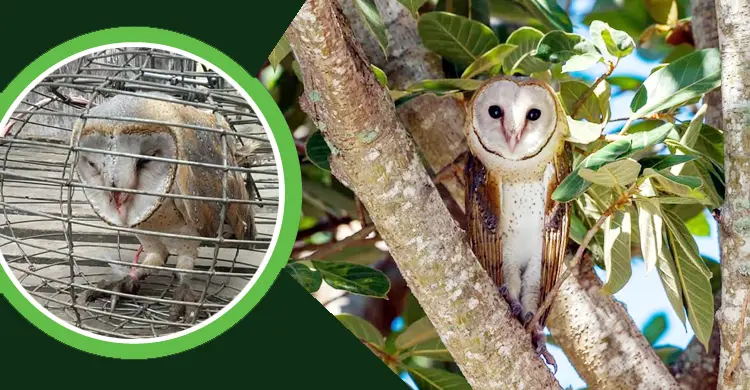
Some misconceptions and rumours about owls are widespread in rural Bangladesh. People believe the call of the lakshmi pencha (barn owl) is a harbinger of misfortune: when this owl calls near a house at night, death has come calling, and within a few days someone in that house dies or an accident happens.
Followers of the Sanatan (Hindu) faith, meanwhile, named this owl lakshmi pencha in the belief that it is the carrier of the goddess Lakshmi, and to them the bird is worthy of worship. But according to scientists, the owl is neither auspicious nor inauspicious. Like other animals, it is simply a member of the animal world.
Since ancient times, owls have attracted more superstition than any other bird. One belief is that if you come face to face with an owl on a dark night, you must spit on your body. In some areas, to drive off an evil wind, an iron object is heated in the stove and pressed against the body. In some places owls are burnt to death as bad omens. In some faiths, in the hope of improving one's fortune, an owl is sacrificed and parts of its body are put into an amulet worn round the neck.
Species and habits
Detailed information on the life cycle of the owl has been set out in Wikipedia, Banglapedia, the Asiatic Society journal and several other articles.
Although more than a hundred species of owl are found around the world, 10-15 species are seen in Bangladesh. Notable among them are the hutum, lakshmi, nimkhor, bhutum, rupali, pishach, jamdut, guha, himhim and banarmukho owls.
According to Wikipedia, the owl's beak is fleshy white, and its legs and toes are fleshy. Its face is large compared with its body. The owl has a large head, a flat face and eyes set at the front of the head. Like other birds of prey such as eagles and hawks, it has long, strong feet with sharp talons.
Wikipedia also says that as a nocturnal bird of prey, the owl becomes active at dusk, though it is sometimes seen in the daytime too. It is usually found in woodland and likes to sit on top of a post or piece of wood with its prey. It can move very silently and has very sharp hearing, and guided by sound alone it can catch prey in pitch darkness. With a slight turn of the head, an owl can hear faint sounds such as a rat chewing grain. This is because the shape of its head means sound reaches its two ears at slightly different times.
One study found among the owl's unusual traits that the female is slightly larger than the male. Owls live in tree hollows, but they also like high treetops and abandoned houses. They can detect two different sound waves in their two ears. Because they cannot bear bright daylight, owls go hunting very early in the morning and at dusk.
The owl also plays a very useful economic role: it protects crops by eating rats, the main enemy of crops.
'Neither good nor bad omen'
Professor Manjurul Kibria of the zoology department at the University of Chittagong told Jagonews: "The owl is an environment-friendly animal. None of the beliefs common in the country about owls being lucky or unlucky is correct. Everything in the animal world was created for the needs of ecological balance. According to our Muslim faith, Allah created everything for the needs of humans. The owl is not an endangered animal in Bangladesh, but it is protected by the Wildlife Conservation Act. If we neglect it, though, it too will end up on the list of endangered animals. Not only owls but all animals must be kept alive for the sake of humans."
He added: "Owls have economic importance. In rural Bangladesh, branches are stuck into crop fields so that birds can perch on them and eat insects harmful to the crops. Sitting on these branches at night, owls eat the rats that damage crops, and this saves crops worth a lot of money. And when the crop ripens, a scarecrow is put up in the middle of the field so that birds cannot perch and eat the crop."
Source: Jagonews24. First published in Bengali on The Agro News.


Comments
(0)