
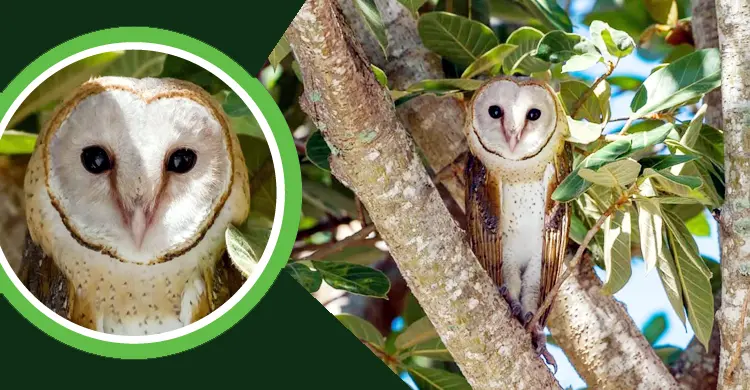
People hold many superstitions and supernatural ideas about the owl, a nocturnal bird, yet it is valued as useful all over the world. Owls play an important role in keeping nature and the environment in balance. There are about 200 species of owl worldwide, and 16 in Bangladesh. Notable among them are the lakkhi pencha, kotore pencha, nim pencha, kupokh or black owl, bhutum pencha, hill owl, grassland owl, bhuma pencha, collared nimpokh owl and the large forest owl.
Owls are not fussy about food. They live on small rats, caterpillars, small birds, lizards, rat snakes, frogs and the like. Although owls are birds, they do not live with other birds but alone, hidden in hollows of large trees, forests, gaps in buildings or behind dense foliage. They are hard to spot in the daytime because they rest hidden among leaves or in holes. Many believe owls cannot see by day. This is a misconception: owls can see in daylight, but their large eyes help them see better at night.
There is hardly anyone in Bangladesh who does not know the owl, though village people are far more familiar with its call than city people. Because of its somewhat unusual call and nocturnal habits, many superstitiously consider it an "ill-omened bird". So there are many fairy-tale-like stories and superstitions about it.
Beliefs from around the world
- In some parts of India the owl is believed to be the wife of the bat. In ancient times people in northern India believed that anyone who ate an owl's eyes would see well at night. Owl meat was even used to treat rheumatic pain and as a digestive medicine. In northern India a black owl was taken as a symbol of death.
- In the Middle East, if an owl was seen on the road before going to war, it was assumed the war would end in bloodshed.
- The Ainu people of Japan offered a special wine to the owl before any expedition, believing it would protect them from any danger.
- The Kikuyu people of Kenya believe the owl announces the coming of death: anyone who sees an owl or hears its call will die.
- To the Bantu of central Africa the owl was a symbol of the sorcerer, and to the Zulu of southern Africa it is a magical bird.
- The Swahili of east Africa believed the owl brings the signal of a small child's illness. In west Africa the owl was thought to be the messenger of sorcerers and witches, warning of bad times ahead.
- Aboriginal people in Australia believe the bat carries male souls and the owl female souls.
- People in Poland believed that after death unmarried women become doves and married women are reborn as owls.
- In Germany it was believed that if an owl called at a child's birth, the child would have bad luck.
- People in France believed that if a pregnant woman heard an owl call, she would have a daughter.
- People in Belgium believed Jesus Christ ordered the owl to live in churches to stop rats causing trouble there.
- In ancient Spain people believed the owl was a melodious bird until the death of Jesus, after which its call changed one night.
A useful bird in decline
In popular belief the owl is seen as an image of bad luck, physical illness or death, a belief held since ancient times. Even now, as in other countries, villagers in Bangladesh believe that an owl calling at night brings misfortune to the household. But owls naturally call at night.
The fact is that at this time owls come down to the ground to catch rats, and they call. Hearing an owl late at night is therefore perfectly ordinary and natural. Carrying all these superstitions and supernatural ideas with it, the owl goes on making a vital contribution to protecting nature and the environment.
Many owls were once seen in Bangladesh's towns and villages, but they are rarely seen now. Indiscriminate deforestation, the use of chemical fertilisers and pesticides on crops, hunters, lack of food and killing them as ill-omened birds are among the reasons owl numbers in nature are falling day by day.
The writer, Benazir Ahmed Siddiqui, is a pharmacist and social worker.
Source: Jagonews24. First published in Bengali on The Agro News.


Comments
(0)