
The holde, or oriole, is a familiar bird of rural Bengal. In some areas it is also known as kutum pakhi or bene bou. The melodious bird catches people's attention by its own charm and livens up the countryside in every season.
It calls from bamboo clumps, banyan and guava trees in village courtyards, while children tease it by pulling faces. But the number of these birds in the wild has now fallen because of environmental imbalance.
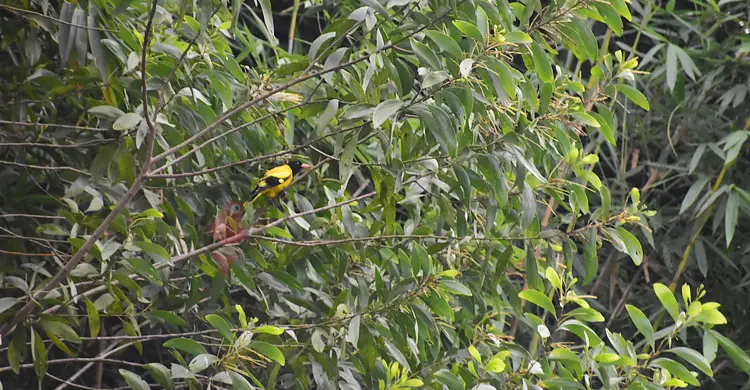
Recently an oriole was seen in a bamboo clump in Murali village of Rajnagar upazila in Moulvibazar district. It was caught on Jago News's camera as it flitted about, but soon disappeared from view again.
About the bird
The oriole's scientific name is given as Oriolidae, and its English name is oriole. Its feathers are bright yellow. The bird is about the size of a myna and 24 centimetres long. The tips of its tail and wings are black. Its throat and head are glossy black, while its beak and eyes are bright red, and its legs are light black. It usually builds its nest on tree branches with dry twigs, straw and weeds in bushes.
Its breeding season falls between spring and summer. It lays three or four white eggs with brown spots, and the male and female take turns to incubate them, hatching the chicks in 15 to 17 days. The long-billed yellow bird eats insects and fruit. It lives in Bangladesh, India, Myanmar, Indonesia and other countries of South Asia.
Losing its trees
According to experts, our birds are part of nature's beauty, but aggressive human behaviour is clearing forests and native trees and creepers, doing great harm to biodiversity. The oriole and all native bird species are at risk of becoming endangered, though they have not yet reached a critical level. The International Union for Conservation of Nature (IUCN) has declared the species least concern.
Bird lover Sanaur Rahman of Murali village told Jago News that people's aggressive attitude has cleared big trees such as banyan, mango, jam and chamkathal, so many native birds are disappearing. "Once the oriole was seen very close by, but now it is seen less," he said.
Swapan Deb Sajal, director of the Bonnyoprani Seba Foundation in Srimangal upazila of Moulvibazar, told Jago News that the loss of eco-friendly trees and creepers from our nature has reduced this farmer-friendly bird. Insects that harm crops are its main food, so its decline is harming crops. The bird is no longer commonly seen in rural Bengal, he said.
Bird expert and tea planter Ibadul Haque of Panchagarh told Jago News that the oriole, or benebou, is found in South Asian countries. This familiar bird is at risk of becoming endangered, and everyone's cooperation is needed to protect it, he said.
Source: Jagonews24. First published in Bengali on The Agro News.
Comments
(0)