
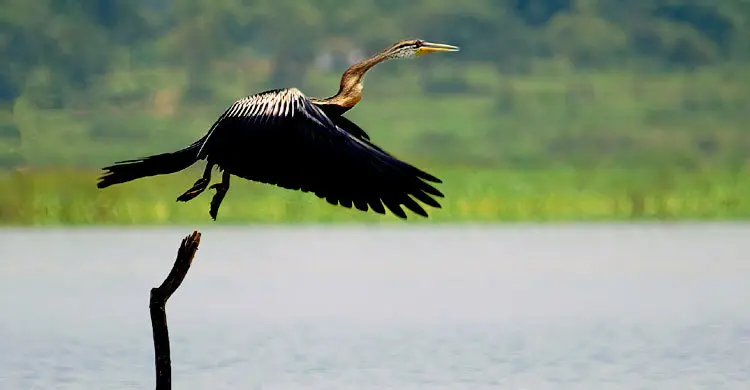
The oriental darter, known in Bengali as the goyar or "snake-necked bird", is now near threatened, and in Bangladesh it is endangered. Once seen in large numbers, the bird has declined rapidly over the past 30 years.
Although it is a bird, the darter can stay under water for several minutes at a stretch. Its favourite foods are fish, snakes and frogs, and it hunts fish by diving swiftly. When it takes its whole body deep under water to hunt, it looks much like a snake. A third of its body is neck and beak.
While swimming it holds its long neck and head in a way that resembles a snake, which is probably why it is also called the "snake bird" or "snake-necked bird". Its Bengali name is goyar; in English it is the darter or oriental darter, and its scientific name is Anhinga melanogaster.
Nesting and diet
Its fairly large size makes it an easy target for hunters. An adult weighs about one and a half kilograms and is around 90 centimetres long. It usually nests near water, with the male and female building the nest together from thin dry twigs high in a tree.
The breeding season runs from June to December. The female usually lays five or six eggs, which take 24 to 26 days to hatch. The chicks grow feathers within 12 days and learn to fly at 45 days. Fish is its favourite food, but it also eats frogs, snails, grasshoppers and the tender tips of aquatic plants, and will even take young checkered keelback snakes when it gets the chance.
Though no longer seen as before, the bird still turns up now and then in the country's large haors, beels, rivers and lakes. It usually lives alone, in pairs or in small groups, dives to catch fish with its beak and calls "chigi-chigi-chigi". It suns itself with wings spread on bamboo poles set in the water, on tree branches or on the ground.
Hunting and habitat loss
Inam Al Haque, founder of the Bangladesh Bird Club, said: "At one time they could be seen in every wetland in the country, even in ponds. I have seen darters in ponds myself. Now they are seen only in the big haors, on average about five to ten in each haor."
He added: "The bird is declining mainly because of illegal hunting, loss of habitat and a shortage of food. They used to nest in big bamboo groves. Their favourite foods are fish, snakes and frogs, but all of these are dwindling day by day. Without food and shelter, how will they breed?"
Source: Jagonews24. First published in Bengali on The Agro News.

Comments
(0)