
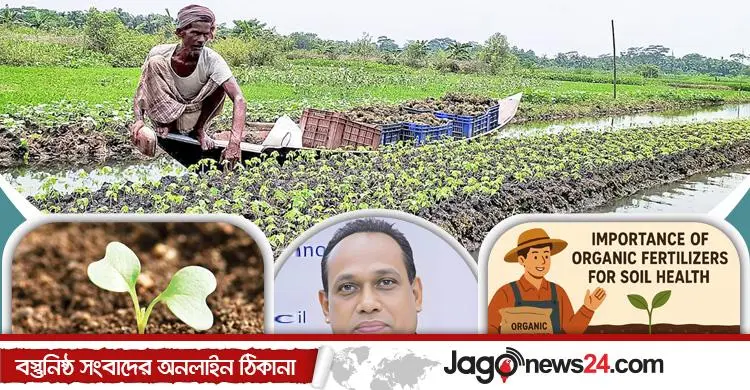
Organic fertiliser is immensely important for protecting the health of soil and crops. In modern farming, excessive use of chemical fertiliser and pesticides to raise production is reducing soil fertility and upsetting the balance of the environment. Soil microbes, earthworms and other natural components are being destroyed, and soil quality is declining. In this situation, organic fertiliser can be one of the main solutions for sustainable agriculture.
Organic fertiliser is made from natural materials such as cow dung, compost, organic waste and green manure. It supplies the soil with essential nutrients and improves its structure. By increasing the soil's organic matter it raises its water-holding capacity, so crop output stays relatively stable even in drought or heavy rain. It also improves crop quality and reduces the risk of chemical residues harmful to human health. There is therefore no alternative to organic fertiliser for the long-term health of soil and crops, and encouraging and training farmers to use it is now a pressing need.
Organic fertiliser and sustainable farming
Bangladesh's farm sector has made notable progress over the past few decades. Production has risen, food shortages have fallen and the farm economy has gained a firmer footing. But because this progress has relied mainly on chemical fertiliser and pesticides, the soil's natural structure and fertility are being damaged over the long term. Excessive chemical use is destroying beneficial micro-organisms, spoiling water quality and reducing the nutritional value of crops. So although productivity rises for a while, sustainable development is held back.
Against this background, the importance of organic fertiliser is growing day by day. It is made from natural materials such as livestock dung, crop residues, rotted leaves and compost. It increases the soil's organic matter, improves water retention and helps prevent pollution, and crops grown with it are safe, nutritious and environmentally friendly. To secure sustainable agriculture, dependence on chemical fertiliser must be reduced and organic fertiliser use increased. That requires raising farmers' awareness, building local organic fertiliser production centres and closer cooperation between the government and the private sector. With proper planning and application, organic-based farming can move Bangladesh towards an environmentally friendly, safe and sustainable farming system.
The consequences of chemical dependence
Over the past few decades Bangladesh's agriculture has advanced considerably. Modern technology, high-yielding seed varieties and chemical fertiliser and pesticides have multiplied output. But behind this progress lies a serious concern: excessive dependence on chemical inputs. Although farm growth has risen over the past five years, most of it has come through farming that relies on chemical fertiliser, pesticides and hormones. Output has risen for now, but the soil's natural structure is slowly being ruined.
Excessive use of urea, TSP, MoP and other chemical fertilisers is destroying the soil's organic content. Beneficial micro-organisms, the tiny creatures of the soil essential for maintaining fertility, are dying. As a result, the soil's water-holding capacity and its natural ability to regenerate are falling. Land that once easily gave good yields now needs twice as much chemical input or more for the same yield. This pushes up production costs and leaves farmers worse off financially.
The effects of excessive chemical use reach beyond the soil to the environment and human health. Water mixed with pesticides and chemical fertiliser spreads through rivers and canals and is seriously harmful to fish and other wildlife. Chemical residues also remain in food grains, and over the long term cause various illnesses in people, such as kidney and liver problems, cancer and hormonal disorders. This trend has become a major threat to sustainable farm development and food security. To secure sustainable agriculture, chemical dependence must be reduced now and farming must return to organic and natural methods. That will protect soil health, benefit farmers and give future generations safe, nutritious food.
The importance of organic fertiliser
Organic fertiliser is a natural fertiliser made from decomposing plant and animal matter such as cow dung, ash, leaves, crop residues and other organic materials. It is widely used in farming as an environmentally friendly alternative to chemical fertiliser, and it improves soil quality through its positive effect on the soil's physical, chemical and biological properties.
First, organic fertiliser makes the soil crumbly and well aerated, so plant roots grow easily. It increases the soil's water-holding capacity, helping crops keep growing even in drought. Second, it releases nutrients slowly, keeping the soil's nutrient balance and raising fertility over the long term. It also activates germs and micro-organisms in the soil, enriching its biological life. These micro-organisms break down organic matter into nutrients plants can easily use, increasing the soil's biodiversity, which is vital for sustainable farming.
Crops grown with organic fertiliser are more nutritious, tastier and free of poisons, which benefits human health. Demand for organic products in the market is steadily rising, so farmers also gain financially. In short, organic fertiliser not only protects soil fertility but lays the foundation for environmental conservation, health protection and a sustainable farming system.
Organic fertiliser use in Bangladesh
The country's annual demand for organic fertiliser is 60-65 lakh tonnes, and more than 75 percent of the raw material is available at home. In other words, with effective initiatives the entire demand could be met domestically. This would help develop the livestock sector, revive the rural economy and secure environmentally friendly farming.
Policy initiatives and subsidies
At present 70 percent of the farm sector's allocation is spent on subsidies, 80 percent of which goes to chemical fertiliser. The government is now working to cut chemical fertiliser use by 32-35 percent and increase organic fertiliser use. Experts have called for subsidies and incentives for organic fertiliser so that farmers can adopt it easily.
Challenges and what to do
Although the importance of organic fertiliser is widely recognised, there are challenges in using it. The main ones are slow production of organic fertiliser, a lack of awareness among farmers and its limited availability in the market. Many farmers are still reluctant to use it because chemical fertiliser works faster. Technical shortcomings in production and storage and a lack of quality organic fertiliser are also major obstacles.
Meeting these challenges needs coordinated effort. Farmers should be trained and made aware at government and private level so they understand the long-term benefits of organic fertiliser. Setting up production centres at local level would make it easier to obtain and cut transport costs. Steps should be taken to keep its market price affordable so that farmers can use it easily, and more research and technical support are needed to make production more efficient and less time-consuming.
To secure a sustainable future for Bangladesh's farm sector, increased use of organic fertiliser is essential. It plays an important role not only in protecting soil and crop health but also in protecting human health and the environment and securing food security. Now is the time to reduce chemical dependence and move towards environmentally friendly, sustainable agriculture.
Source: Jagonews24. First published in Bengali on The Agro News.


Comments
(0)