
Bangladesh has had a strong onion season. Demand has been met from home-grown onions as the season ends, and imports have been almost nil. Good prices are drawing farmers into growing more. Meanwhile, Indian farmers and traders, unable to export onions to Bangladesh, are at a loss.
While Indian media report onions dumped on roads, rotting in sacks and farmers in tears over low prices, Bangladeshi farmers are relieved. India, which relied heavily on Bangladesh as an export market, is now in trouble over onions, and consumers in Bangladesh are glad to be eating local onions.
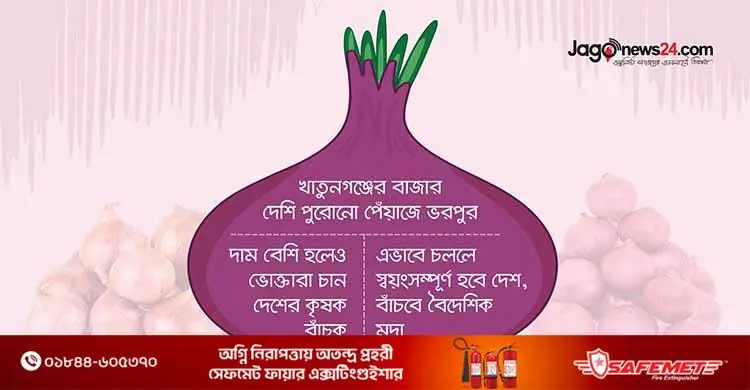
Onions currently sell at Tk 95 to Tk 120 a kg, depending on quality, in the Khatunganj wholesale market in Chattogram. The agriculture department says rain delayed planting this season, but if all goes well, new local onions could reach the market within the next 10 days.
Consumers are willing to pay a little more so that local farmers survive. Consumers and traders say that if things continue as they have this year, the country will become self-sufficient in onions and save foreign currency by not importing.
Three seasons a year
According to the agriculture department, the climate allows onions to be grown year-round in Bangladesh, in three seasons: Kharif-2, Rabi and Kharif-1. The Kharif-2 crop is harvested in November and December and sold as new local onion; it can be stored for one or two months. These onions, known as murikata, will reach the market in the next one or two weeks.
Most of the country's onions are grown in the Rabi season, which accounts for 65 to 70 per cent of total production. This crop is harvested from February to April, is of good quality and can be stored for three to five months. The Kharif-1 crop, harvested in June and July, is comparatively small.
According to the Bangladesh Bureau of Statistics, onions were grown on 535,599 acres in FY2024-25, producing 3,221,431 tonnes. In FY2023-24, 513,527 acres produced 2,917,354 tonnes, and in FY2022-23, 502,909 acres produced 2,546,994 tonnes.
Indian markets in trouble
For several days Indian media have reported that local traders and farmers are frustrated, even in tears, at being unable to export onions, and some have protested by dumping onions on roads. In some Indian markets onions are selling for two rupees a kg, according to the Economic Times and ETV.
On Saturday (29 November), ETV reported that wholesale onion prices had fallen to a record low this winter season. Because of export restrictions and oversupply, Indian farmers cannot recover their production costs.
Indian traders complain that halted shipments to major destinations, including Bangladesh, have brought disaster to the whole market. With exports to Bangladesh effectively stopped, onions brought to Delhi's Ghazipur wholesale market are rotting in sacks. Some are priced at just two rupees a kg and still find no buyers.
Commodity export and foreign trade expert Lokesh Gupta told ETV: "Bangladesh used to buy a third of India's total onion exports. But Bangladesh has now stopped imports from India to protect its own production and its farmers' interests."
Parmanand Saini, an onion trader at the Ghazipur wholesale market, said that with exports halted, onions are selling at two to at most 13 rupees a kg.
Indian exporter Ajit Shah told the Economic Times: "Indian onions used to fetch good prices because of their quality. But during the export ban, international buyers found alternative suppliers. Now we cannot find buyers in the season."
According to the Economic Times, India exported 724,000 tonnes of onions to Bangladesh in FY2023-24, 42 per cent of its total onion exports. In the first six months of FY2025-26, Bangladesh imported only 12,900 tonnes.
Imports in past years
By Bangladesh's official estimates, production exceeds demand by at least 400,000 to 600,000 tonnes, yet the country has had to import seven to eight lakh tonnes a year to meet demand. Most imports come from India, a neighbour with land ports. Over the past five years, imports from India were 571,000 tonnes in FY2019-20, 553,000 tonnes in FY2020-21, 665,000 tonnes in FY2021-22, 743,000 tonnes in FY2022-23 and 724,000 tonnes in FY2023-24.
In the current FY2025-26, however, hardly any onions have had to be imported, thanks to a good harvest and good prices that encouraged farmers. Local onions are arriving at Khatunganj wholesalers from Faridpur, Rajbari, Pabna, Chuadanga, Jhenaidah, Kushtia, Magura, Meherpur, Rajshahi, Rangpur and Manikganj. In past years, the Khatunganj-Chaktai warehouses would be full of Indian onions at this time. This year, no Indian onions at all have been found in the Khatunganj wholesale market.
Prices in Chattogram
Visits to Khatunganj and Chaktai warehouses over the past few days found no Indian onions, though local onions were somewhat dear. Wholesalers said Indian onions sold at Tk 120 a kg wholesale at this time last year.
Traders say onions sell for Tk 95 to Tk 120 a kg wholesale depending on size and quality. Abu Toyob, a trader at Khatunganj's Hamid Ulla Mia Bazar, told Jagonews: "There are no onions below Tk 100 now. The highest price is Tk 120 a kg. There is plenty of supply in Khatunganj."
Abul Bashar, proprietor of Bashar and Sons in Middle Chaktai, told Jagonews: "There are no Indian onions in the market this year. Although the season is ending, local onions are still available. Farmers in Pabna, Sirajganj, Rajbari and Kushtia still have onions at home, so supply in Khatunganj-Chaktai is normal, as elsewhere in the country. The best local onions now sell at Tk 110-115, whereas Indian onions sold at Tk 120 a kg at this time last year."
On the higher prices he said: "Even though prices are high, this time the money is going into our farmers' pockets. And not importing has saved foreign currency. If this continues, onion prices will fall in coming years, farmers will survive and we won't need to import."
Farmers expect to plant more
Bangladeshi farmers are happy with the prices and hope to grow more. Pabna produces the most onions in the country. Md Jahangir Alam Pramanik, deputy director of the Department of Agricultural Extension (DAE) in Pabna, told Jagonews: "Onions have been grown on 53,150 hectares in Pabna this year, which will produce about 9 lakh tonnes."
Nusrat Kabir, agriculture officer of Bera upazila in Pabna, told Jagonews: "Onions have been grown on 1,988 hectares across Bera upazila. Rain delayed planting in the current Kharif season, so the harvest is coming a little late. Murikata onions will reach the market in the next 10-15 days as new onions, so we expect farmers to get good prices."
Md Siddique Ali, a farmer from Dayalnagar village in Masumdia union of Bera, told Jagonews: "I have planted about eight bighas of murikata. It may take two months for them to reach the market, but onions planted in the char areas will come in about two weeks."
He said: "Last season I sold 200 maunds of onions. At first I got Tk 2,500 a maund, but towards the end I got as much as Tk 4,000. I have grown onions for many years; sometimes I made a profit, sometimes a loss. This time the market was good and I got better prices. I hope to grow more."
Sirajganj is the country's second-largest onion-producing district. Agriculturist Md Shahaduzzaman, Sirajganj district agricultural extension officer, told Jagonews: "Sirajganj is second in the country for onion production. Last season onions were grown on 48,000 hectares, producing six and a half to seven lakh tonnes."
He said: "The onion market is good now and farmers are getting good prices, so they are planting onions again with new enthusiasm. The country's demand can be fully met. But if onions are imported, our local farmers will suffer."
Saltha upazila grows more onions than any other upazila in the country. Saltha upazila agriculture officer Sudarshan Shikder told Jagonews: "The onion market was good all year. Having made a good profit last year, farmers are planting better-quality seed this time, so yields will be better than before."
Md Munnu Matabbar, a farmer from Boro Lakkhandia in Saltha, profited from onions last year and plans to grow them on more land this time. "Last year I grew onions on 10 bighas by our local measure and sold 1,100 maunds (of 40 kg). I got Tk 3,500 to Tk 4,000 a maund," he said.
DAE Director General S M Sohrab Uddin told Jagonews: "The country has not had to import onions all year. This is very positive for us: it has saved foreign currency. During the dollar crisis of the past few years, not importing onions kept the crisis from dragging on. This is a positive for the economy. With the stocks farmers now hold, we hope no onions will need to be imported this year."
Source: Jagonews24. First published in Bengali on The Agro News.
Comments
(0)