
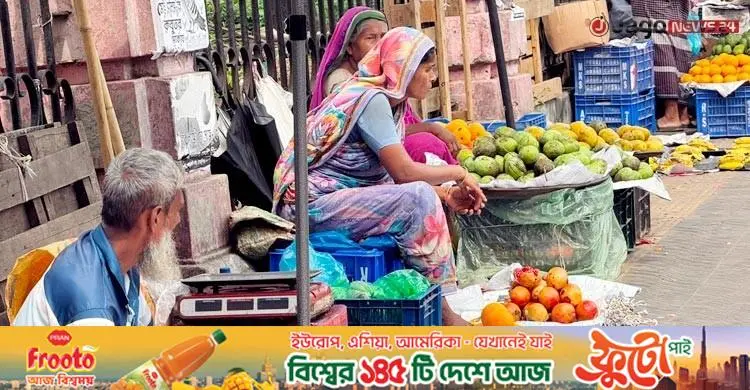
For about 30 years an unusual fruit market has been held on the pavement in front of Ahsan Manzil in Old Dhaka. Apples, grapes, malta, oranges, pears, pomegranates, mangoes and many other local and imported fruits are sold here at roughly half the market price. Fruit with small blemishes, bruises or minor transport damage, which is in less demand in the main markets, has become a relief for low- and middle-income families.
At a time of rising prices, when fruit and other nutritious food are disappearing from many middle-class families' diets, this market has become a blessing for many. Cheap fruit, small traders' struggle to make a living and the prevention of food waste together make the story of this three-decade-old market a different kind of reality.
Beside the country's big wholesale fruit market
Ahsan Manzil stands on the bank of the Buriganga river in Old Dhaka. Small traders occupy the pavement on the south side of this Nawab palace with baskets of fruit. A short walk away is Badamtoli, Dhaka's largest wholesale fruit market.
From dawn every day the narrow lanes of Badamtoli come alive, crowded with covered vans loaded with fruit, small trolleys and buyers. Small traders sit in rows on both sides of the road, some with red apples laid out, others with heaps of oranges, grapes, malta, mangoes or dragon fruit. From a distance it looks like any other fruit market, but up close the difference shows: small spots on many fruits, a slight bruise here and there, and some fruit dented during transport or storage.
Where fruit shops and supermarkets in the capital charge Tk 300 to Tk 400 a kg for imported apples and other fruit, similar slightly blemished fruit sells here for Tk 150 to Tk 200. Because of this big price gap, buyers come from far and wide every day, especially salaried people on limited incomes, labourers and middle-class families who can keep fruit in their diet at low cost.
A buyer named Jafar said: "I bought apples at Tk 150 a kg. Some fruit gets marked because it is carried in containers or cartons, which is why it is cheaper. But the fruit is fine to eat and we are satisfied. In an ordinary shop these apples would cost Tk 300 to Tk 350 a kg at today's prices, but here they are nearly half price. For middle-class families like ours this is a big relief."
It is not just apples. Depending on the season the market sells many kinds of fruit: mangoes, lychees, watermelon and jackfruit are in demand in summer, while oranges, grapes, malta and various imported fruits appear at other times. Sellers set prices according to the type and condition of the fruit.
Thin margins for traders
Traders said the fruit is bought from Dhaka's large fruit wholesale houses, importers and wholesale markets. On long journeys by truck, container or other transport, knocks and pressure spoil the appearance of much of the fruit, though the quality inside often remains fine. When the price of such fruit falls in the main market, traders buy it and sell it on the pavement in front of Ahsan Manzil.
Fruit seller Mishu, in the trade for about 12 years, said: "Where good apples cost Tk 300 a kg, we sell lightly marked apples for Tk 150 to Tk 200. We make Tk 5 to Tk 10 profit a kg. The margin is small, but we run our households by selling more."
Haridas, a trader in the market for about 30 years, said: "There used to be many more buyers here. Now, because of market conditions, some days sales are good and some days we sit all day without selling much. Often we buy Tk 10,000 worth of fruit and part of it spoils. Then we sell it cheaply to recover at least some of our capital."
Locals say the Badamtoli fruit market is not just a place to buy and sell but a long-familiar sight of Old Dhaka. Hundreds of people come every day to buy the fruit they need cheaply, and many buyers have relied on it for years. They say that with fruit prices as high as they are, without such an affordable market it would be even harder to buy fruit regularly for children and elderly family members.
Sellers, for their part, say that despite limited profit this trade is their families' main source of income, so they keep selling from dawn until night despite daily uncertainty and the risk of loss. They collect fruit from the wholesale houses at dawn and sell on the pavement; if sales are good they profit, and if not they bear the loss.
Cutting food waste
The market also plays an important part in reducing food waste. Fruit that might once have been thrown away because of minor external damage now reaches people's tables, cutting traders' losses while giving ordinary people cheap, nutritious food.
Experts say, however, that buyers must be careful. They should check whether fruit is overly rotten, smells bad or has become unfit to eat through long storage, and use it soon after buying. The authorities concerned should also keep an eye on market supervision and food safety.
Source: Jagonews24. First published in Bengali on The Agro News.
Comments
(0)