
There has been no rain in the northern region even in the month of Boishakh. It is the season for mango, jackfruit and litchi, and in the intense heat the mango and litchi crops of the Pabna and Natore area are being damaged. Farmers say the drought has dried out the stalks of mango and litchi, and the fruitlets have fallen.
Mizanur Rahman, a farmer from Payrabandh village in Mithapukur upazila, said: "We get drought when it should be storm and rain, and rain when it should be dry. Rain used to come with storms at the start of Boishakh. Now we don't get the rain we hope for even in the monsoon. For small farmers like us, it is hard to spend extra money growing aman paddy without nature's help."
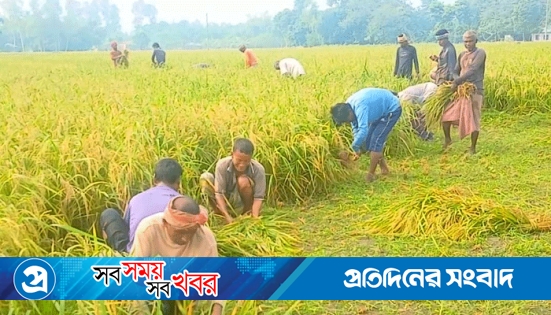
In the fields, paddy is swaying and in most areas the panicles have filled. Experts say the fields must hold water at this point: if the base of the plants dries out, the lack of moisture will leave the grains empty and production will fall.
What farm officials advise
According to agriculture officials, paddy risks empty grains when the temperature goes above 35C, and this year it has exceeded 39-40C. Water is critical while the paddy is flowering. Water should be held at the base of the plants; if that is not possible, the field must at least stay wet. Their advice is to water the base of paddy, mango, litchi, jackfruit, black plum (jam), rose apple (jamrul) and other fruit trees. If enough water is ensured, crops will not suffer much even as the sun gets hotter.
Fields of aubergine, tomato, chilli, bottle gourd, sweet pumpkin, bitter gourd, ridge gourd, snake gourd, pointed gourd, cucumber and okra should be irrigated every three to four days. Leafy vegetables such as stem amaranth, red amaranth, Indian spinach, water spinach and bottle gourd leaves need irrigation every two to three days.
Scorched maize and hard-baked soil
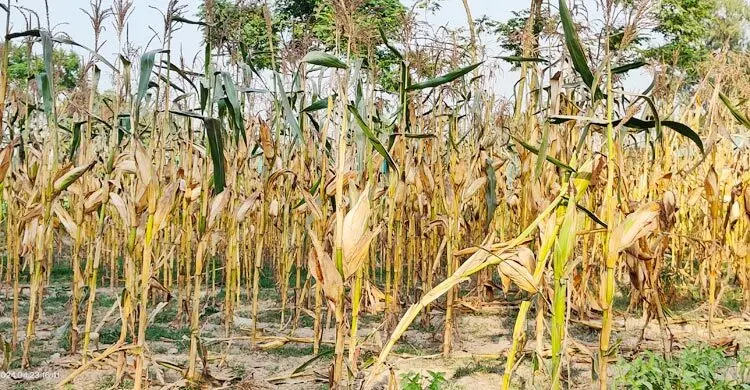
Across different areas, farmers are at a loss over nature's hostile behaviour. Because aman paddy depends entirely on rain, supplementary irrigation will not give a good yield, and farmers fear a crop failure. Along both sides of the Mithapukur-Badarganj road lie wide fields of paddy and other crops. Demand for maize growing has risen in the area, and hundreds of bighas of maize line the road. But much of it has been scorched by the heat and sun, the leaves and cobs burnt before maturing. The yellow, faded fields show the farmers' despair.
Farmer Abul Hossain said he sweats all the time and feels weak when he works. It looks as if the drought will last longer if it does not rain. The soil here is sticky, and without water it has dried as hard as wood.
In Pabna district of Rajshahi division most rivers have dried up, including the Padma, Jamuna, Kageshwari, Sutiali, Bannai, Chandrabati, Baral, Hura Sagar, Ratna, Ichhamati, Atrai and Gumani. Environmentalist Tuhin Wadud said all the rivers flowing through the districts of Rangpur division are now without water too, though they used to hold at least some. The once fast-flowing Brahmaputra is in a pitiful state, and the Teesta can be crossed on foot over its chars. The Buri Teesta, Dharla, Dudhkumar, Phulpur, Nilkamal, Ratnai, Karatoya, Ranachandi, Atrai, Mahananda and other rivers barely flow, though many farmers depend on them for their livelihood. The Jamuneshwari, Dhepa, Ichhamati, Chhoto Jamuna, Ghaghat, Akhira, Holholia and other rivers have in places shrunk to drains or canals.
In the intense drought, groundnut, sesame, mango, litchi and other fruit on the chars are drying and dropping early. With the water table unusually low, tube wells are not giving water. Agriculture experts say crop production may be under threat from the long drought, and besides the economic loss, coping with the situation will be a major challenge for farmers in the north. The fields are hot from the morning, with a blazing sun overhead.
Farmers' costs double
Akkas Ali, a Mithapukur farmer standing at the edge of his maize field in the Boishakh midday heat, said: "I planted the crop with money borrowed from an NGO. Now it is being ruined in front of my eyes by the drought. There is no moisture in the soil, and no rain, so the maize is falling from the plants. When I give water from the machine the soil soaks it up in a moment. The plants don't improve."
From a neighbouring vegetable field, a farmer named Harej said: "The pesticide I'm using isn't working. Out of 50 aubergines, 45 have pests. The soil can't hold the irrigation water. Frequent irrigation of vegetables, maize and other crops in the heatwave has doubled our costs. Insects have increased too. All in all, we are at a loss."
Meteorologists say rainfall in the northern region has fallen over the past few years. This year too the sun has been glaring since the start of Boishakh, with temperatures hovering around 39-40C, leaving farmers in trouble.
Agriculture expert Dr Ismail Hossain said water must be given at the base of the paddy, as a lack of water risks empty grains. It is good to dig ring-type trenches around plants and water them. Spraying the right amount of pesticide mixed in water on the leaves, after consulting field-level agriculture officers, would also offer some protection.
Source: Jagonews24. First published in Bengali on The Agro News.
Comments
(0)