
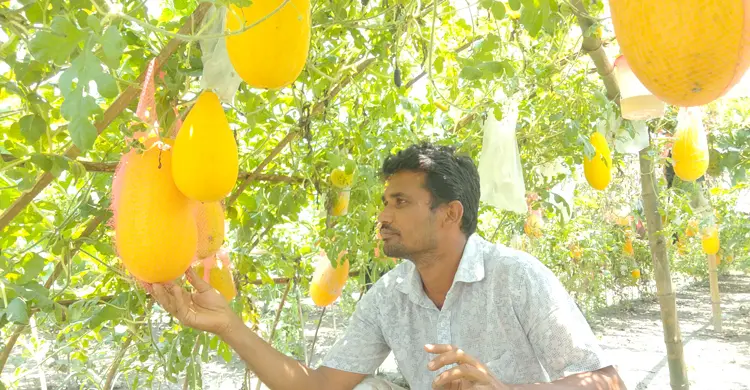
Samsul Islam, a farmer in the Itakhola area of Nilphamari Sadar upazila, grows paddy, maize, potatoes and other vegetables, and his family lives on what he earns from them. For several years, though, natural disasters and other problems had kept his yields poor. Unsure what to do, he tried a new yellow watermelon on a trial basis with the help of the agriculture office. The trial has given him a good crop, and he now hopes for a bigger profit.
Like Samsul, Nurin Nur, known as Mukta, of the Harowa area of Nilphamari municipality has also had a good yield from the new watermelon. The Department of Agricultural Extension (DAE) says that because it is a summer watermelon it can be grown widely in the region's soil, and farmers will profit more.
Two varieties, three months to harvest
According to the DAE, the watermelon comes in two varieties, Black Baby and Tripti. It is grown mainly in summer and suits the local soil, so high yields are possible. Each fruit weighs up to 2-3kg and can be harvested in 80-100 days. The department says sales of up to about Tk 3 lakh are possible from one bigha of land, farmers are being encouraged, and it expects cultivation to grow.
Samsul Islam told Jagonews: "I grow potatoes, maize and paddy, but for several years storms, rain and pests have ruined the crops and there has been little income. Then the agriculture officer advised me to grow this, so I planted it on 15 decimals. Now the yield is good. I spent Tk 20,000 and I think I can sell about Tk 1 lakh worth."
Mukta Begum said: "I grew Tripti and Black Baby watermelons on 20 decimals. The yield is good and I hope to make a profit."
"First grown in Nilphamari"
Sub-assistant agriculture officer Zakaria Islam told Jagonews: "This is a completely new variety of watermelon, grown for the first time in Nilphamari. It is very profitable: it takes little time and there is a chance of big profit at low cost. We are trying to increase its cultivation and output."
Sadar upazila agriculture officer Md Atiq Ahmed told Jagonews: "We gave the farmers seed free of charge, and technical support on how to do everything. Three farmers have grown it on 20 decimals each, and all have had good yields. One bigha can earn Tk 2-3 lakh. Neighbouring farmers have been encouraged, and we hope to spread cultivation widely through them."
Source: Jagonews24. First published in Bengali on The Agro News.

Comments
(0)