
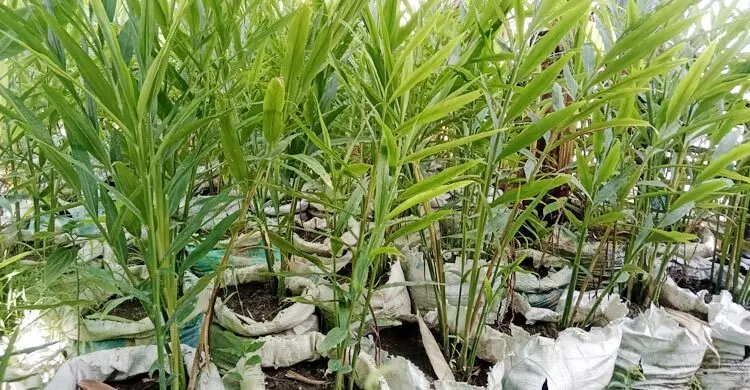
Farmers in Nilphamari have started growing ginger on fallow land in the hope of higher income at low cost. Interest in growing ginger in sacks is rising in every upazila of the district, where ginger is being grown in more than 3 lakh sacks, and the practice is growing day by day.
According to the district Department of Agricultural Extension (DAE), sack cultivation of ginger is growing commercially as a source of extra income for farmers. The cost is low: spending Tk 50-60, a farmer can get about 1-2kg of ginger from each sack. Ginger is being grown in 3,32,775 sacks in the district. Because ginger is used as a spice and a herbal medicine, its price is quite high, so many have started growing it in sacks both for household needs and for commercial profit. Informed observers say that if more ginger is grown, demand for imported ginger will fall considerably.
Upazila by upazila
Enquiries in the district's upazilas show that ginger has been grown in 3,32,775 sacks this year: 1,05,000 in Nilphamari Sadar, 65,000 in Domar, 60,000 in Dimla, 58,400 in Kishoreganj, 26,000 in Jaldhaka and 18,150 in Saidpur upazila. The department concerned says the practice will expand in future if it succeeds.
Manna Mia of Ramnagar in Sadar said: "I had never grown ginger in sacks before. This time I am growing it in 9,000 sacks. Even though I am growing it on fallow land beside my house, there has been no significant disease."
Md Mozam Hossain of Haritakitala in Palashbari runs a grocery business. Alongside it, he has for the first time started growing ginger in 100 sacks on fallow land beside his house. He looks after the plants regularly with advice from the upazila agriculture office and hopes to profit.
Sadar ginger farmer Nuruzzaman said: "After seeing the method online, I grew ginger in 2,500 sacks around the banks of my pond. I have already taken training from the upazila agriculture office. From the condition of the crop now, I will make a profit."
Farmers expect big profits
Rokon Ibn Aziz of Nitai union has grown ginger in 2,500 sacks. Faruk Mondal of Singergari Parerhat said: "With the help of the upazila agriculture officer I have grown ginger in 4,700 sacks. Even though 200 sacks were damaged, I hope to make a profit of Tk 7-8 lakh."
Shahjahan Mia of Mia Para village in Magura union has grown a local variety in 1,030 sacks on 20 decimals of fallow land. Ginger now sells at Tk 300 a kg. If he gets Tk 200 a kg at harvest, he will make a profit of over Tk 2 lakh, with returns well above costs.
Farmer A Kader of Bahagili union in Kishoreganj upazila has caused a stir across the upazila by growing ginger in 6,735 sacks on 30 decimals of fallow land around his yard.
Officials offer support
Sub-assistant agriculture officer Md Abdul Ahkam Sarkar told Jago News: "Growing ginger in sacks needs no extra cropland or labour. The soil in a sack is easy to control. Farmers are mixing cow dung, oil cake, ash and chemical fertiliser with soil and using fallow land to grow ginger in sacks. With a little care and occasional watering, the plants will survive. We are encouraging farmers to grow ginger and giving them support and the advice they need."
Sadar upazila agriculture officer Atik Hasan told Jago News: "Ginger is being grown in 1,05,000 sacks in Sadar upazila. This time the agriculture department has given fertiliser and pesticide for 15,000 sacks free of charge. Farmers are being encouraged to grow ginger by this new method and given various advice. Ginger can easily be grown this way in shaded spots around homes, in gardens and on fallow land."
Lokman Alam, agriculturist in Kishoreganj upazila, said: "There was a disease of ginger (rhizome rot) in the upazila, and some ginger farmers suffered losses because of it. Growing ginger in sacks is profitable. Through motivating farmers, ginger has been grown in 58,400 sacks in various areas. If the market stays good, there will be a profit."
Dr SM Abu Bakr Saiful Islam, deputy director of the Nilphamari district DAE, told Jago News: "Ginger has been grown in 3,32,775 sacks in the district. It is now grown in sacks to a greater or lesser extent in every upazila. The agriculture offices have been advising farmers to meet family food needs and increase marketing, given the interest in low-cost ginger farming. Sack-grown ginger has become quite popular at homesteads and as a companion crop with other crops. Because production costs are low, I hope it will be possible to meet food needs and sell as well."
Source: Jagonews24. First published in Bengali on The Agro News.


Comments
(0)