
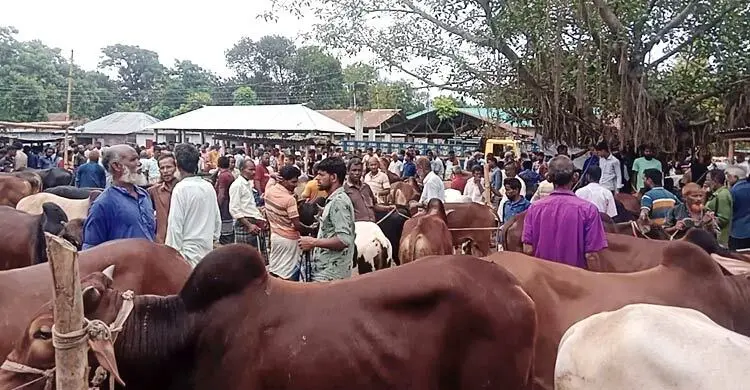
Livestock markets in Nilphamari have come alive ahead of Eid-ul-Azha. Plenty of local cattle and goats have started arriving and trading has begun. Wholesale buyers are coming from different parts of the country, and every market in the district is busy with buyers and sellers.
This year permission has been given for sacrificial animal markets at 41 places in the district, 31 permanent and 10 temporary. Animals are also being bought and sold on six online platforms.
According to the district livestock office, demand for sacrificial animals this Eid is 143,109, and there are 133,092 more animals than that, which will help meet demand in other parts of the country. In all, 276,201 animals are ready for the sacrifice with 30,972 farmers and livestock keepers in the district: 75,833 cattle, 33 buffalo, 186,151 goats and 14,184 sheep. Twenty-nine medical teams are carrying out health checks at the markets.
Allegations over receipts
However, the cattle markets in Nilphamari have been seen charging extra for receipts. There are allegations that the markets are collecting hasil (toll) above the amount set by government rules. In some markets, receipt writers employed by the leaseholders issue receipts without writing the toll amount on them.
Animal seller Safiqul Islam said cattle prices seemed lower this time than last. Buyers are coming to the market but leave after asking the price. Many buyers this year are checking prices in the market, while others have come to buy, and many are buying, he said.
Mamun, a cattle trader, said: "I bought 15 cattle at the Bosunia market today. Cattle prices are very high, and the receipt charge is high. They took Tk 1,000 per animal for the receipt from the buyer and seller."
Abdur Rahman, a buyer, said most of the cattle and goats now arriving at the market are raised locally. "The price didn't match today, so I didn't buy. I'll buy at the next market."
Sahidul, a local man, said he brought eight cattle to the market and has sold three. As there is still time before the sacrifice, buyers are bargaining, and sales will rise at coming markets, he said.
Md Jamiar Rahman of Jamirbari village in Sonaray, Domar upazila, said: "I brought 10 cattle to the Bosunia market today and seven have already sold. But feed prices are high, so our production costs have risen a lot. Still, demand for cattle at the market is good."
Sharif, a trader who came from Chattogram to buy cattle, said: "For several days I've been buying cattle and sending them by truck to Chittagong. Cattle prices seem higher this time, but I'm still buying. For those of us who come to Nilphamari from outside to do business, the markets have no facilities. The receipt charge for cattle is high here. There's no point telling you."
Police, vets and the leaseholder
Nilphamari Superintendent of Police Md Golam Sabur PPM (Seba) told Jago News that temporary police camps would be set up at the markets, and machines to detect counterfeit notes were available. The amount of hasil must be written on a signboard at each market designated for sacrificial animals. Plain-clothes police will be active alongside market committee members to avoid any untoward situation. "I would tell buyers and sellers not to eat anything given to them by others at the market," he said.
District livestock officer Dr Sirajul Haque told Jago News that farmers in the district are raising more than 276,000 animals this year, against demand of a little over 143,000, so more than 133,000 animals will go to other districts. Veterinary medical teams of the Department of Livestock Services will be at the markets.
Mofakkharul Islam Swapan, leaseholder of the Bosunia market, said the market toll had been fixed after a district-level meeting. "There's no need for you to talk about it. They're taking Tk 1,300 per receipt at a cattle market in Nilphamari, look at that first," he said, and hung up.
Source: Jagonews24. First published in Bengali on The Agro News.
Comments
(0)