
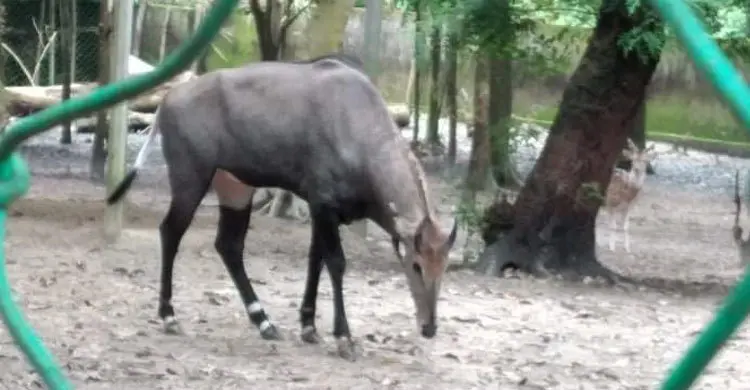
The female nilgai at Bangabandhu Sheikh Mujib Safari Park in Sreepur, Gazipur, has at last found a companion after a long time. On the park authorities' initiative, a male nilgai left alone at the Ramsagar recreation centre in Dinajpur was brought to the safari park on Wednesday. The animal is now in quarantine and will be put with its mate after a set period. The park authorities hope this will help the extinct nilgai breed.
Tabibur Rahman, the park's officer in charge, said the nilgai, a species extinct in Bangladesh, was placed on the Red List of the International Union for Conservation of Nature (IUCN) long ago. On 5 September 2018 a female nilgai was rescued from the border area of Ranisankail upazila in Thakurgaon and brought to Ramsagar. Then, on 22 January 2019, a male nilgai was rescued from Jotbazar in Naogaon. The female and male were kept together at Ramsagar National Park for breeding, but the female died in an accident on 16 March 2019, leaving the male alone.
Meanwhile, on 21 February this year, BGB rescued a female nilgai stuck in mud in the border area of Shibganj upazila, Chapainawabganj. It was later brought to Bangabandhu Sheikh Mujib Safari Park with the Forest Department's help.
Asia's largest antelope
Anisur Rahman, the safari park's wildlife supervisor, said the nilgai is an extinct species of wildlife. Although its name suggests a cow, it is not of the cattle family at all; rather it is a deer-like animal, the largest antelope in Asia. Nilgai love to eat grass, grain and woody plants, and like to live among small bushes or scattered trees.
He said that about a hundred years ago nilgai were seen in various parts of India, Pakistan and Bangladesh. By various accounts, the last nilgai was seen around 1940. There are now two nilgai in the country, and keeping the female and male together means good news of breeding could come soon.
Source: Jagonews24. First published in Bengali on The Agro News.
Comments
(0)