
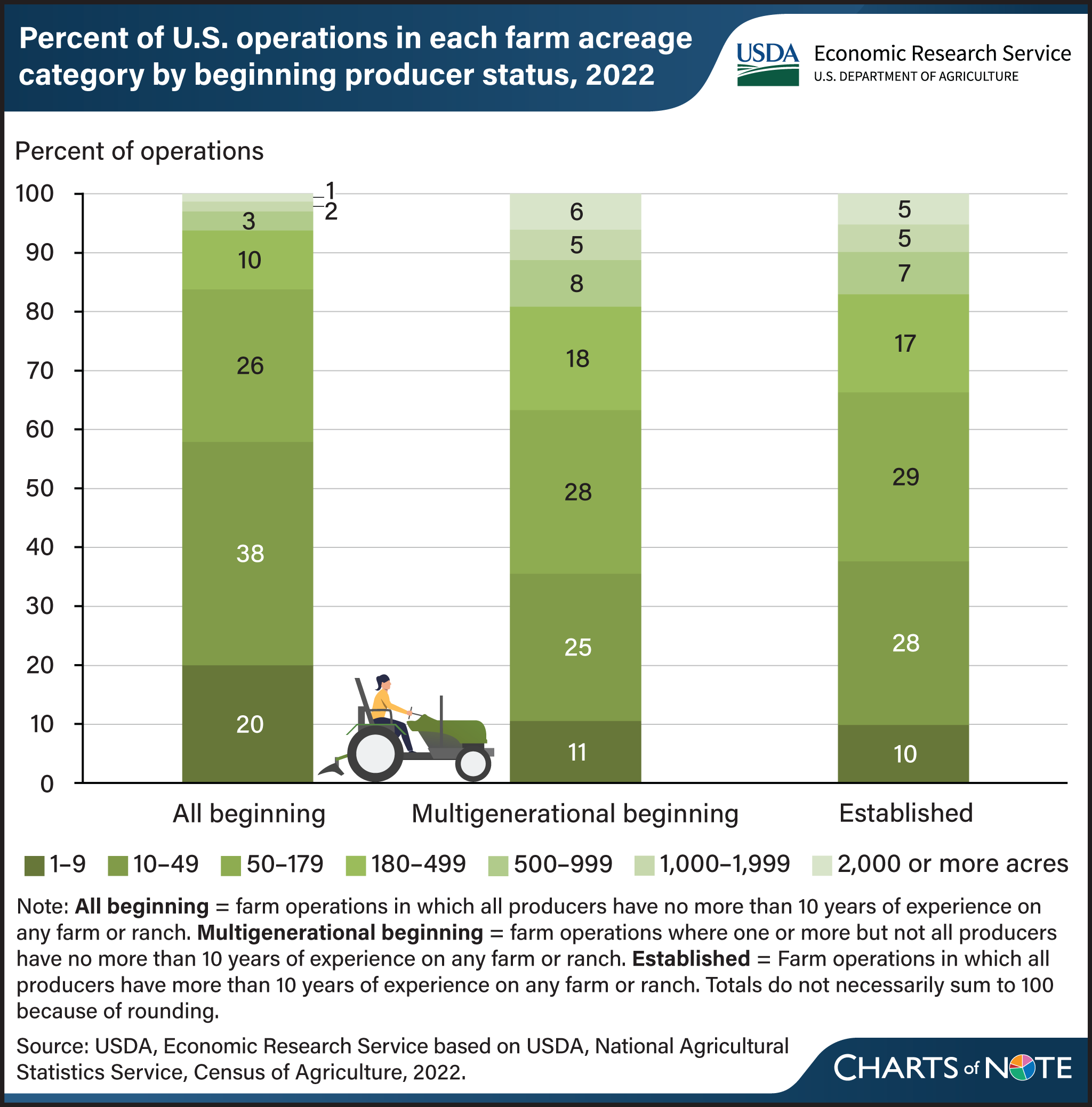
Farms and ranches run entirely by newcomers were markedly smaller than those run by experienced hands in 2022, an analysis of the Agricultural Census by USDA's Economic Research Service has found.
ERS counts as a beginning operator any farmer or rancher with no more than 10 years of experience running any farm or ranch. Using operators' own answers to the 2022 census, the agency sorted every operation into three groups: "all beginning", where every operator is a newcomer; "established", where every operator has more than 10 years behind them; and "multigenerational beginning", where the two work side by side.
The dividing line falls between the first group and the other two. Multigenerational and established operations had broadly similar size distributions, while all-beginning farms were smaller on average. Fifty-eight percent of all-beginning operations worked 49 acres or fewer, against 36 percent of multigenerational beginning operations and 38 percent of established ones.
The same gap shows at the top of the scale. Only 6 percent of all-beginning operations farmed 500 acres or more, compared with 19 percent of multigenerational beginning operations and 17 percent of established farms.
Acreage is only one measure of scale, so ERS researcher Katherine Lacy checked the pattern against gross cash farm income, a broad measure of what a farm takes in before expenses. It held. About 86 percent of all-beginning operations fell into the lowest income band, below $75,000 a year, against 67 percent of multigenerational beginning operations and 72 percent of established farms.
The contrast between the two beginning groups is the useful part of the finding. A newcomer who farms alongside an experienced operator — most often within a family — starts at roughly the scale of an established farm. A newcomer starting alone starts small, on both land and income, which is the harder position from which to survive the first decade.
The chart appears in the ERS report Beginning Farmer and Rancher Operations: Characteristics Associated With Business Survival, published in March 2026.
Source: USDA Economic Research Service


Comments
(0)