
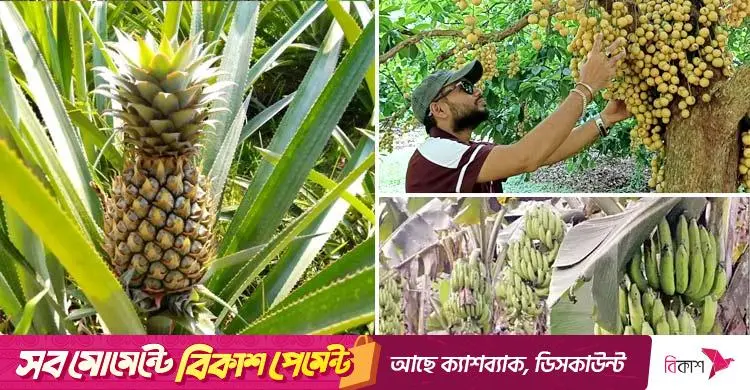
The soil of Narsingdi seems to have laid out a basket of fruit with its own hands. Fragrant Sagar bananas, juicy Ghorashal pineapples and tasty latkan are the district's three jewels. Their fame once spread across the country, and their scent, colour and juice still carry the story of traditional farming and the history of the district's heart.
The banana's golden age
Whenever Narsingdi was mentioned, bananas were the first thing that came to mind. Even before commercial cultivation, local people enjoyed wild bananas, jackfruit and pineapples. Over time the banana groves here became an enchanting sight. The taste, aroma and quality of Narsingdi bananas were unmatched and famous everywhere. Many rulers of Bengal kept Narsingdi bananas in their daily diet.
Bananas were so prized that they were the second main cash crop of Narsingdi's people after jute, and a strong local economy grew up around them. According to geologists, the hilly and flat land of Narsingdi is about 10,000 years old. Because the banana originated in Asia, it is thought that bananas have been grown in Narsingdi since the beginning of farming, even from the time rice cultivation began.
In the early years of British rule, bananas were grown on about 4,000 hectares in the district's six upazilas, about 3,000 hectares of it under the tasty Sagar banana. Sabri, Kabri, Champa, Chini Champa, Agnisagar and other varieties were also grown. Production was about 80 lakh tonnes, and some one to one and a half lakh people were directly or indirectly involved.
Bananas from Narsingdi were sent to different parts of the country, including the capital. During Pakistani rule, a local Bangladesh Railway train was nicknamed the "Kolar Gari" (banana train). Every afternoon thousands of baskets of bananas were collected at Daulatkandi, Shrinidhi, Methikandi, Khanabari, Amirganj, Narsingdi, Jinardi, Ghorashal and other stations and loaded on to the banana train after dusk for different parts of the country.
Every train on the Dhaka-Chattogram and Dhaka-Sylhet lines had a banana carriage, and hundreds of hawkers sold ripe Narsingdi bananas in the compartments. Narsingdi bananas were just as present on launches, steamers and buses. New sons-in-law visiting their in-laws took huge bunches of ripe yellow Sagar or Sabri bananas, which raised their standing further.
When bananas ripened, growers cut whole hands and sent them to their daughters' in-laws. Because of their nutritional and medicinal value, kabirajes advised patients to eat bananas, and milch cows were even fed ripe bananas in the hope of more milk. These many uses were why Narsingdi's people happily grew bananas on hilly and flat land alike.
Most bananas were grown in Monohardi upazila, where several banana markets grew up, including Chalakar, Sagardi, Monohardi and Hatirdia. From these markets truckloads went to Dhaka and elsewhere. Thousands of tonnes were also traded at Charsindur, Gazaria, Taltali, Parulia, Kalir Bazar and Raban Bazar in Palash, Charnagardi, Bhatpara and Shilmandi in Narsingdi, and Fatehpur, C&B and Palpara in Shibpur, among other markets.
A decline
Sadly, those good days for Narsingdi's bananas are gone, and banana farming is in decline. Production of the tasty, fragrant native Sagar banana in particular has fallen alarmingly. Its place has been taken by the Nepali Sagar banana, which does not taste or smell as good but yields more and suffers less disease. Champa and Sabri bananas are also grown, but farmers are not getting the output they want.
Conscious growers say the native Sagar banana is part of the heritage, and the agricultural research institute must work to conserve it. If researchers can develop a high-yielding native Sagar banana through intensive research, farmers will again become interested in growing bananas.
Ghorashal pineapple
Besides bananas, pineapple is another popular Narsingdi fruit: nutritious, tasty and juicy. The attractive fruit is red at the bud stage, then green, and turns yellow when ready to eat. It usually weighs between 400 and 2,000 grams. Three main types of pineapple are found in Bangladesh: Joldubi, Kalenga or Calendar, and Ghorashal. The pineapple grown in the Ghorashal area of Narsingdi is named after it.
Farmers in Raban, Jinardi and nearby areas of Palash upazila, and in Patuli, Bajnab, Amlab and surrounding areas of Belabo upazila, earn about Tk 30,000-50,000 a year from pineapples. The Honey Queen variety, formerly called Joldubi, is now grown most. About 300 hectares in the district's Ghorashal-Belabo area are under pineapple. Because it is still grown by traditional methods, farmers are not profiting as much as they could; they would earn more with modern methods.
Latkan
Among the many fruits of Shibpur upazila in Narsingdi, latkan is very tasty, with a sweet-sour flavour. The small, round, yellowish fruit is called the Burmese grape in English, and its scientific name is Baccaurea ramiflora. Inside the juicy fruit are two to four seeds arranged like segments, each surrounded by a juicy, delicious pulp, and the fruit has a pleasant smell. Because of demand at home and abroad, hundreds of farmers in the hilly areas of Shibpur and in Belabo and Monohardi upazilas grow it commercially, earning Tk 1-2 lakh a year from the fruit.
The latkan is a medium-sized evergreen tree that grows 20-25 metres tall. Fruit hangs in clusters along the whole trunk from base to tip. Each cluster holds 7-15 fruits, each weighing 15-25 grams. The tree starts bearing within two to three years of planting and keeps fruiting for 20-30 years. The fruit is very good for the human body, and demand for it has grown beyond the country's borders. Its cultivation should be expanded using modern technology.
Narsingdi's fruits are not just crops of the soil; they are symbols of the hard work, heritage and love of the region's people. Government and private initiatives are urgently needed to bring back the banana's good days and to expand pineapple and latkan farming. Then Narsingdi will regain its old glory.
The writer, Fahim Hasnat, is a feature and column writer.
Source: Jagonews24. First published in Bengali on The Agro News.
Comments
(0)