
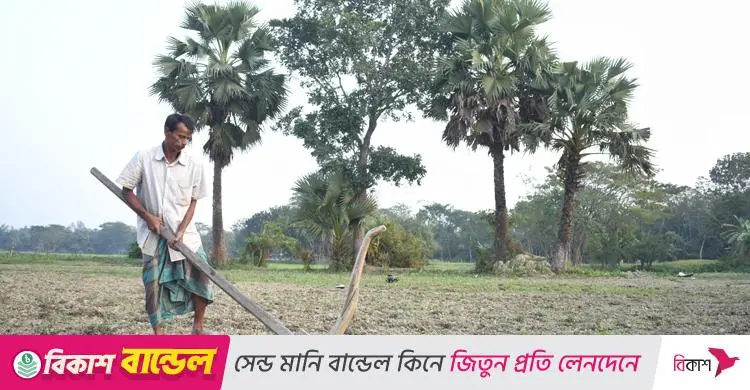
The most familiar image of farming in old Bengal is a farmer standing in the middle of a field with a wooden plough in his hands. Over time, farming has changed. Modern machinery and mechanised cultivation have arrived. Yet in some parts of the country the familiar scene can still be found: a field, a farmer and a wooden plough.
In an open village field in Monohardi, Narsingdi, stands one such farmer. There is simplicity in his clothes, concentration in his eyes and an old wooden plough in his hands. Dry soil lies under his feet and open sky above his head. Behind him stand a few palmyra palms, like silent witnesses of nature. The scene is not new, but with time it has become rare.
Against the tide of machines
Today, when everyone relies on tractors or power tillers to plough farmland, one man still works his field by hand with a wooden plough. It is not just a scene but a kind of protest: a quiet resolve to return to one's roots against dependence on technology.
Working this way is not easy. Clothes are soaked with sweat, and the farmer must constantly wrestle with the soil on bended knee. Yet in this labour there seems to be a hidden satisfaction. Machine ploughing saves time, but a machine does not understand the soil. The soil understands the touch of a hand, and the language of care and labour.
For a farmer like this, every day of ploughing means connecting with the soil anew. The soil is not only a livelihood for him but part of his soul. Every furrow of the wooden plough tells a story of life, struggle and quiet love.
A fading identity
To today's young people this sight may seem surprising, and some may wonder how it is possible. Yet this scene was once the familiar identity of Bengal. Now that identity is being lost to the noise of machines. But as long as there are people who still find meaning in life in the smell of the soil, Bengal's farming culture will not disappear.
The scene reminds us that progress sometimes means not only moving forward but looking back and holding on to our roots. Those roots are the soil and people's bond with it, a bond that some still keep alive with a wooden plough, quietly and with devotion.
Source: Jagonews24. First published in Bengali on The Agro News.

Comments
(0)