
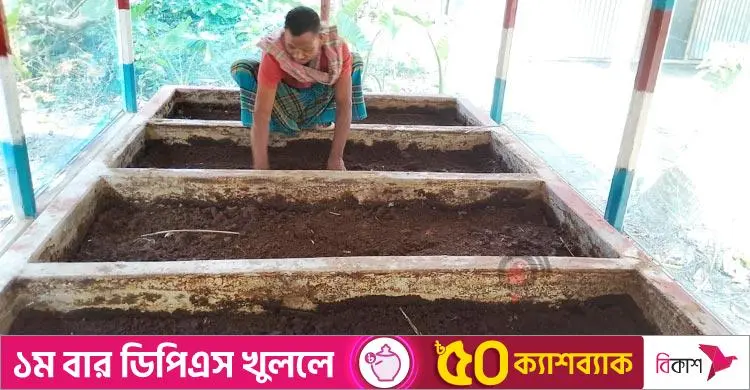
Commercial production of vermicompost, or earthworm compost, has begun for the first time in Narail Sadar upazila. Dipak Biswas of Gopalpur village took the initiative and, following advice from the upazila agriculture office, is now self-reliant from producing it. Cow dung is first stored under a tin roof, then lightly dried and kept in a ring or tank for a few days. Earthworms are then added, and after 35 to 40 days the vermicompost is ready.
Dipak Biswas began producing vermicompost in March 2024 for his own farming needs, on the advice of a local agriculture officer. He started on a small scale on unused space in his yard, but because of demand he now produces it commercially. He packs it at home and sells it in the local market. Farmers are using his compost instead of chemical fertiliser on winter vegetables, making the vegetables poison-free and tasty.
"Hardly any cost"
"I started producing earthworm compost on the agriculture office's advice," Dipak Biswas said. "At first the office helped me in various ways. There is hardly any cost in producing this compost from cow dung. I use it to meet the needs of my own nutrition garden and sell the rest in the local market. Most people in the village take compost from here to grow winter vegetables."
Farmer Palash Sheikh told Jagonews24: "I have grown winter vegetables on 26 decimals. No chemical fertiliser has been used. I buy organic compost cheaply from Dipak's house and use it, and the vegetable yield has been good."
Hasibur Islam of Singia village told Jagonews24: "I have grown cauliflower, cabbage, and beans using the sack method. I have used this earthworm compost on all my crops, and I hope for a good yield."
Sadar Upazila Agriculture Officer Roknuzzaman told Jagonews24: "If vegetable growers use less chemical fertiliser and give priority to organic fertiliser, the vegetables will be poison-free, and the quality of the soil will improve. Seeing his compost production, many local people will come forward and become self-reliant like him."
Source: Jagonews24. First published in Bengali on The Agro News.


Comments
(0)