
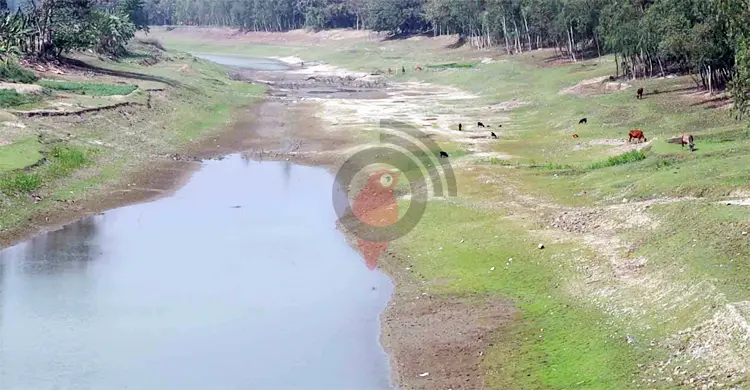
Water in the Chhoto Jamuna and several other rivers in Naogaon has fallen ahead of time, worrying farmers who cultivate with river water. Fishermen who depend on the rivers are also turning to other occupations. Those concerned believe that dredging the rivers would protect the agriculture, livelihoods and animal resources linked to them.
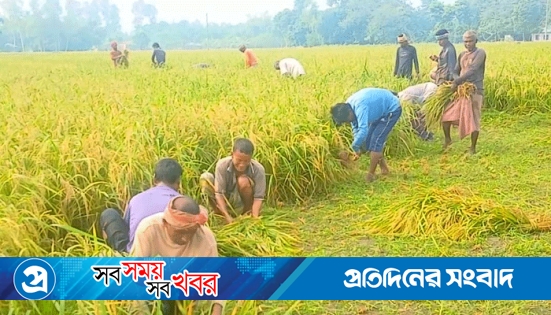
Farmers in Naogaon, a northern border district, are busy planting and tending IRRI-Boro rice. But with the water falling early, farmers along the rivers are worried about growing Boro. Because of low rainfall, water in the Chhoto Jamuna, Atrai, Tulsiganga and Mahananda rivers is falling faster than in past years, and in some places the rivers have dried up. About 10,000–15,000 hectares of Boro are grown with water from these four rivers, and wheat, potatoes, jute, mustard, vegetables and other crops are grown at other times of year. Within a short time, a number of river-based LLPs (floating irrigation pumps) will shut down for lack of water.
A river that has lost its youth
Once, sailing boats plied the Chhoto Jamuna in full flow, and traders came from Joypurhat and Natore districts to do business. Life and livelihoods centred on the river, and crops were grown with its water. That once fast-flowing river has now dried up. There is a little water in places, but grass now grows on the riverbed in most spots.
According to the Barind Multipurpose Development Authority (BMDA), about 98,000 hectares of Boro in the district are grown under 4,103 deep tube wells and about 1 lakh hectares under 196 LLPs (floating irrigation pumps).
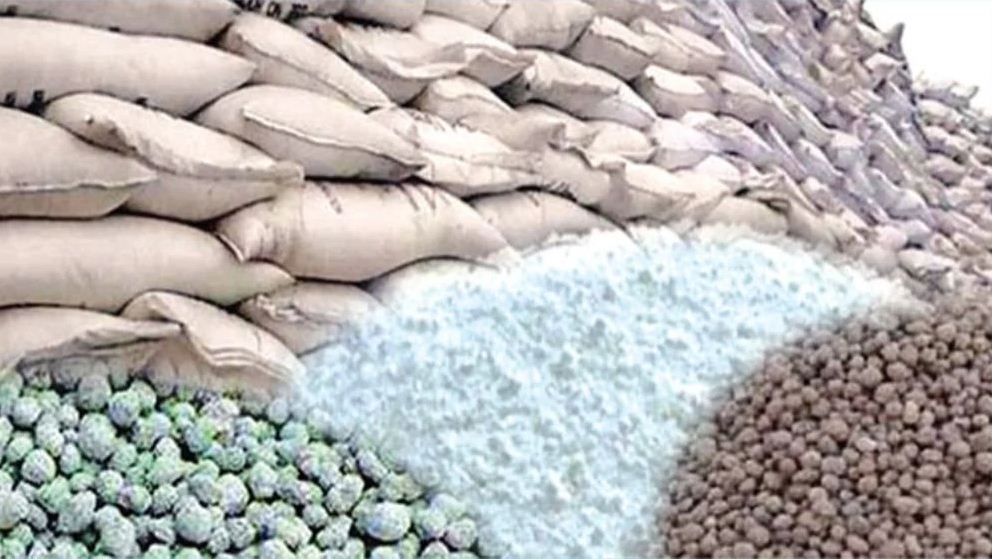
Farmers say the lack of rain and siltation have filled up the riverbeds, so the rivers overflow in the rainy season and dry up quickly in the dry season. Higher prices of fertiliser, fuel, labour and pesticides have also raised the cost of growing Boro, which comes to about Tk 14,000–15,000 a bigha from planting to harvest. Costs have risen, but profits have not kept pace.
Depending on the area, the BMDA charges Tk 1,400–1,800 per bigha for water from deep tube wells, while LLP pump owners charge Tk 2,000 to Tk 2,200 per bigha.
Farmers and fishermen speak
Tushar, an LLP owner in Ikortara village in Tilakpur union of Sadar upazila, said he had run the pump with water from the Chhoto Jamuna for the past five years to grow 100 bighas of Boro, and also irrigated other crops. But this time the river water had fallen a lot a month early, and the land would need irrigating for another two months. If the river dries up, a deep tube well will have to be sunk, which will raise the cost of cultivation. They are worried as the water falls, he said.
Abul Kalam of Bhabanipur village in Sadar upazila said, "Our lives and livelihoods centre on the river. Even 15–20 years ago, plenty of fish were caught in the river. Now it is hard to get even fish to eat from the river this season. If we depend on this river, our families and lives will not run. Some are driving rickshaws and vans, others have taken up farming or day labour. If the river is dredged, the fishermen will survive and the crops will be protected too."
Moklesur Rahman, a farmer who cultivates with river water, said crops are grown all year with water from the Chhoto Jamuna. He has planted Boro on four bighas, and irrigating with river water keeps costs a little lower. "We need water now, but the river has dried up. Because the river has not been dredged for a long time, the bed has filled with silt, and in places it has dried up and grass has grown. And when we don't need water, it overflows the embankment. We have to live with the risk."
Kashem Ali, a farmer of Tilokpur village, said the prices of all kinds of fertiliser, pesticide and labour had risen, raising the cost of Boro by at least Tk 3,000–4,000. It costs Tk 14,000–15,000 from planting to harvest. "Costs keep rising, but we can't make a matching profit. We can't leave the land fallow. If the price of rice stays at Tk 1,500 a maund, we can make some profit."
Deep tube wells as an alternative
Md Mostafizur Rahman, executive engineer of the Barind Multipurpose Development Authority, Naogaon Region-1, said the BMDA provides irrigation with both groundwater and surface water. Water in the Chhoto Jamuna, Atrai, Tulsiganga and Mahananda is falling fast, and because the rubber dam at Shutkigachha in Atrai upazila is damaged, the water level is going down. But there is no cause for concern: as an alternative, deep tube wells will be installed on an emergency basis to carry out irrigation, he said.
Source: Jagonews24. First published in Bengali on The Agro News.
Comments
(0)