
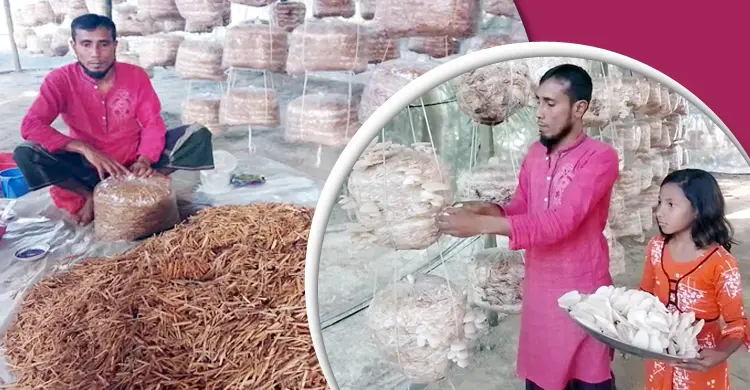
Sagar Ali is a young vegetable trader. For about 12 years he has made his living selling vegetables from a small shop in the market in front of the upazila parishad in Naogaon town. For the past year he has also been growing mushrooms. His first mushroom crop earned him a profit of about Tk 70,000, and encouraged by that he started a second, larger commercial crop.
This time he is hoping for a sizeable profit. Growers believe that with government patronage and training, mushrooms could be grown all year round, which could reduce unemployment and contribute to the economy.
From YouTube to a backyard farm
Sagar Ali is from Benifatepur village in Kirtipur union of Naogaon Sadar upazila. He studied up to class five. During the pandemic his vegetable business slumped and the shop did not run properly. At that time he was inspired by YouTube videos on mushroom farming. He then took four days of training in mushroom cultivation from a private organisation called DM Centre in Barokhari village of Magura Sadar upazila. But he had no farmland to grow on. He collected seed (spawn) from there and, spending about Tk 20,000, grew mushrooms in his courtyard, selling Tk 90,000 worth in four months the first time.
Encouraged, he again collected master mother seed (spawn) and, alongside his vegetable business, set up a commercial mushroom farm on a small plot beside his house. This time about Tk 20,000 went on 300 spawn packets and building the farm: Tk 8,000 on seed and materials and about Tk 12,000 on the shed and structure.
The new farm is a month old. Mushrooms can be harvested within 40 days of planting the seed, and during that time water must be sprayed several times a day. For the past week 5 to 8 kg of mushrooms have been harvested every day, and output will rise as time goes on. His elder daughter, Suraiya Akter, helps him look after the mushrooms.
Every day many people come from nearby and other areas to see Sagar's farm. Some buy mushrooms, others seek advice, and young people are being inspired by it. Many sick people also say they have benefited from eating mushrooms. Several restaurants in the town and individual customers buy from him regularly.
Costs, yield and method
Mushroom farmer Sagar Ali said: "This time I have started with 300 packets. Seed, straw and pesticide for each 5 kg packet cost about Tk 40 to 45. Over three months each packet will yield about 4 to 4.5 kg of mushrooms, which are selling at Tk 250 wholesale and Tk 300 retail. At Tk 250, the 300 packets will yield about 1,200 kg of mushrooms over the next three months, worth about Tk 3 lakh. I have already sold about Tk 9,000 worth. They sell from the vegetable shop, and many people order by phone. The more I produce, the more I will sell."
On how mushrooms are grown, he said: "The main materials are straw and seed (spawn). The straw is chopped into small pieces, boiled in hot water and then lightly dried. When preparing a packet, you add the seed, tie the mouth and make a few holes with a needle. Fungicide is added so that fungus cannot attack the packet. After 20 days you cut holes of about an inch in six or seven places on each packet so the mushrooms can come out. From 20 days on, water is sprayed on the packets to keep the mushrooms fresh. From a month on they are ready for sale. I now make my own mushroom seed (spawn)."
His daughter Suraiya Akter said: "Alongside my studies, I help my father morning and evening by bringing water to spray the mushrooms. I also help chop and dry the straw needed to make the packets."
Neighbours and officials
Elderly Muntaz Ali said: "I have been eating mushrooms regularly for six months. I had never eaten or even seen them before. Now they are grown right next door. They are tasty and a bit like cattle or goat tripe. I have found them very helpful for my diabetes and allergy. I used to take medicine regularly; now I take less."
Muktar Hossain, a young man from Paharpur village, said: "I heard mushrooms were being grown in the next village and came to see. I've heard he is making a good profit. It also takes little space and little work. If training were arranged for us, we could grow them too. Besides extra income, it could reduce unemployment."
Naogaon Sadar upazila agriculture officer Farhana Naznin said: "Mushrooms are a nutritious, tasty food with medicinal qualities. Growing them needs no arable land and can be done cheaply in a small space. Mushroom farming is profitable. We have already visited Sagar's farm. There is no allocation for mushroom farming, but anyone interested will be given training and all-round support."
Source: Jagonews24. First published in Bengali on The Agro News.
Comments
(0)