
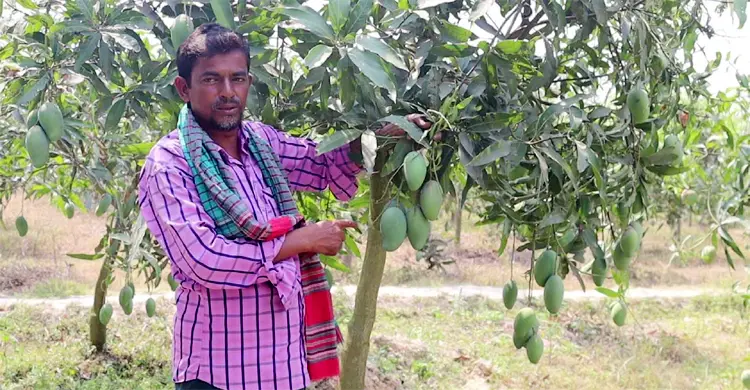
Mango orchards have spread across Naogaon in the northern Barind region within a few years, with many sweet varieties grown in the district. But this season growers have had a hard time from the start because of lack of rain. Despite a long wait, rain has not come. Mangoes are dropping and growing smaller, and growers fear they will not get the harvest they hoped for.
According to the Department of Agricultural Extension (DAE) in Naogaon, the district's target this year is 378,000 tonnes of mangoes from 30,000 hectares, or 12.50 tonnes a hectare. Guti varieties usually ripen first, and picking of Guti mangoes will begin on 22 May, followed by other varieties in phases.
In the border upazilas of Sapahar, Porsha, Niamatpur, Patnitala and parts of Dhamoirhat, known as the Barind area, the only crop was once rain-fed Aman paddy. Now people are leaving rice for mango orchards. This season the drought has caused a severe water shortage and there is no means of irrigating the orchards. The sap in the stalks dries up and the mangoes fall, while the fruit is also getting smaller. To save the crop, growers are bringing water from far away to spray the trees.
Sprays not working
Vitamins are also being sprayed to stop the fruit dropping, but nothing is working. Growers are worried, with the harvest only days away.
Alauddin, a grower in Lalchanda village of Sapahar upazila, said he has BARI-4 and Amrapali orchards on 16 bighas. "The lack of rain has caused trouble this year. I have not seen such drought and lack of rain in 40 years. Water is scarce in the Barind area. Still, we brought water from far away as much as we could, but now there is none left. A lot of mangoes have dropped and the fruit has got smaller. I fear a loss."
Rabiul Islam, a grower in the same village, said vitamins are being sprayed to stop the drop but to no real effect. "The severe drought is causing us problems. Last year Amrapali mangoes were about 200-250 grams; this year they are about 150 grams. The fruit is smaller and the yield lower."
He said 60 mangoes filled a crate last year; this year it will take about 80. Yields are lower and costs higher, though mango prices are likely to be higher from the start this year.
Officials' advice and export hopes
Sapahar upazila agriculture officer Shapla Khatun said orchards cover 9,255 hectares in the upazila, with a target of 14 tonnes a hectare, which would give about 129,570 tonnes. But the severe drought is causing some fruit drop and the mangoes have got smaller. Farmers are being advised to irrigate orchards in the morning, or to spray water on the trees if they cannot irrigate.
Abul Kalam Azad, deputy director of the DAE in Naogaon, said Naogaon has overtaken other districts in mango production. Last year 77 tonnes of mangoes were exported, and about 400 tonnes may be exported this year. Farmers have been trained with that aim, and there has been a lot of promotion to brand the mangoes so that the district's fruit becomes known as a brand across the country.
Source: Jagonews24. First published in Bengali on The Agro News.
Comments
(0)