
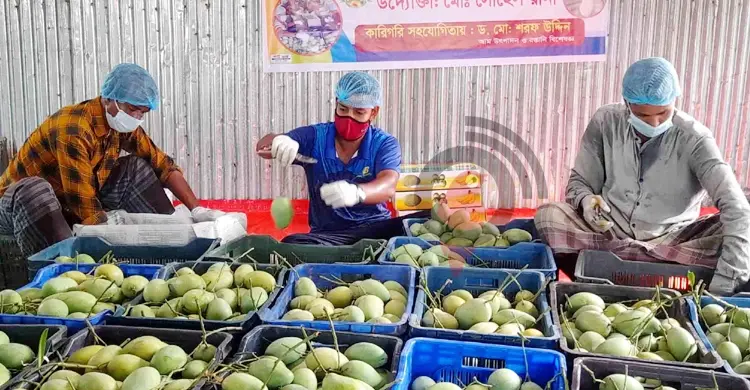
Naogaon has produced mangoes on a large scale for several years, yet the district has no research centre other than the Soil Resource Development Institute. Stakeholders say a research centre and processing house are needed to realise the district's mango potential.
According to the Department of Agricultural Extension (DAE), mango orchards now cover 30,000 hectares in the district, 525 hectares more than last year. At 12.50 tonnes a hectare, output of 375,535 tonnes is possible.
Parts of the border upazilas of Sapahar, Porsha, Niamatpur, Patnitala and Dhamoirhat are known as the Barind area. Once these areas grew only one rain-fed crop, Aman paddy, but people are now leaving rice for mango orchards. Mangoes from the area are very tasty and sweet, and picking will begin in mid or late May.
Growers' problems aired
Before the mangoes reach the market, a meeting was held with growers, exporters, traders and other stakeholders at 3.30pm on Sunday 30 April in the Deputy Commissioner's conference room, organised by the district DAE. Deputy Commissioner Khalid Mehedi Hasan was chief guest.
The meeting heard that a large market grows up in Sapahar upazila town in the season, with mango depots on both sides of the road causing traffic jams. Mangoes are sold morning and afternoon, but when they are sold in the afternoon the banks are closed and farmers cannot be paid. Traders want banks to stay open two hours beyond normal hours. Farmers run short of money at picking time after tending their orchards and, with no help from banks, are forced to borrow from NGOs at high interest. Extortion and harassment in transport were also discussed.
Seeking a geographical indication (GI) certificate for the Nak Fazli mango, Sapahar entrepreneur Sohel Rana said the district is already known as the capital of mangoes. It needs a mango research centre, he said: this year growers had to run from place to place to find out which pests were attacking their mangoes. "We need a regional packing house," he said.
He said a maund of mangoes is counted as 45 kg, but with a 3 kg crate it is sold as 48 kg, and this weight should be fixed. Farmers face a cash crunch at picking time and, unable to get bank loans, have to borrow from NGOs at 30-40 per cent interest. Bank loans would help farmers, he said.
Sohel Rana added that mangoes have been exported for two years. On paper 77 tonnes were exported, but more went abroad than is known, and it should be known which exporter sent how much.
Exporters, bank and police
Two Dhaka University students, Towfiq Ferdous Chatok and Shahadat Hossain Sajib, also took part. They said that as new entrepreneurs they had chosen mango exports, having seen the Bangladesh government send its famous mangoes to India and Pakistan as gifts to build demand abroad, and they had come forward to take that effort further.
They said they had already reached importers in European markets through digital channels and talked to importers in the UK, France and Germany, and the problems they had faced were resolved in those talks. Only a very small share of Bangladesh's mangoes is exported, while a big market for Bangladeshi mangoes has grown abroad. They hope many more will come forward to bring Naogaon's mangoes to the world market.
Sonali Bank Deputy General Manager Oliuzzaman said mangoes play an important role in Naogaon's economy. This year Tk 1 crore in loans has been disbursed to mango growers in the district, and traders will later be supported with exports or processing. Traders have been advised to use Sonali Bank's digital e-wallet, which allows transactions 24 hours a day without the risk or hassle of handling cash.
District DAE Deputy Director Md Abul Kalam Azad said the district will produce safe mangoes, not only for export but for the home market too. Last year 77 tonnes were exported; this year the export potential has been put at about 450 tonnes, and farmers are growing with that aim. Growers will get full support in marketing and exports, he said.
Additional Superintendent of Police (Administration) Gaziur Rahman said the depots on both sides of the road in Sapahar cause jams in the picking season. In past years a control room was set up there so that trade was not disrupted, and it will be set up again, with 30-50 police staying for three months. Courier services charge more to carry mangoes in the season, and that will be looked into. Police will give full support to transporting the district's mangoes to every part of the country, he said.
Naogaon Deputy Commissioner Khalid Mehedi Hasan said he hopes exports rise further this year and the potential of mangoes is realised. A week-long mango festival will be held for wider publicity. To solve growers' difficulties in getting loans, they will be linked with SME loans under the small and cottage industries scheme and with banks. He also advised people not all to go into growing mangoes but to take up processing, packaging and other mango businesses.
Md Abul Kalam Azad chaired the event, attended by agriculture officers from various upazilas, mango growers, traders, exporters and local journalists.
Source: Jagonews24. First published in Bengali on The Agro News.
Comments
(0)