
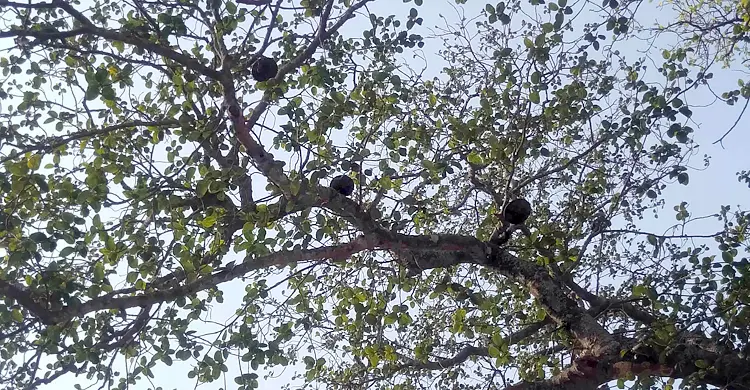
An unusual initiative to build bird 'sanctuaries' in Naogaon has fallen apart. With no supervision, the clay pots tied to trees have come down and broken. Biodiversity researchers believe bird numbers are falling for lack of safe shelter and food.
Sources said the district administration launched the initiative in 2018 to create safe sanctuaries for birds. Clay pots were tied to large government-owned trees at markets in various upazilas of the district, but without proper oversight the pots broke.
A 400-year-old banyan
Locals said there is a banyan tree about 400 years old in Patghata village of Balubhara union in Badalgachhi upazila, visited by many species of birds. To make it a bird sanctuary, more than 50 clay pots were tied to its branches. Thinking them safe, magpie robins, doves, weaver birds, bulbuls and other species built nests in them, and even squirrels moved in. Within a few years many pots fell and broke. The birds no longer live in the few that remain on the tree.
Pots were also tied to government trees for birds at Kirtipur hat, Paharpur bazar, Dubalhati bazar and Hapania bazar in Sadar upazila, Balubhara bazar in Badalgachhi upazila, the children's park and upazila premises in Mahadebpur upazila, and other markets.
Jahid Iqbal, a grocer in Patanghata village of Balubhara union, said: "About three years ago around 40 pots were tied to the village's old banyan tree. I saw mynas living in a few of them. But birds did not settle in the pots tied lower down the tree. Some fell off, and some are still on the tree. But the purpose for which they were tied has not been achieved."
Shariful Islam, a tea-stall owner at Shahapur bazar in Baktarpur union, said: "A few years ago I saw clay dishes on two banyan trees. Now only a handful remain; the rest are gone. But I never saw any birds living in them."
Sirajur Islam, a grocer at Balubhara bazar, said: "About two years ago I saw pots being tied to the banyan tree in the middle of the market. Now there are none. I don't know who put them up or why."
Conservationists' view
Yunusar Rahman Hefzul, president of Jibon, the Mahadebpur biodiversity, wildlife and river conservation organisation in Naogaon, said: "The upazila administration tied pots to the trees to protect birds and give them homes, but it did not work. Birds should be allowed to follow their own behaviour and move freely. Nothing artificial lasts. The pots tied to the trees were destroyed by storms."
Kazi Nazmul Hossain, president of the Mahadebpur Pran O Prokriti organisation, said: "The administration tied small clay dishes, and in some places pots, for birds to live and breed. They were tied to the trees without planning. The dishes were tied so that they swung in the wind, and the pots were not suitable for birds to live in."
He said: "Awareness campaigns must be run in villages. Birds cannot be protected just by building homes for them. We need tree planting, and bird hunting must stop. Only when their habitat is safe can they breed."
Dr SM Iqbal, president of the Bangladesh Biodiversity Conservation Federation and associate professor of zoology at Government Maulana Mohammad Ali College in Tangail, said: "Birds do not go to the pots that are tied up to conserve them. Magpie robins and mynas in particular live in them, but these birds do not need all this. They can breed and multiply naturally."
He added: "Vultures, parakeets, Alexandrine parakeets, green pigeons and other birds are disappearing. Steps must be taken to save those on the path to extinction. Tying up pots shows love for birds and an effort to conserve them; it conveys a feeling."
Alpana Yasmin, upazila nirbahi officer (UNO) of Badalgachhi, said: "I am not aware of pots being tied to trees for birds. But after consulting local public representatives, a fresh initiative to conserve birds could be taken."
Source: Jagonews24. First published in Bengali on The Agro News.
Comments
(0)