
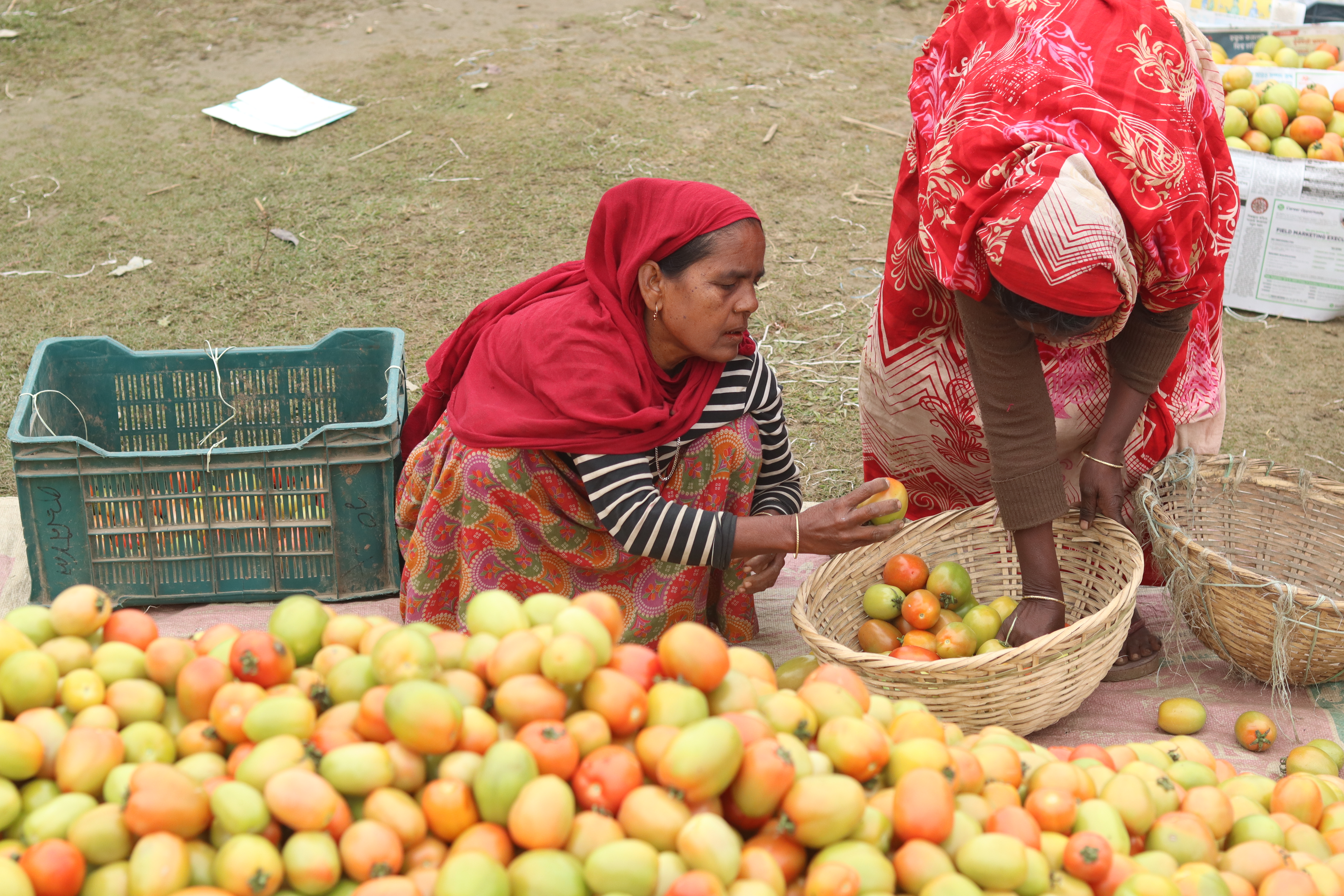
Tomato growers on the char lands of Nagarpur upazila in Tangail district had a bumper harvest in the 2024-25 winter season, but by the end of February 2025 the price they were being paid had fallen far below what it was when picking began, and many of them feared losses. Jagonews24's Tangail district correspondent reported on 28 February 2025 that farmers were busy picking tomatoes but could find few buyers. The report described the crop as "bishmukta", grown free of poisonous chemicals, and said tomatoes from the area were meeting local demand and also going to Dhaka and other parts of the country. The upazila agriculture office told the paper that it was giving farmers all-round support.
A bumper crop and a falling price
According to the growers who spoke to the paper, tomatoes sold for Tk 2,000 to Tk 2,500 a maund when sales began in the season. At the end of February they were selling for Tk 300 to Tk 500 a maund. Various varieties of tomato had been planted in the upazila that season, the farmers said, and with prices at that level they feared they would make a loss rather than a profit.
The maund (mon) is the traditional unit of weight still used in Bangladeshi produce markets; throughout Bangladesh one maund is reckoned at 40 kilograms. Land in the villages is still commonly measured in decimals (shatak), an old unit equal to one hundredth of an acre, or about 40.47 square metres, which has officially been replaced by metric units but remains in everyday use among rural people.
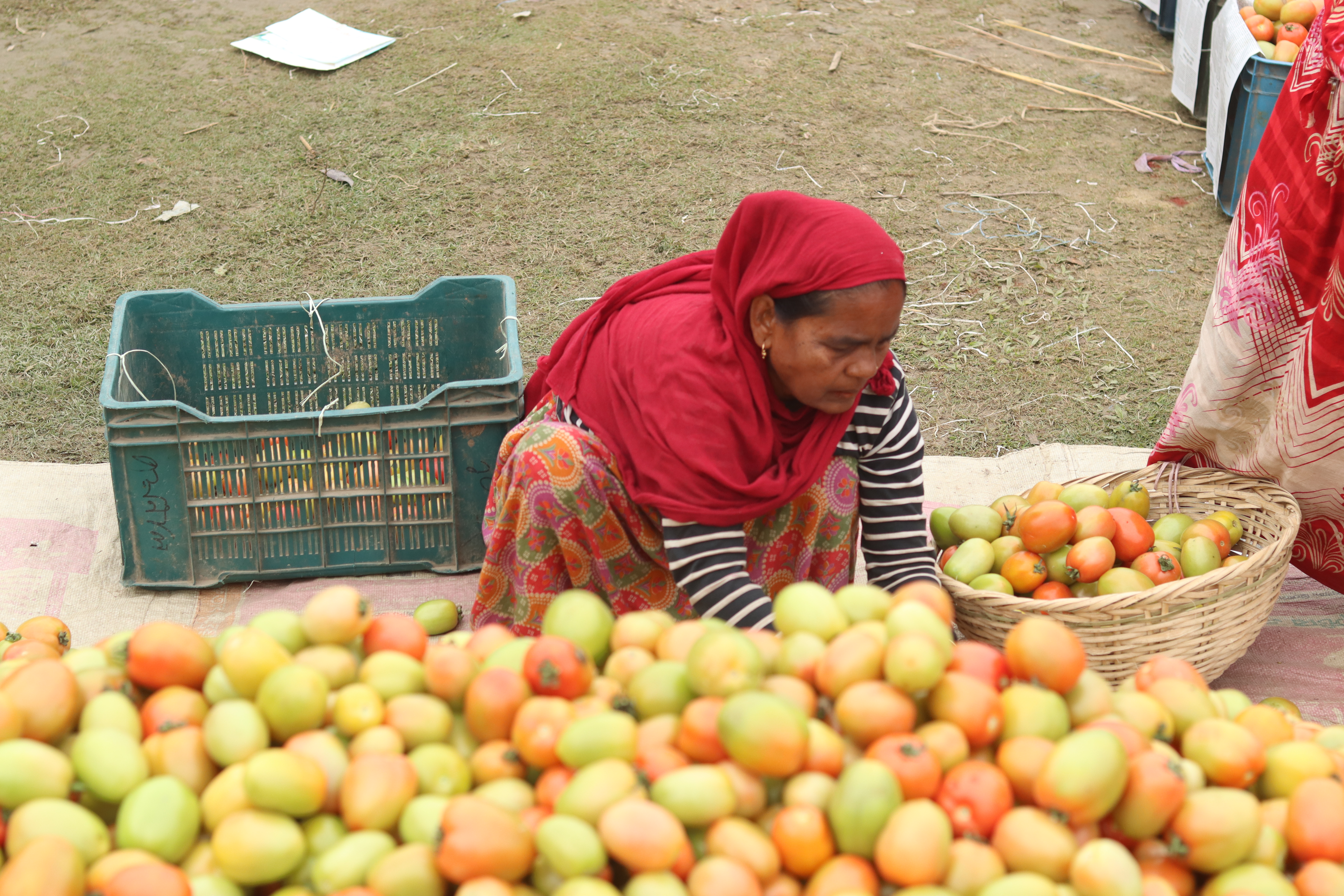
The upazila agriculture office gave the paper the area under the crop. Tomatoes were grown on 152 hectares in Nagarpur in the current season, it said, against 130 hectares in the previous year. The office did not give a production figure in the report. The correspondent found that farmers in the char villages were spending their days picking ripe fruit from the plants, and that the mood among them was one of frustration because of the price.
What the growers said
Badsha Mia, one of the farmers, said he had grown tomatoes on 115 decimals of land and had a bumper crop. "At the market I have to sell at Tk 300 a maund," he told Jagonews. "Before, a maund sold for Tk 1,500 to 2,000." He put the fall down to the size of the harvest: production was high, so the market price was low. At the same time his costs had gone up, because fertiliser and seed were expensive. "So far I have not even sold Tk 1.5 lakh worth of tomatoes," he said.
Rubel Islam, another grower, described the difficulty of finding buyers. "The tomatoes are being picked from the field and kept for sale, but with few buyers I cannot sell them properly," he said. Because of the higher prices of fertiliser and seed, he expected the crop to bring him a loss, and he asked the government for support and for steps to raise the price.
Farmer Md Robiul said that fertiliser and farm labour had both cost more that season, so tomato cultivation had been more expensive than before. "Most farmers in the village are in the same position," he said.
Amena Begum, who manages her household, had planted about 40 decimals of land beside her house with tomatoes. Although the crop was bumper, she said, she was not getting a good price, and if prices stayed low she would lose a lot. She still hoped prices would rise later in the season.
What the agriculture office said
Abdul Baset Mia, a sub-assistant agriculture officer, told the paper that farmers were selling tomatoes at Tk 30 a kilogram in the market, and that they would have made a profit if they could sell at Tk 40 to Tk 50 a kilogram. Tomatoes would remain in the fields for another two months, he said, and if the price were higher the growers would benefit.
SM Rashedul Hasan, the Nagarpur upazila agriculture officer, said the upazila had great potential for tomato growing and that the area under the crop in Nagarpur was increasing day by day. In his view farmers were profiting from tomatoes, and his office was giving growers all-round support. The farmers' and the officials' accounts were reported side by side in the original story.
Both officers belong to the Department of Agricultural Extension (DAE), the government body responsible for agricultural extension in Bangladesh, which works under the Ministry of Agriculture and has its headquarters in Dhaka. The department was formed in 1982 by merging several earlier bodies: the Agriculture Directorate (Extension and Management), the Jute Directorate, the Plant Protection Directorate, the Horticulture Board, the Tobacco Development Board and the Central Extension Resource and Development Institute. It ran Training and Visit programmes for farmers until 1990 and then moved to group training, and its work is guided by the New Agricultural Extension Policy adopted in 1996.
Nagarpur, an upazila of rivers and chars
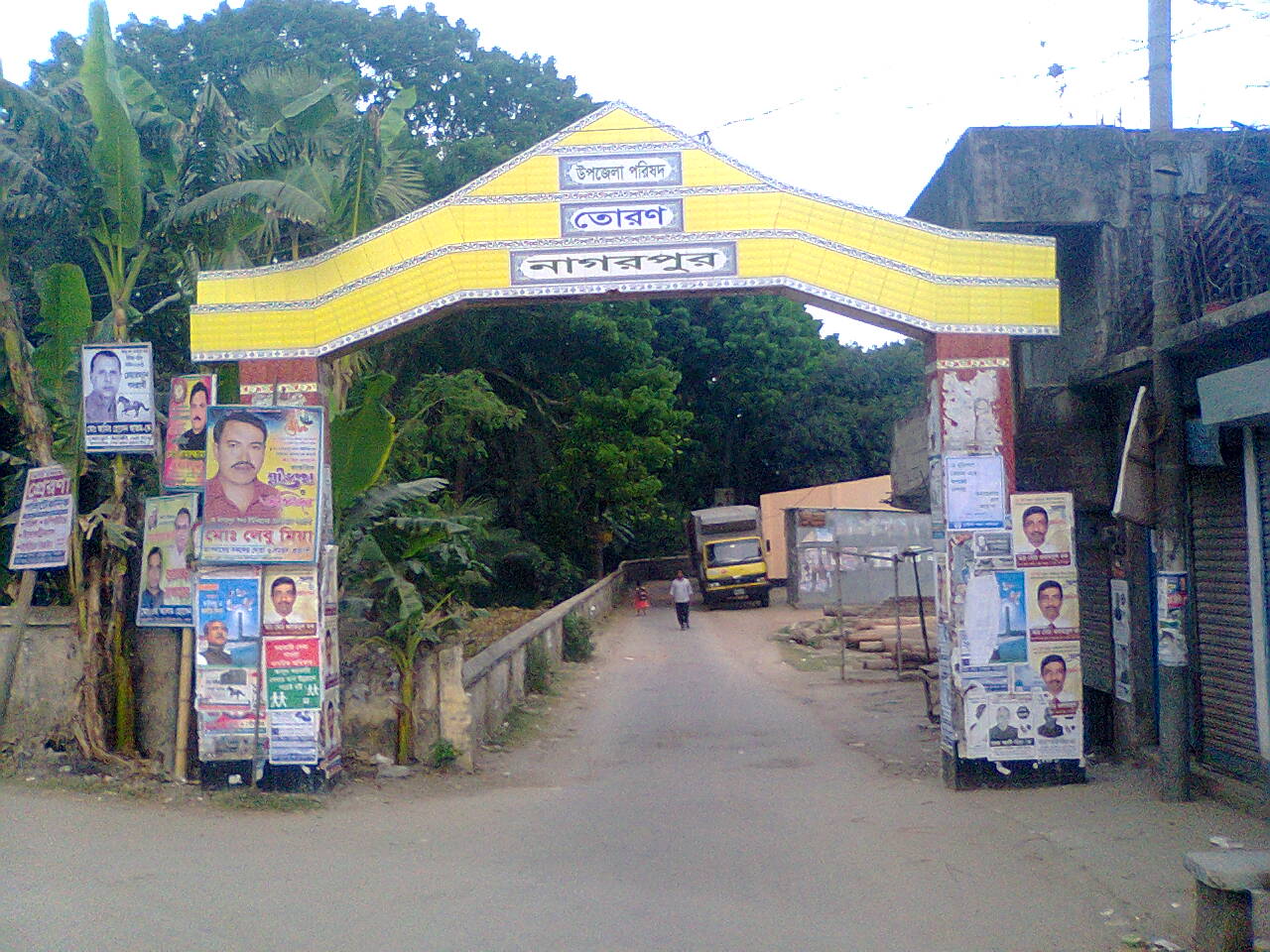
Nagarpur is the southern upazila of Tangail district. Banglapedia, the national encyclopaedia of Bangladesh, gives its area as 262.70 square kilometres. It is bounded by Tangail Sadar and Delduar upazilas to the north, Daulatpur in Manikganj district and Saturia to the south, Mirzapur and Dhamrai to the east, and Chauhali and Shahjadpur, across the Jamuna, to the west. Four rivers run through or along it: the Jamuna, the Dhaleshwari, the Old Dhaleshwari and the Bangshi. Gaighata Canal and Bharua Beel are its notable water bodies.
The upazila has 12 unions, 217 mouzas and 245 villages. At the 2011 census its population was 288,092, of whom 136,585 were male and 151,507 female, at a density of about 1,097 people per square kilometre. Agriculture is the main source of income for 61.63 per cent of households, followed by commerce at 11.20 per cent and service at 10.50 per cent. Banglapedia records that 65.78 per cent of households own land and 34.22 per cent are landless.
Banglapedia lists paddy, jute, wheat, mustard and sugarcane as Nagarpur's main crops, and mango, jackfruit, banana, papaya, blackberry and plum as its main fruits; paddy, jute, banana and sugarcane are its main exports. Its list of crops that have nearly disappeared includes sesame, linseed, kaun, sweet potato, china and kalai. The upazila has 23 hats and bazaars, among them Nagarpur, Salimabad, Sahabatpur and Dhuni Para hats, through which village produce reaches traders. Nagarpur Thana was formed in 1906 and became an upazila on 9 September 1983.
Tangail district itself covers 3,414.35 square kilometres in Dhaka division and borders Jamalpur to the north, Dhaka and Manikganj to the south, Mymensingh and Gazipur to the east, and Sirajganj to the west. It has 12 upazilas, and its rivers include the Jamuna, the Dhaleshwari, the Lohajang, the Bangshi, the Turag and the Jhinai. At the 2011 census the district had 3,605,083 people, and agriculture was the main source of income for 57.28 per cent of households.
The Dhaleshwari, one of Nagarpur's rivers, is a distributary of the Jamuna that begins in the north-west of Tangail district. Banglapedia describes it as a meandering river about 160 kilometres long, which flows through Tangail and Manikganj, splits into two branches around Manikganj, meets the Shitalakshya near Narayanganj and loses its separate identity in the Meghna near Shaitnol.

What a char is and how it is farmed
A char, in Bangladesh, is land built up by a river inside its own course or estuary; once such accretions are covered with vegetation they are commonly called chars. Banglapedia distinguishes island chars, which stay surrounded by water all year, from attached chars, which are joined to the mainland under normal flow. A study it cites found that a char which survives its first four years without being eroded can be used for cultivation or settlement by the end of that period.
The Jamuna, on Nagarpur's western side, is the river of chars. Banglapedia puts the total area of chars in Bangladesh at about 1,722 square kilometres in 1993, and says chars made up about 45 per cent of the area within the Jamuna's banks in 1992. In that year the Jamuna's chars covered about 100,000 hectares, more than all other rivers combined. About 631,000 people lived on chars in 1993, 65 per cent of them in the Jamuna chars, and between 1981 and 1993 riverbank erosion displaced about 729,000 people, more than half of them along the Jamuna.
Farming on chars carries particular risks. Island and attached chars are generally less productive than the adjacent mainland because of poorer soils in places, the uncertainty of erosion and frequent floods; a large share of chars is flooded every year, and early floods can damage crops. Newly formed soils in the upper Jamuna are mostly coarse sand, which is less suited to farming, while elsewhere soil and water conditions favour settlement and cultivation. Water is plentiful in the rivers, but Banglapedia notes that irrigated crops are scarce on most chars. Nagarpur's tomatoes, as the Jagonews24 report described them, are a winter crop of these char lands.
The tomato as a crop
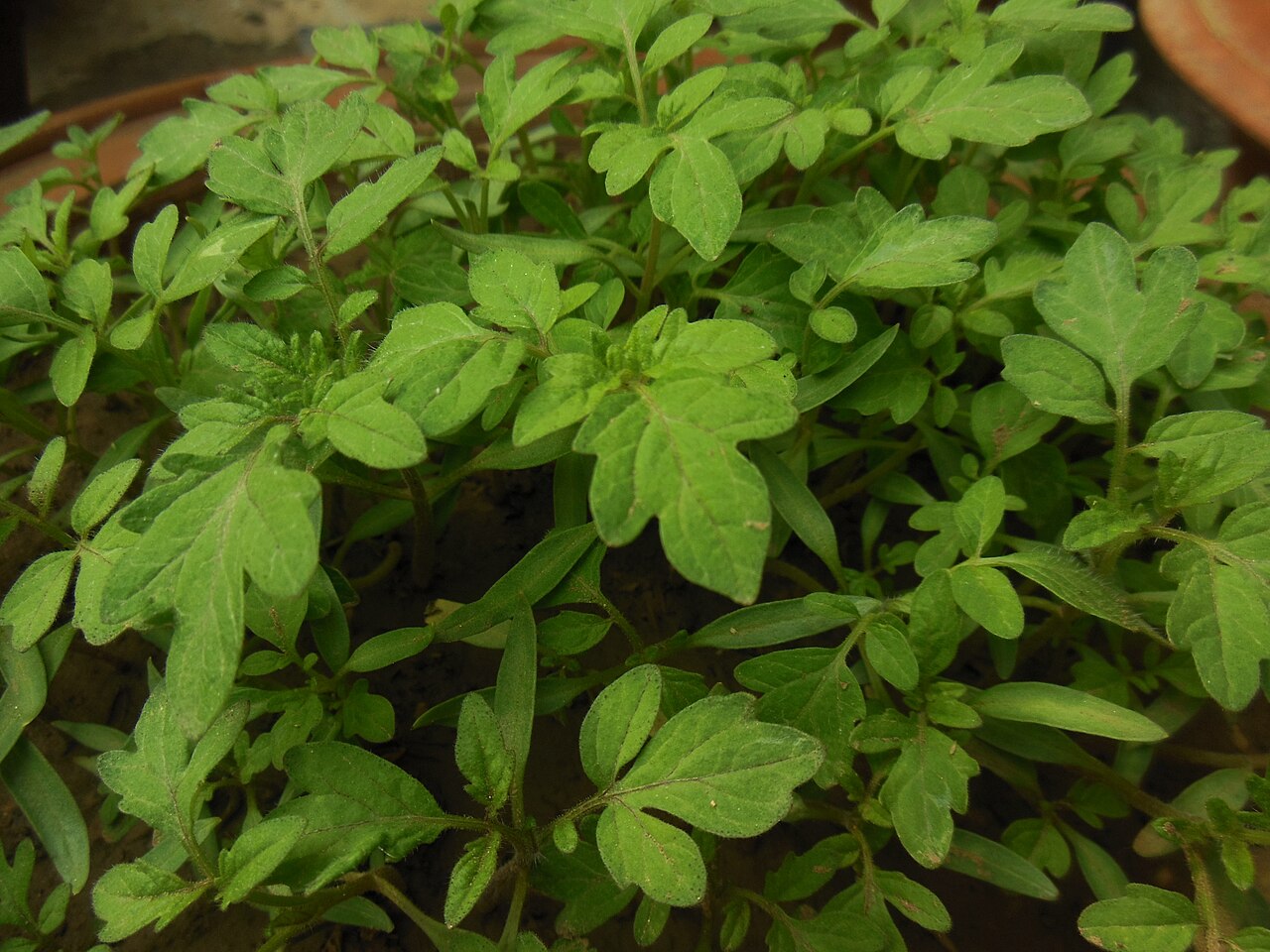
The tomato (Solanum lycopersicum, listed by Banglapedia under its older name Lycopersicon esculentum) belongs to the nightshade family, Solanaceae. Its wild ancestor is native to western South America, and tomatoes were already cultivated in southern Mexico by 500 BCE. Spanish colonists carried the plant to Europe, where it was grown by the 1540s, and to the Philippines, from where it spread through Southeast Asia and across the continent.
Banglapedia describes the tomato as a mildly acidic, pulpy fruit, usually red and sometimes yellow, which is used as a vegetable. In Bangladesh seedlings 25 to 30 days old are usually transplanted in November and December, and the crop is ready in 80 to 90 days. The encyclopaedia gives an average yield of about 40 to 50 tonnes per hectare. It distinguishes determinate plants, whose stems end in a flower bud, from indeterminate plants, whose stems end in a vegetative bud and keep growing.
Popular varieties named by Banglapedia include Oxheart, Marglobe, Sunmargino, Roma VF and Pusa Ruby. The Bangladesh Agricultural Research Institute (BARI) has developed its own varieties, among them Ratan, Manik, BARI Tomato-3, BARI Tomato-4, BARI Tomato-5, Chaiti, Apurba, Shila, Lalima and the hybrid Anupama; BARI Tomato-4, BARI Tomato-5, Chaiti, Lalima and Anupama are suited to the warm season. BARI, founded in 1976 as an autonomous institute under the Ministry of Agriculture with its central station at Joydebpur in Gazipur, carries out research on crops other than rice, jute, sugarcane and tea, which have their own institutes. In October 2022 the state news agency BSS reported that BARI had released three summer hybrid varieties, hybrid tomato-4, 8 and 11, and that summer tomatoes were being grown on about 3,000 hectares in Godagari upazila of Rajshahi after the Aus paddy harvest.
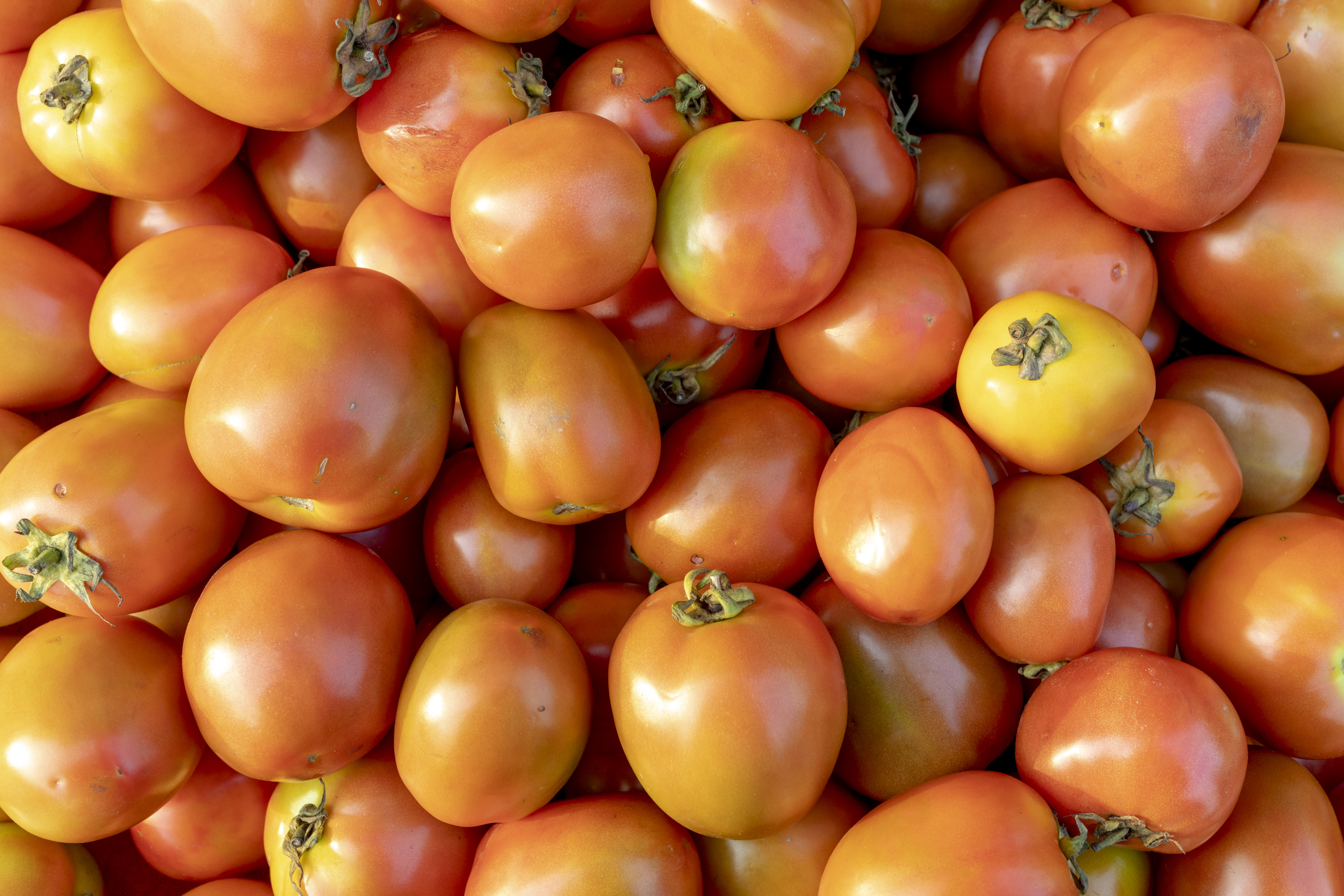
The fruit is eaten raw in salads or cooked, and is made into soup, pickle, chutney, ketchup and sauce. Banglapedia notes that it is rich in vitamins A and C, calcium and phosphorus. Nutrient tables give a raw red tomato about 94.5 grams of water, 18 kilocalories and 14 milligrams of vitamin C per 100 grams, along with lycopene, the pigment that makes ripe tomatoes red.
The same season in other districts
Nagarpur's growers were not alone in the 2024-25 season. On 8 January 2025 The Daily Star reported from Rajbari Sadar upazila, on the Padma, that tomato growers there were satisfied after a bumper yield, citing the local Department of Agricultural Extension. Commercial cultivation covered 132 hectares in four unions, with hybrid varieties such as TM 120, Mitali and Red Jewel. One grower told the paper that the first week's price had been Tk 4,400 a maund and that it had since fallen to Tk 1,600 a maund in the local wholesale markets. Another said he had spent Tk 1.15 lakh on 100 decimals of tomatoes.
By early February the fall was steeper in the south-west. Dhaka Tribune, carrying a UNB report on 4 February 2025, said tomato farmers in Bagerhat faced serious difficulty selling their produce because of oversupply in local markets as winter ended. Tomatoes there were selling at Tk 8 to 10 a kilogram retail and Tk 4 to 5 wholesale, and some growers had stopped harvesting and left ripe fruit to rot in the field. A grower in Charbaniari village told the agency that the price had dropped from Tk 50 to 60 a kilogram to Tk 3 to 4. A local entrepreneur had begun shipping Bagerhat tomatoes to Malaysia, with 40 tonnes sent since 25 January 2025 and 26 more due, paying farmers Tk 12 to 13 a kilogram, and the Bagerhat deputy director of the DAE said the exported tomatoes had passed quality checks.
In the capital, Prothom Alo reported on 24 February 2025 that tomatoes were selling in Dhaka's retail markets for Tk 15 to 20 a kilogram, and that at Karwan Bazar a pallet of good tomatoes sold for Tk 100. A Karwan Bazar trader told the paper that winter vegetables, especially tomatoes, beans and cauliflower, had become much cheaper because they were in the last stage of their peak season.
Gluts in earlier seasons
Late-winter tomato gluts have a history in Bangladesh. On 13 March 2018 Prothom Alo reported that tomato prices had fallen so low that year that many farmers left the crop unharvested; in Bagerhat in late February that year a maund of tomatoes was worth about the same as a kilogram of coarse rice. A Bangladesh Agricultural University professor of agribusiness and marketing told the paper that harvest timing was crucial, because farmers tend to harvest when supply is highest, and he also pointed to overproduction and poor market information. The report cited a 2015 study by CAPSA that put post-harvest losses of vegetables in Bangladesh at 18 to 44 per cent.
The same 2018 report quoted a former chief of party of the USAID-funded Cold Chain Bangladesh Alliance, who said tomatoes keep only four to five days in normal conditions, while green tomatoes last about 30 days in cold storage. Bangladesh had more than 300 cold storages, he said, but they were used mainly for potatoes, and vegetable storage was held back by short shelf life, costly transport, a shortage of refrigerated vans and the lack of a central temperature-controlled wholesale market. A Sher-e-Bangla Agricultural University professor suggested processing and export as ways to use surplus tomatoes.
In July 2022 The Financial Express reported that Bangladesh had imported 76,000 tonnes of tomatoes in the 2021-22 fiscal year even though domestic production had reached a record 1.75 million tonnes. At a seed event at the Bangladesh Agricultural Research Council, the then agriculture minister expressed dissatisfaction with the imports at a time when some farmers could not recover their investment during the harvest glut, and urged more summer tomato production so that supply would be spread across the year.
The cost side: fertiliser, seed and labour
The Nagarpur growers named three costs that had risen: fertiliser, seed and hired labour. The fertiliser increase is on record. On 10 April 2023 the Ministry of Agriculture and the Ministry of Finance issued notices raising the farmer-level prices of the four main chemical fertilisers by Tk 5 a kilogram, and The Financial Express reported on 12 April 2023 that the new prices were Tk 27 a kilogram for urea, Tk 21 for DAP, Tk 27 for TSP and Tk 20 for MoP. Urea had been Tk 22 a kilogram since August 2022.
The ministry described the change as an adjustment to global prices, and said the government would still be subsidising each kilogram, by Tk 21 on urea, Tk 49 on DAP, Tk 23 on TSP and Tk 40 on MoP. The Financial Express noted that world urea and MoP prices had in fact fallen in the preceding six months, and an agricultural economist it quoted estimated the extra cost to farmers at Tk 34 billion, or roughly Tk 500 to 550 a bigha. Seed and labour costs were not given in figures in the Nagarpur report; the farmers described them only as higher than before.
Photo: Frameofashik / Wikimedia Commons (CC BY-SA 4.0)
Sources: Jagonews24, Banglapedia, The Daily Star, Dhaka Tribune (UNB), Prothom Alo, The Financial Express, Bangladesh Sangbad Sangstha (BSS), Wikipedia
Comments
(0)