
By Dr Forkan Ali
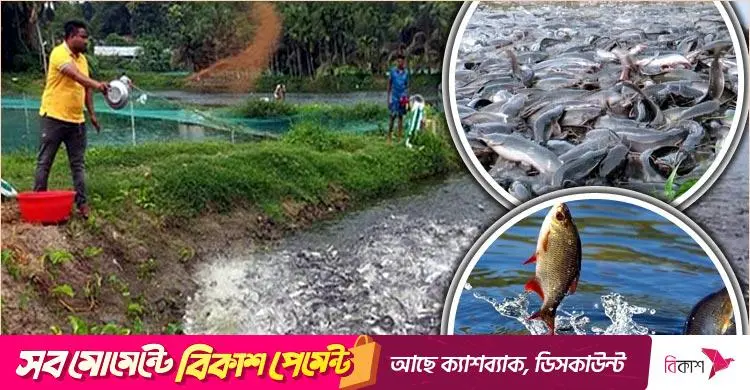
In this country, whose economy rests on agriculture, the fisheries sector is making a unique and growing contribution to national income, employment, poverty reduction and meeting nutritional needs. To keep this trend going, the Department of Fisheries has taken a number of practical steps to raise production from closed inland water bodies. A successful example is the Mymensingh Aquaculture Extension Project.
It began in July 1990 as a pilot project in six thanas of Mymensingh district. In its first phase the main aim was, by spreading improved fish farming methods among the target group (landless and marginal farmers), to achieve: 1. self-employment, 2. capital formation, and 3. poverty reduction.
Demonstration ponds and loans
At the very start, demonstration fish farming began in selected ponds to teach local people improved techniques by hand and to encourage them. In the first phase 511 demonstration ponds were run on 43 hectares of water, producing 116 tonnes of fish. In 1993-94 similar work was done in another 128 ponds covering 5.9 hectares. The demonstrations drew a strong response from local people.
From the start, collateral-free loans were introduced alongside technical support to let landless and marginal farmers take part in fish farming. In the first phase Tk 85.85 lakh was lent to 823 farmers for mixed carp culture and nurseries, some of them women farmers. About 99 per cent of these one-to-three-year loans were recovered. At the start of the second phase an attempt was made to strengthen the programme by bringing in commercial banks alongside the project's own lending, but for strategic reasons the involvement of NGOs was considered.
So that rich and poor alike in the project area could adopt improved fish farming technology, efforts were made to strengthen extension through contact fish farmers, who received training and technical support alongside the demonstration and loan programmes. In the first phase and the early part of the second, up to 1994, a total of 2,594 farmers joined. Their ponds covered 297 hectares and produced 1,065 tonnes of fish.
Second phase and DANIDA
Regular training was arranged for fish farmers at every level, and officers, staff and extension workers in the project area were given up-to-date training. After the remarkable success of the first phase, the donor agency DANIDA recommended extending the project to a second phase. Following agreement between the government and the donor, the second phase began in July 1993 in 26 thanas of seven districts in greater Mymensingh and Gazipur. According to the proposal in the project document submitted in April 1999, in the first year of the second phase the project would give government loans to the target group of landless and marginal fish farmers, and from the second year commercial banks and suitable NGOs were advised to be involved.
Alongside continuing the work of the first phase, it was decided to post training officers at thana level in the second phase to strengthen training. From 1993 to 1997 the project continued without NGO participation; for various reasons NGOs could not be brought in during this time. Meanwhile, following a mid-term evaluation (conducted by the donor in 1996) and the discussion and agreement of a round-table meeting of the implementing authority, the donor and the ministries concerned, the project made a new start through three-way participation from 3 May 1998. On that day a memorandum of understanding (MoU) was signed between the NGOs, the donor (DANIDA) and the government's nominated representative.
The physical target of the second phase was average production of 2.5 tonnes a hectare in 25,000 ponds. Loans and technology extension have already been delivered in 20,000 ponds, and responsibility for lending in the remaining 5,000 ponds has been handed to NGOs. Three-way participation has added a new dimension to the project's work.
The new approach
- Work to group targets instead of single-centred targets in spreading improved fish farming technology.
- Provide microcredit through fish farmer groups.
- Use participatory action and learning methods in technology transfer.
- Cut production costs, with farmers collecting and investing possible inputs themselves, such as cow dung and, in some cases, rice bran.
- Lending through NGOs on easy terms.
- Repeated harvesting and restocking.
- Preparing and implementing project proposals from the grassroots through fish farmer groups.
- Groups of 10-15 members that bring together people in the many jobs of fish farming and management: table-fish producers, nursery operators, fry traders, fish catchers and marketers, and input makers such as net makers.
- Forming group executive committees to build local leadership able to take decisions, and continuing to create opportunities and an enabling environment for women's participation and empowerment at every level.
- NGO (DOF) cooperation to continue the ongoing work after the project ends (for at least five years).
Some new and innovative arrangements have also been adopted in managing the project. In central project management, NGO partners are represented alongside the government and the donor. Direct participation of the DOF, DTA and NGOs has been ensured in group formation and motivation, training, raising social awareness, technology transfer and the loan programme.
Training officers, thana women development workers and lower-ranking staff among the project officials have been placed with the NGOs concerned, and the DTA will bear all their costs (salaries and allowances) during the project period. This was done so that trained and experienced staff could help the NGOs and the project could be completed smoothly.
Alongside central management, an institutional structure for three-way management has been built at district and thana level. The project authority has supplied NGOs with physical facilities, offices, extension equipment and vehicles for use during the project period.
Outlook
It is hoped that, by creating opportunities for women as well as men in income-generating activities, this new phase will allow a successful and profitable programme to reach its goals. Using the same strategy, the Patuakhali-Barguna Aquaculture Extension Project and an aquaculture extension project in greater Noakhali have also begun.
The Mymensingh Aquaculture Extension Project has already been recognised as a bold and practical effort to counter the declining trend of fish production in open inland waters.
The project's target group, landless and marginal farmers, women and men, will be able to become self-employed by adopting improved fish farming methods and taking part directly in income-generating work, improving their socio-economic and physical conditions. Thana-level capacity to develop and extend fish farming will grow, and applying improved technology in the project area's closed water bodies will greatly increase fish production. Pond operators will be assured of loans on easy terms through NGOs.
The writer is a researcher and former principal.
Source: Jagonews24. First published in Bengali on The Agro News.
Comments
(0)