
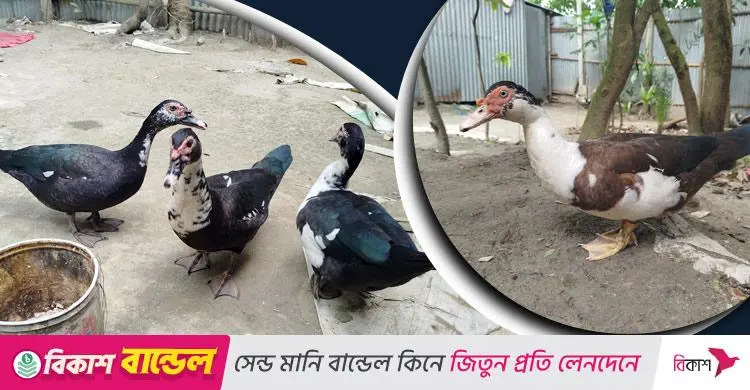
Duck rearing has long played an important role in the rural economy, and the muscovy duck, also known as the "Chinese duck", stands out. It has recently become especially popular. Easy rearing, high returns at low cost and nutritious eggs and meat make it an attractive option for rural farmers.
Although originally a species of South and Central America, the muscovy is now widely reared in many Asian countries, particularly Bangladesh. It is easy to identify by the red caruncles on its head. An adult male weighs about 4.5 to 5 kg and a female 2.5 to 3 kg.
Easy to keep
Muscovy ducks can forage naturally in open surroundings. They eat insects in paddy fields and fallow land, which benefits the land. They need no separate farm or complicated structures and can easily be kept in a yard or open space.
The breed is relatively resistant to diseases such as Newcastle disease and bird flu, which reduces health risks and treatment costs for farmers. They can live on readily available greens, insects and rice bran.
A muscovy duck lays 60 to 120 eggs a year on average. Each egg weighs about 75 to 85 g and is richer in nutrients than an ordinary duck egg. Hatching takes about 35 days, and the ducks naturally sit on their eggs and can hatch most of them.
Income and farming benefits
Muscovy droppings can be used as feed for fish, so farmers who raise ducks and fish together can double their gains, creating a sustainable circular farming system.
Rural women can become self-reliant by rearing these ducks at home. It has been seen that a farmer rearing 50 ducks can earn more than Tk 1 lakh a year, improving their finances and quality of life.
The droppings can also be used as organic fertiliser, contributing to environment-friendly farming and reducing the need for chemical fertiliser. Improved muscovy varieties such as Cuban White and hybrid muscovy are now available on the market; they grow fast and give more eggs and meat. Besides local markets, demand in urban areas is growing day by day.
With low costs, simple methods, nutritious eggs and meat and a place in environment-friendly farming, the muscovy duck is a promising side of rural livelihoods. With planned training and government support, it could play an effective role in reducing rural poverty.
References: Bangladesh Agricultural Research Institute; Food and Agriculture Organization (FAO); Bangladesh Livestock Research Institute; Bangladesh Bureau of Statistics.
Source: Jagonews24. First published in Bengali on The Agro News.

Comments
(0)