
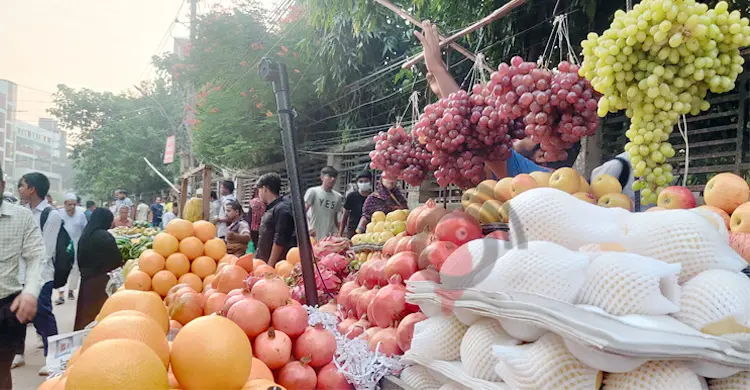
Demand for ripe papaya has risen with the dengue outbreak. Across the capital, local papaya sells at Tk 80-100 a kg depending on the area. But the picture is different outside Mugda Medical College Hospital, where sellers are asking Tk 150 a kg. They knock off Tk 5-10 after bargaining but will not go below Tk 140. Many patients' relatives are turning away because of the price, and some are arguing with sellers over it.
Not only papaya: all kinds of local and imported fruit are expensive outside this hospital, and fruits that help dengue patients recover cost even a little more. For example, although green coconut prices in Dhaka fell after drives by the Directorate of National Consumer Rights Protection, outside Mugda they are still Tk 160-180.
This was found on the afternoon of Sunday, 10 September, along North Mugdapara Road in front of the hospital. The pavement beside the road is occupied by fruit traders selling every kind of fruit, and a large share of buyers are patients and their relatives.
Patients' relatives complain that private hospitals charge a lot and doctors fleece them, and now fruit traders are fleecing those who come to Mugda Medical for low-cost treatment.
Green coconuts sell most
Green coconuts are the biggest seller on the Mugdapara Road pavement. Just to the left outside the hospital gate, 4-5 people sell them from vans, with another 7-8 sellers a little further on. The second van in the row beside the gate belongs to Billal Hossain, who has sold various fruits in the area for more than 15 years. Close to 50, he has sold only green coconuts for the past three months.
Billal said large coconuts cost Tk 180, medium ones Tk 160, and smaller ones picked a few days earlier Tk 150.
Asked why prices were higher than elsewhere, Billal grew angry and said loudly: "Come on, you're buying coconuts in front of Mugda, of course the price will be higher. You say it's expensive - what was it like a few days ago? You're getting them cheaper now because the magistrate put pressure on the wholesalers. Otherwise these (big ones) would have hit Tk 220."
Other coconut sellers nearby agreed. All had large, medium and small coconuts at nearly the same prices. Although they compete, they said they set prices together.
Fruit prices by the kilo
At the fruit stalls on the pavement, malta was selling at Tk 420-430 a kg, Gala apples at Tk 370-380, dragon fruit at Tk 350-400, red grapes at Tk 480-490 and oranges at Tk 380-420.
Pomegranate was the most expensive, with sellers asking Tk 500-520 a kg depending on size. Local hog plums cost Tk 60-80 a kg and guavas Tk 75-80. Sagar bananas were Tk 95-110 a dozen and Sabri bananas Tk 150-155 a dozen (Tk 13 each).
Sajib Hossain, a young man whose elder sister is admitted with dengue to the women's ward on the third floor and whose mother also feels feverish, was going round the stalls buying fruit for them. He told Jago News: "They are asking high prices for all fruit here. I went round a lot further in, and every shopkeeper quotes the same price. They have formed a syndicate and are forcing us (patients' relatives) to buy at higher prices."
He said: "What can I do? My sister asked for papaya and malta. I took a papaya weighing 1 kg 400 g, and it cost Tk 196. Malta was Tk 415 a kg. Three maltas weighed nearly 750 g. The price came to Tk 287; the seller took Tk 285 and said, 'I knocked off two taka, uncle.'"
Fruit seller Sohrab Hossain, however, thinks it is normal for fruit outside the hospital to cost Tk 5-10 a kg more. He told Jago News: "Fruit is expensive everywhere. It's bound to be a little more here. We also have to pay every day (extortion) for a spot on the pavement. Business isn't going well either; sales are low. If we don't make a little profit, how will we survive?"
Cheaper elsewhere
Fruit is considerably cheaper in other areas. The Basabo Buddhist temple is 900 m to 1 km from the hospital, with several fruit stalls in front of it. There, Gala apples selling for Tk 380 outside the hospital cost Tk 320-330 a kg, and malta Tk 390 a kg. Grapes, oranges, papaya, guava, bananas, dragon fruit and all other fruit sell for Tk 20-30 less in front of the temple.
A similar difference was seen at the Rampura kitchen market, where fruit was even a little cheaper than in front of the Basabo temple. The same picture (lower prices) was seen in Mohakhali, Madhya Badda and Uttar Badda.
Sugarcane juice at Tk 30 a glass
Because doctors advise dengue patients to take liquids, many are giving them sugarcane juice instead of buying expensive green coconuts. Four or five people sell sugarcane juice beside the road outside Mugda Medical, but a glass costs more there than elsewhere too.
Lokman Ali, who had come with a bottle to buy juice, said: "In our area (Madhyamanda) sugarcane juice is Tk 20 a glass, and the glass is bigger. Here the glass is smaller and the price higher: they want Tk 30 a glass. I have to give it to my daughter, so I'm taking it."
Sugarcane juice seller Abdus Samad said: "It's Tk 30 at every stall here. I can't go by what others charge elsewhere. Sugarcane is hard to get and I buy it at a high price. There's the fuel cost of running the machine. If I don't sell at Tk 30 a glass, there's no profit."
Source: Jagonews24. First published in Bengali on The Agro News.
Comments
(0)