
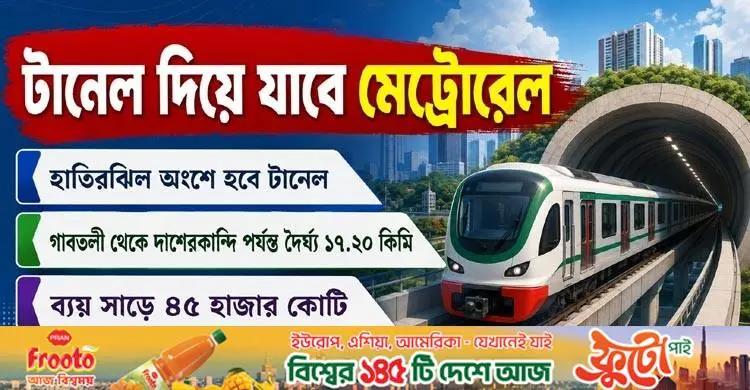
MRT Line-5 (South) may soon see the light of day, with almost everything about the project ready. The metro line will run 17.20 km from Gabtali to Dasherkandi in Dhaka. The Hatirjheel section will pass through a tunnel, and the rest, from Aftabnagar, will be elevated.
The total cost of the project is estimated at Tk 45,503 crore. Of this, the government will provide Tk 15,197 crore, and the remaining Tk 30,306 crore will come jointly from the Asian Development Bank (ADB) and South Korea's Economic Development Cooperation Fund (EDCF).
Route and stations
From Gabtali the line will run underground via Technical, Kallyanpur, Shyamoli, College Gate, Asad Gate, Sukrabad and Karwan Bazar, beneath Hatirjheel, to Tejgaon and Aftabnagar. The tunnel will be built 16 to 38 metres below ground level.
The 13.10 km from Gabtali to Aftabnagar will be underground, and the remaining 4.10 km from Aftabnagar to Dasherkandi will be elevated. Fifteen stations are planned on the route: 11 underground and four elevated.
Dhaka Mass Transit Company Limited (DMTCL) sees the project as a transformative step in linking the west and east of the city by metro rail. It says the aim is to introduce a fast, safe, reliable, air-conditioned, time-saving, electric, remotely controlled and environmentally friendly modern mass transit system to ease traffic congestion and improve the environment in Dhaka.
Awaiting ECNEC approval
The Planning Commission has completed all preparations to place the project before the Executive Committee of the National Economic Council (ECNEC). Finance and Planning Minister Amir Khasru Mahmud Chowdhury signed the project's development project proposal (DPP) on Sunday for submission to ECNEC.
The next ECNEC meeting will be held on Wednesday, 19 August, chaired by Prime Minister Tarique Rahman. If the project is not placed at that meeting, it will be presented at the following one.
The project director of the Dhaka Mass Rapid Transit Development Project (Line-5) Southern Route, Brigadier General (retd) Mohammad Abdul Wahab, told Jagonews24: "All preparations to place the project before ECNEC are complete. If it is not taken up at Wednesday's ECNEC meeting, it will be presented at the next one."
Explaining that most of the project is underground, he said: "It will be underground from Gabtali via Hatirjheel to Aftabnagar, and the rest, from Aftabnagar to Dasherkandi, will be elevated."
Capacity and benefits
According to an ADB study, passengers will be able to use the route from the 2030-31 fiscal year. The route will save 21 crore 49 lakh 70 thousand working hours, save 41.22 thousand tonnes of fuel a year, and cut distance travelled by vehicles by 642 thousand km a year, reducing road traffic. Carbon dioxide emissions will fall by 2,07,964 tonnes a year.
Operations will begin with 19 six-car train sets, to be upgraded to eight-car trains from 2040. Each of the four middle cars will carry up to 391 passengers and each driving trailer car up to 374, giving each train a capacity of up to 2,312 passengers.
At the start, in 2030, trains will be able to carry 20,107 passengers an hour in one direction, rising to 38,255 in 2060. Each train will have a separate car for women, and trains will run every 4 minutes 30 seconds. Elevated trains will run at 100 km an hour, and underground trains at 90 km an hour.
The project director said the rolling stock will have an electro-pneumatic service system in the brake control scheme, reducing jolts during braking. Noise barrier walls will line both sides of the elevated viaduct, and the soil around the underground tunnel will act as a sound barrier. Overall, he said, the project will not harm the environment and will instead play a major role in improving it.
Construction and spoil
DMTCL said underground and elevated stations will have modern lifts and escalators, and people will be able to use station stairs, lifts and escalators to cross from one side of the road to the other, in addition to existing footbridges and underpasses. Pedestrians will not, however, be able to enter the paid zone or the platforms.
The 11 underground stations will be built by the cut-and-cover method. First, using half of the road, a station about 220 metres long will be built by open excavation. The station under construction will then be covered with thick steel plates, over which vehicles can pass easily while the remaining work continues underneath. Traffic will be diverted to parallel roads on both sides while the underground stations are being built.
Building each underground station by open excavation will remove about 70,000 cubic metres of soil, and the 11 underground stations together with the tunnel will remove about 31 lakh 20 thousand cubic metres in total.
DMTCL said this soil will be used for land development in Dasherkandi and nearby low-lying areas and to build the depot's link road. It could also be used for government highways, roads and embankments, and for land development at the depots of other MRT lines. Any soil left over will be sold through open tender.
DMTCL believes the new route will bring further change to Dhaka's transport system once it opens.
Source: Jagonews24. First published in Bengali on The Agro News.
Comments
(0)