
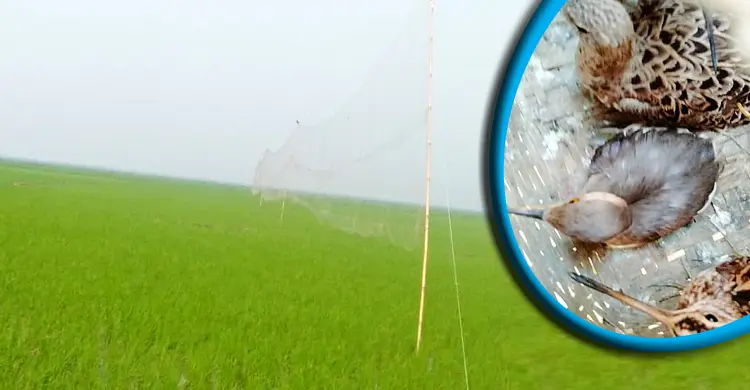
Migratory birds are being hunted openly in the haors of Moulvibazar district with net traps and poison bait. There are allegations that the Forest Department and the administration have taken no steps to stop it, and nature lovers fear biodiversity will be threatened.
At Kawadighi haor in the north-west of the district, hunters were seen openly trapping migratory birds with nets strung on bamboo poles in Girim, Majer Ban, Kubjari Ban, Koilta, Mitipur and other parts of the haor.
The hunters set their nets during the day. At night, migratory birds coming to feed are caught, and in the morning the hunters sell them to local wholesale buyers. As a result, the number of migratory birds in the haors is falling day by day.
Poison bait too
Birds are being killed not only with nets but also with poison bait in various places. Besides Kawadighi, migratory birds are being hunted at Hakaluki, the largest haor in South Asia, which lies in the district, and at Hail Haor and Baikka Beel.
Migratory birds come from Siberia, China and other Asian countries at the start of winter in search of warmth, safe shelter and food, and nearby villages, haors, beels and ponds fill with their calls. But because of the hunters, the birds cannot feed in peace.
Hakaluki haor, Kawadighi and Baikka Beel are among the main places in the country where migratory birds gather. They stay in the haors for the whole winter and return to their homes at the start of the hot season.
Locals and conservationists speak
Shafiqul of Islampur village beside the haor told Jagonews that hunters set nets during the day, and at night 10 to 15 birds are caught in each net as flocks fly from place to place looking for food. Birds are also caught with current nets (fine monofilament nets) set in the beel water. "When we tell them not to hunt birds, they threaten us instead," he said.
Ansar Ali of Kashimpur in the haor area told Jagonews that a hali (four) of birds is selling for Tk 1,000 to Tk 1,200. The birds include sarali, lenja and some unfamiliar species.
Hasanat Kamal, convener of the Biodiversity Conservation Group, Moulvibazar, told Jagonews that forest administration action to stop bird hunting is urgently needed, along with making ordinary people aware. Unchecked hunting is threatening biodiversity and the environment, he said, though the Forest Department's recent activity gives them hope.
Md Rezaul Karim Chowdhury, divisional forest officer of the Wildlife Management and Nature Conservation Division, Sylhet, said he had no specific complaint against anyone. But drives will be carried out in areas where birds are being hunted after inquiries, he said.
Source: Jagonews24. First published in Bengali on The Agro News.


Comments
(0)