
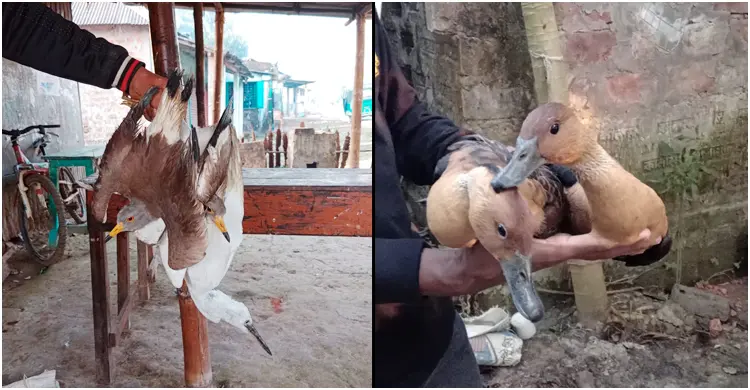
Bird poaching has not stopped in the haors and baors of Moulvibazar. Hunters keep at it with a range of tricks, sometimes using poison bait and sometimes setting traps under cover of darkness.
As the cold deepens, migratory birds begin arriving at Moulvibazar's haors. They choose as their refuge Hakaluki, one of the largest haors in Asia, located in Moulvibazar. They also settle on the beels of Kawadighi and Hail haors.
New tactics to evade monitoring
Seizing the moment, some unscrupulous people turn to poaching in the hope of easy profit. They hunt the birds at night and sell them, and people who relish game buy them at high prices. Because of recent monitoring by the authorities, the hunters have changed tactics: at night they pick spots and lay traps and poison bait. Before dawn they slaughter the birds they have caught and sell them door to door in town, carried in shopping bags.
Although the Forest Department and other authorities have taken steps to stop it, poaching has not ended. Environmental activists, bird lovers and people living around the haors have demanded effective action.
Local people around Kawadighi haor say many species come every year from cold countries to Hakaluki and Kawadighi haors, including the guti eagle, balihansh, bhutihansh, giriyahansh, lenjahansh, sarali, panbhulani and kalim. Alongside the foreign birds, the haors also hold many native species.
Forest guard withdrawn after Hakaluki probe
A two-member inquiry formed by the Wildlife Management and Nature Conservation Division recently found that ducks had been killed with poison bait at Hakaluki haor and then shared out. Forest guard Motahar Hossain, in charge of the Hakaluki beat, was found to be involved and has been withdrawn.
The committee's convener, Shyamal Kumar Mitra, assistant conservator of forests (ACF) of the Moulvibazar Wildlife Management and Nature Conservation Division, said: "Our inquiry found initial evidence of birds being poached at Hakaluki haor and shared out. Forest guard Motahar Hossain, in charge of the Hakaluki beat, was found to be involved. We will submit the inquiry report to higher authorities."
Rezaul Karim Chowdhury, divisional forest officer of the Wildlife Management and Nature Conservation Division, said the committee had found initial evidence in the Hakaluki case. The forest guard in charge of the beat had been withdrawn because of his involvement, and legal action would be taken against those involved in the poaching.
It has emerged that Md Husen Ahmad, son of Alauddin of Murshibadkura village in Talimpur union, killed around fifty ducks with poison bait in a beel of Hakaluki haor. In the morning he brought the birds in a sack to the local Kanongobazar to sell them. On hearing of it, forest guard Motahar Hossain detained Husen with the birds and took him to the local union parishad chairman and member. In front of them, Husen gave a written undertaking that he would not do such a thing again, and he was then released.
But local sources said that after the hunter was let go, the fifty or so birds were "shared out" among local elected representatives and influential people. The written undertaking from Husen mentioned only three birds. The sources said forest guard Motahar Hossain concealed the real figure of around fifty birds to protect the hunter, and local representatives were also involved.
Traps and poison bait on Kawadighi
Poachers have been seen selling birds in various parts of Kawadighi haor. Abdul Hannan Koysar Mia, who lives by the haor, told Jagonews that although shooting has stopped, unscrupulous hunters set poison bait and traps at Borodhol bond, Mandar bond, Boichabil, Onyabil and Kagoji Bari Chorua in Kawadighi haor.
Environmental activist and bird lover Murad Ahmad told Jagonews that unchecked poaching is steadily reducing the number of birds in the haor. He said public awareness must be raised, the administration must act to stop poaching, and local people must be involved in protecting birds.
Social workers Alamgir Hossain and Gous Ahmad told Jagonews that unscrupulous people from Notun Sonapur, Islampur and Kashimpur villages by the haor are involved. They set poison bait and traps at night and sell the birds at dawn to various middlemen, who supply them to homes in town by various means. They do it purely for high profits, the two said.
Rezaul Karim Chowdhury, divisional head of the Wildlife and Nature Conservation Division, said a manpower shortage had prevented them from acting against poaching in remote areas. They occasionally receive reports of birds being shot, he said, and are running awareness activities. Anyone who still poaches birds will face legal action, he said.
Source: Jagonews24. First published in Bengali on The Agro News.


Comments
(0)