
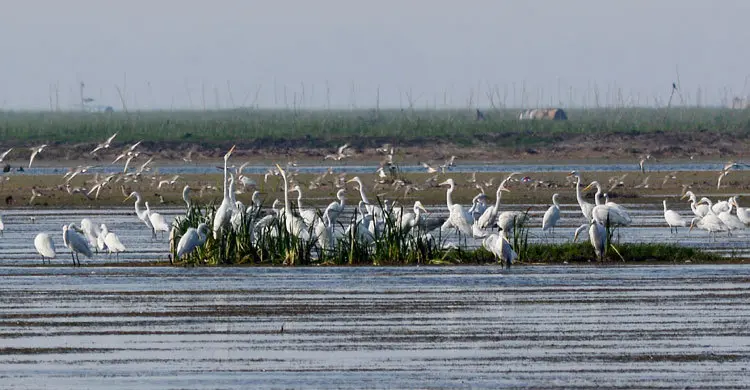
Migratory birds have once again flocked to Hakaluki, the country's largest haor, and to the Baikka Beel bird sanctuary in Sreemangal in Moulvibazar. New birds are seen every day, and both wetlands are alive with birdsong as thousands of migratory birds of many species from around the world play there daily. The arrival of countless birds of different sizes and colours has given these areas a new dimension.
Every year from November to March, Hakaluki Haor, Baikka Beel and the surrounding areas ring with the calls of thousands of birds of many species. This year a total of 50,518 birds arrived in Moulvibazar: 45,100 birds of 44 species at Hakaluki and 5,418 of 38 species at Baikka Beel, according to the Bangladesh Bird Club.
What the count found
Thousands of migratory birds crowd into Hakaluki and Baikka Beel every winter, and the Bangladesh Bird Club recently counted them. At Baikka Beel it found 5,418 birds of 38 species, including 1,580 common teal, 327 bali hansh (lesser whistling duck), 188 bhuti hansh, which is nearly endangered worldwide, and 128 cormorants.
At Hakaluki, the country's largest haor, it found a total of 45,100 birds of 44 species, notably the piyang hansh, common teal, bali hansh, bhuti hansh, cormorant, black coot, common moorhen and purple swamphen, among many other migratory birds.
Numbers down on last year
However, bird numbers at Baikka Beel and Hakaluki are lower this year than in other years. According to Climate Resilient Ecosystem and Livelihood (CREL), a non-governmental organisation working at Baikka Beel, last year's count there found 10,713 birds of 41 species, but this year the number has fallen by half. In 2003 the land ministry declared Baikka Beel, about 250 acres in area, a sanctuary to protect its birds, fish and aquatic plants.
Last year's flood disrupted the growth of aquatic plants. Before its effects had worn off, heavy rain at the end of the year in December raised the water level of the beel and submerged the green aquatic plants. With many plants dying, the green thicket of lotus and dholkolmi that normally surrounds the beel did not form, and birds ran short of food. Experts see the lack of food as the reason for the fall in bird numbers.
At Hakaluki, poison bait and various kinds of hunting are blamed along with the flood. Kulaura upazila fisheries officer Sultan Mahmud said one of the main reasons for the decline at Hakaluki is hunting birds with poison bait, which is why fewer birds came this year than last year.
Divisional forest officer (Wildlife Management and Nature Conservation Division) Mihir Kumar Dey said there are far fewer migratory birds this year, and he would call on bird experts to identify why.
Bangladesh Bird Club general secretary Simanta Dipu told Jagonews24 that people are the only reason for the decline at Hakaluki. Because beels are leased out wholesale, people stay on them, chase the birds away and hunt them. He added that birds are naturally beneficial to any beel or haor: it has been seen around the world that without birds, fish and crop yields fall, because bird droppings are an excellent organic fertiliser.
Source: Jagonews24. First published in Bengali on The Agro News.

Comments
(0)