
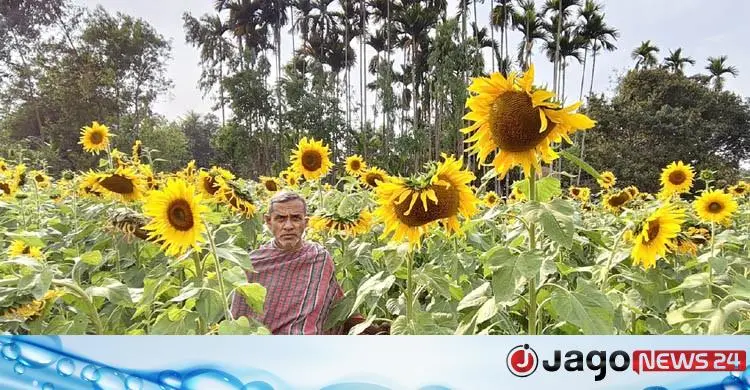
For several years many people in Moulvibazar have been growing sunflowers with enthusiasm, and some have become self-reliant through it. Cultivation has grown gradually since the government began distributing sunflower seed. With the prospect of good profit at low cost, sunflower is becoming known among the district's farmers as a promising crop, and incentives and technical support from the agriculture department are helping it spread. This season, sunflower fields in various parts of the district are already in bloom, which agriculture officials say points to a good harvest.
According to the Moulvibazar agricultural extension office, sunflower cultivation is rising every year in the district's seven upazilas, especially in the haor areas. Juri upazila again has the most this year. In total, sunflowers have been grown on 147 hectares in the district this year. With proper care, sunflowers yield a good deal of oil.
Sunflowers have been planted over a wide area around the agricultural research institute at Akbarpur in Moulvibazar Sadar upazila, and in large quantities at Laharpur and at West Loyarkul in Bhunabir union of Sreemangal upazila. The flowers will be cut in a few days.
Farmers' accounts
Sreemangal farmer Abdur Rahim, alias Mintu Mia, said he has grown sunflowers on 15 decimals of land in Laharpur village this year. The agriculture office helped him with seed and fertiliser, and he has spent about Tk 7,000 so far. He has had a bumper yield and will collect and sell the seed in a few days, hoping to profit if seed prices are high.
Md Khalil Mia said that, as every year, he is growing sunflowers at West Loyarkul in Bhunabir union, this time on 7 decimals. The agriculture office gave him seed and fertiliser, and he has spent about three thousand taka so far. His plants have not flowered yet. He hopes to collect and sell two to three maunds of seed.
The Bangladesh Agricultural Research Institute (BARI) is located at Akbarpur in the district town, where the BARI-3 sunflower variety it developed has been grown. The fields are now full of flowers. The agriculture department says the BARI-3 variety is short but has very large flowers, and its strong stem keeps it from bending easily, so the risk of storm and rain damage is lower. Most promising of all, its yield is almost double that of other varieties. Such an innovation, on the path to self-sufficiency in oilseeds, will not only raise farmers' incomes but also play an important role in reducing import dependence.
Officials expect good yields
Md Masukur Rahman, sub-assistant agriculture officer in Sreemangal upazila, said sunflowers have been grown on about 494 decimals in the upazila this season. Free seed and fertiliser were given to encourage farmers, and yields have again been good in Laharpur, Loyarkul and other areas. Each bigha will yield 6 to 6.5 maunds of sunflower seed, he said, adding that farmers have been encouraged to grow sunflowers to make them self-reliant.
Nilufar Yasmin, additional deputy director of the DAE in Moulvibazar, said sunflower cultivation has increased in the district this season. Most fields have flowered and the agriculture department is optimistic about a good harvest. Thanks to the incentive programme, fallow and single-crop land is being brought under cultivation and farmers are becoming more interested in growing sunflowers and other new crops, she said.
Source: Jagonews24. First published in Bengali on The Agro News.



Comments
(0)