
The Bangladesh Coast Guard and police detained a man accused of poaching, together with 32 kilograms of deer meat and deer-hunting snares, in a joint raid in the Kanainagar area of Mongla upazila in Bagerhat district. The raid was carried out around midnight on the night of Tuesday, 25 November 2025, and the man was handed over to Mongla police station on the afternoon of Wednesday, 26 November. Mongla lies on the northern edge of the Sundarbans, the mangrove forest that is the last refuge in Bangladesh of the spotted deer.
The raid and what was seized
According to the Coast Guard, its personnel and the police carried out the joint operation in Kanainagar, Mongla. During the raid they detained one man accused of poaching and recovered 32 kilograms of deer meat, two deer heads, eight legs and about 2,000 metres of snares of the kind used to hunt deer.
The Coast Guard's media officer in Dhaka, Lieutenant Commander Siam-Ul-Haque, confirmed the arrest. The detained man was handed over to Mongla police station on Wednesday afternoon, 26 November 2025. The Coast Guard said it would continue operations of this kind in future.
The report did not name the detained man or say what case would be filed against him. Under Bangladeshi law he remains an accused person, and any case is for the police and the courts to take forward.
Mongla, the Pasur river and the edge of the forest
Mongla is one of the nine upazilas of Bagerhat district in Khulna division. Banglapedia, the national encyclopaedia published by the Asiatic Society of Bangladesh, gives the upazila's area as 1,461.20 square kilometres. It is bounded by Rampal upazila on the north, the Bay of Bengal on the south, Morrelganj and Sarankhola upazilas on the east and Dacope upazila on the west. Its main rivers are the Pasur, the Mongla, the Bhola, the Bangra and the Chandpai. Mongla thana was formed on 19 September 1976 and became an upazila on 14 September 1983.
The 2011 population census of the Bangladesh Bureau of Statistics, as given by Banglapedia, counted 136,588 people in Mongla. The upazila has one municipality and six unions, one of which is named Sundarban. Paddy is its main crop, and shrimp and crab are listed as its main exports, a reminder of how closely local livelihoods are tied to the tidal rivers and the forest.
Banglapedia lists Mongla port, the country's second seaport, among the upazila's landmarks. It records that the port began as an anchorage about 18 kilometres upstream at Chalna, opened to foreign ships on 11 December 1950, and that the anchorage was shifted to Mongla in 1954 because it could take ships with deeper draughts. The port stands at the meeting point of the Pasur and Mongla rivers, about 48 kilometres south of Khulna town.
The Pasur itself is the continuation of the Rupsa south of Khulna. Banglapedia describes it as very deep and navigable throughout the year, about 142 kilometres long, and notes that south of Mongla upazila it flows into the Sundarbans before reaching the sea. Bagerhat district as a whole covers 3,959.11 square kilometres and was formed in 1984; the Pasur, Madhumati, Baleshwari and Haringhata are among its main rivers.

The spotted deer of the Sundarbans
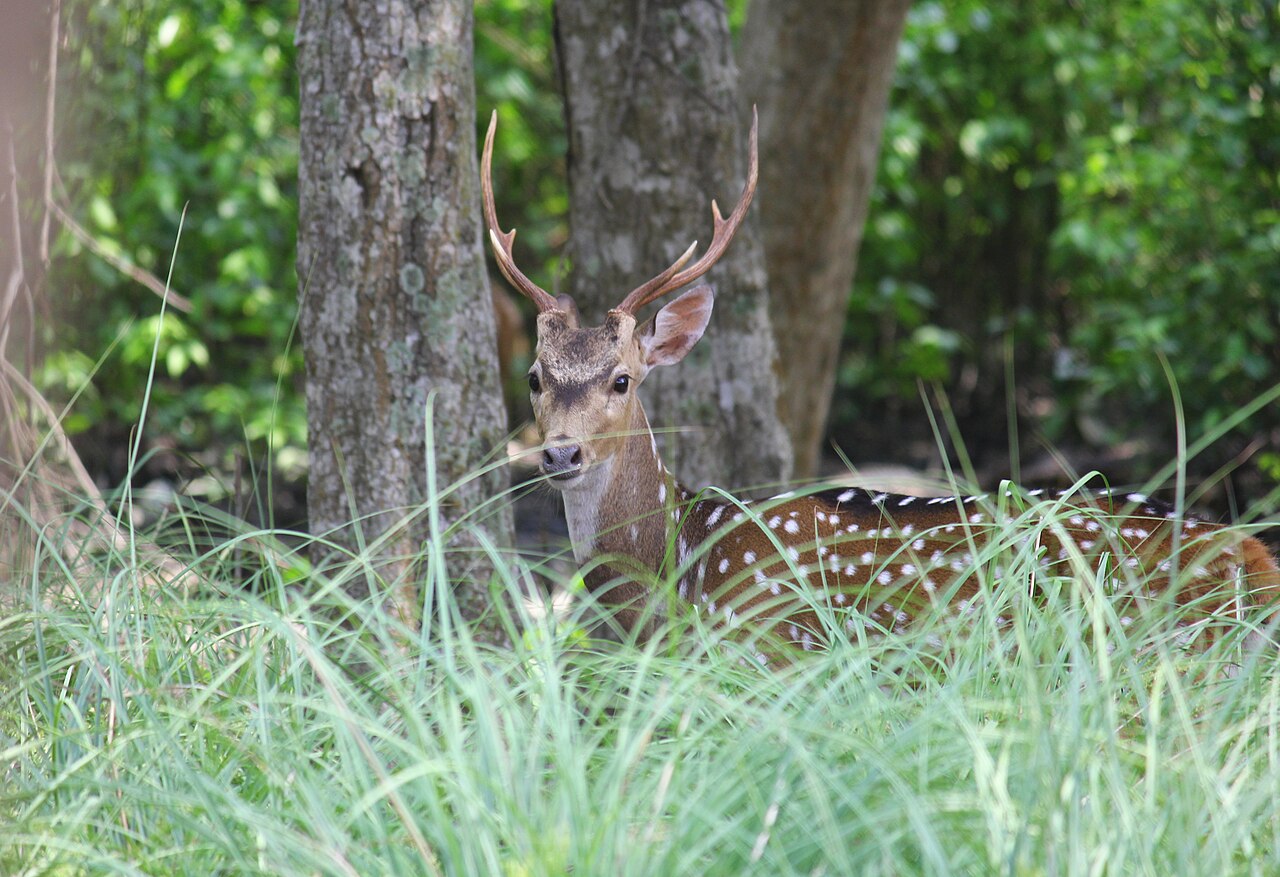
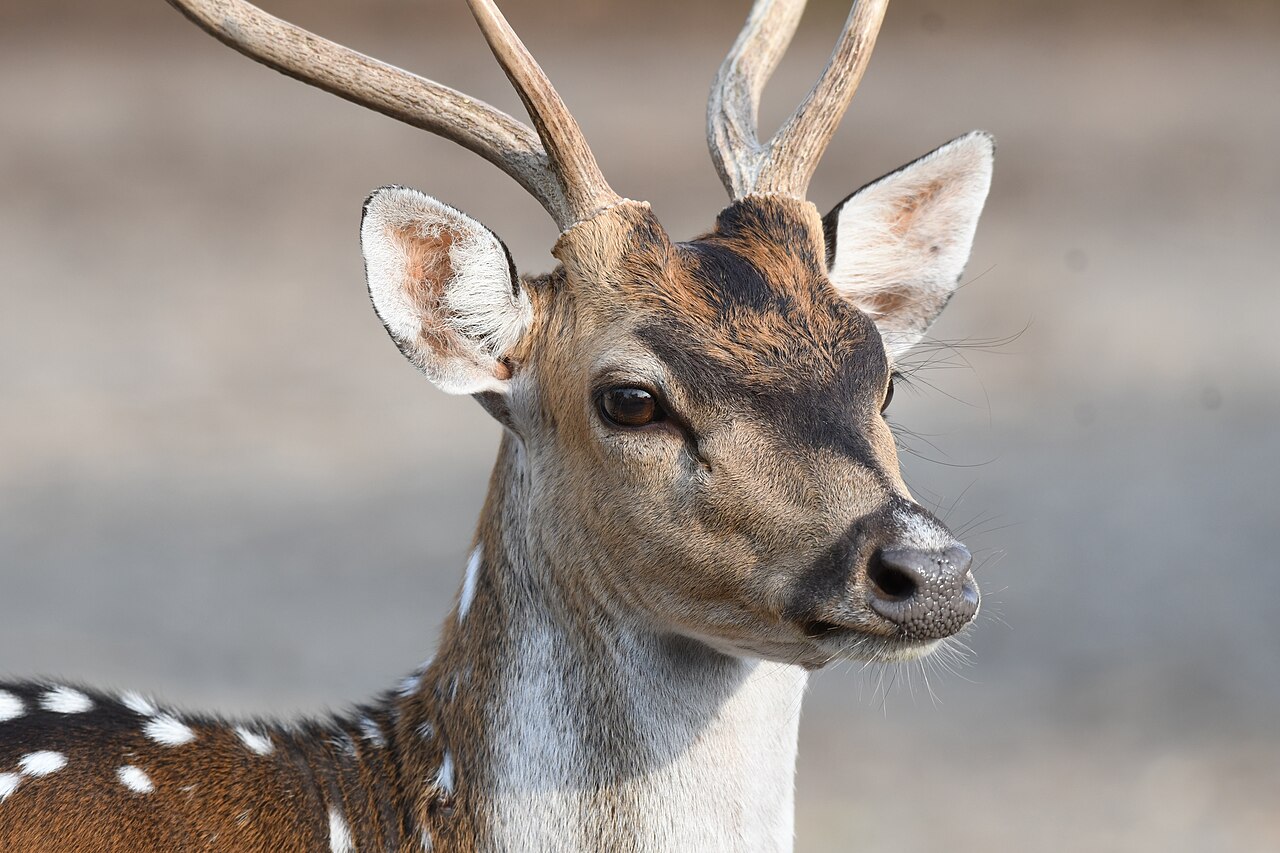
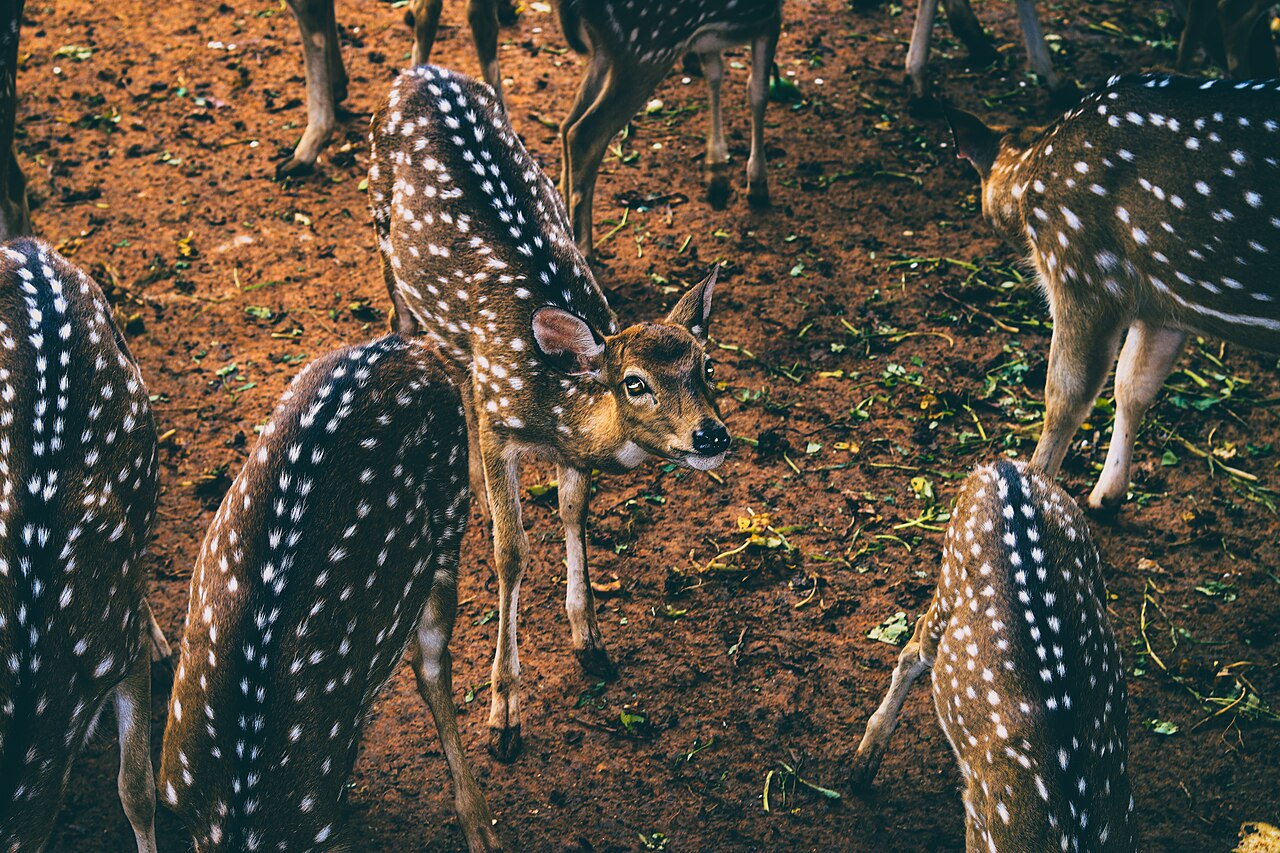
The deer of the Sundarbans that poachers target is mainly the spotted deer, or chital, known in Bengali as chitra harin (Axis axis). Banglapedia describes it as a medium-sized deer standing about 70 to 95 centimetres at the shoulder, with a rufous brown coat marked by white spots that persist throughout life. A dark stripe runs down the back from the nape to the tip of the tail; the abdomen, rump, throat and the insides of the legs, tail and ears are white, and a black band circles the muzzle. An adult weighs about 85 kilograms, and adult males carry three-tined antlers.
According to Banglapedia, the spotted deer was once found in almost all the forests of Bangladesh but is now confined to the Sundarbans. It lives along forest edges and in woodland and is seen in herds of 10 to 30 animals with two or three stags, although gatherings of several hundred are not uncommon in the Sundarbans. Its favoured food is green grass less than 10 centimetres tall. It is a prolific breeder with no definite mating season; gestation lasts about seven months, one young is born at a time, and adults reach sexual maturity in two to three years. Banglapedia also records that, because of indiscriminate hunting for meat and skin, the population declined alarmingly from the 1950s.
The Animal Diversity Web of the University of Michigan adds detail on behaviour. It describes several kinds of herds: matriarchal herds of adult females with their young, bachelor herds of less active males, and nursery herds of females with fawns under eight weeks old. Chital give a bark when alarmed or when they notice something unusual, and fawns squeal when separated from their mothers. Besides grass, they eat flowers and fruits that fall from forest trees. The same source lists the species as Least Concern on the IUCN Red List: the chital is not threatened worldwide, even though in Bangladesh it survives in the wild only in the Sundarbans.
Bangladesh has five deer species, according to Banglapedia. The sambar is the largest and the barking deer, or maya harin, the smallest. The swamp deer, or baroshinga, is no longer found in the wild in the country. Banglapedia notes that, apart from the spotted deer of the Sundarbans, the populations of the other species have fallen alarmingly because of hunting, human interference and habitat loss. In the Sundarbans, the barking deer lives alongside the chital, but the chital makes up most of the deer population, according to the Dhaka Tribune and bdnews24.com.
How many deer the forest holds
Counts published before the Mongla raid showed that the deer population of the Sundarbans had grown over two decades. In December 2023 the state news agency BSS, in a report carried by the Dhaka Tribune, said a 2023 survey of the Forest Department had found 140,357 chital in the Sundarbans, against about 83,000 in 2004. The same survey put the wild boar population at about 45,110, against 28,000 in 2004, the monkey population at about 152,444, against 51,000, and also counted 25,124 monitor lizards and 12,241 porcupines.
Other reports gave a slightly different figure for the same period. The Dhaka Tribune in January 2025 and bdnews24.com in February 2025 cited a survey by the International Union for Conservation of Nature (IUCN), conducted in December 2023, which estimated the deer population at 136,604, also against 83,000 in 2004. Forest conservators quoted by BSS credited the rise to the government's conservation measures, while the forest official in charge of the Khulna region told bdnews24.com that fewer bandits in the forest, regular patrols and the end of large gatherings had all helped.
Natural disasters also take a toll. After Cyclone Remal struck in May 2024, bdnews24.com reported on 1 June 2024 that the bodies of 127 deer and four wild boar had been recovered from the forest and that 18 injured deer had been rescued, given first aid and released. Forest Department records cited in that report showed 40 deer found dead after Cyclone Sidr in 2007, three after Cyclone Aila in 2009 and four after Cyclone Yaas in 2021.
The Sundarbans: a protected world heritage forest
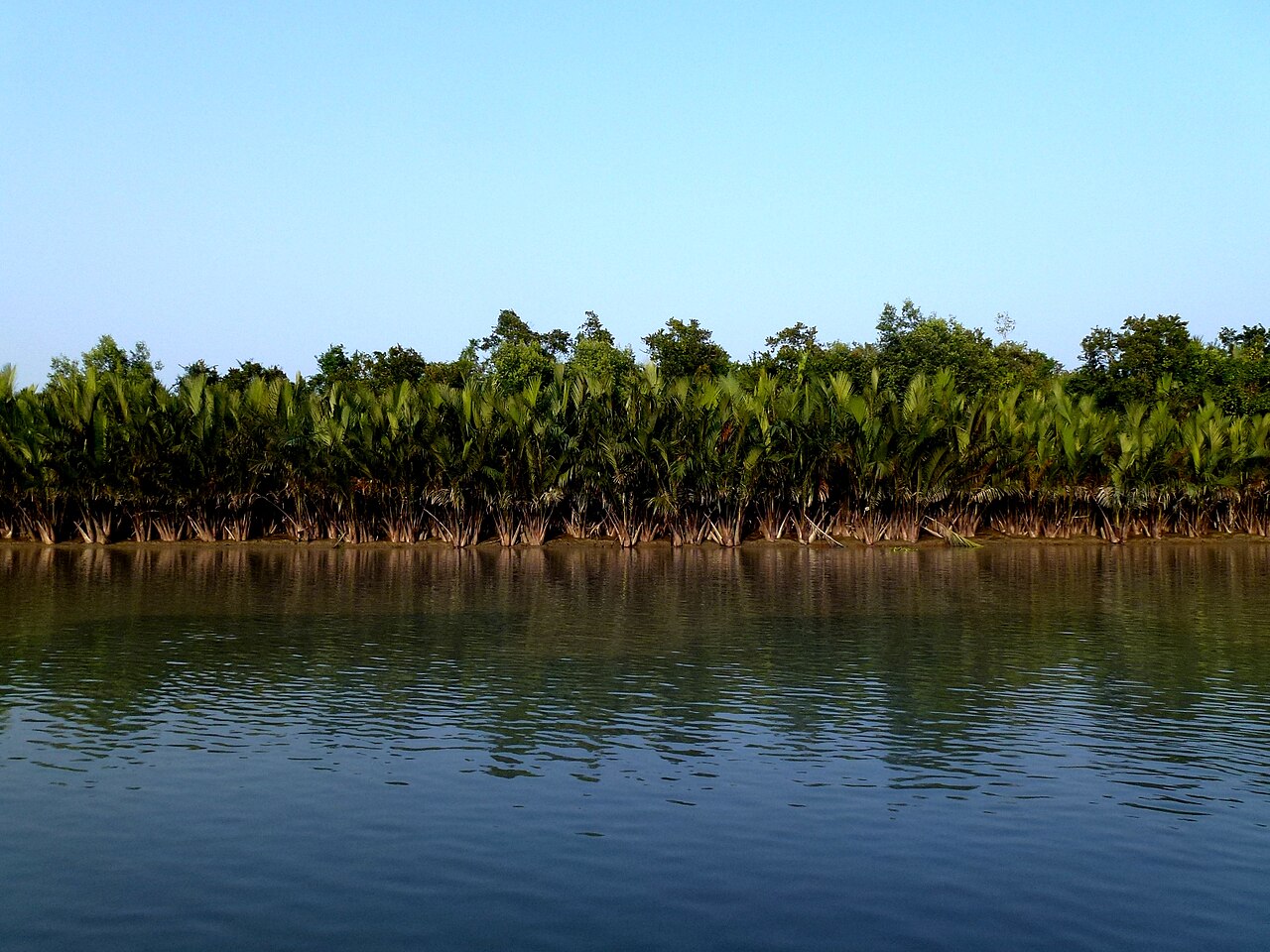
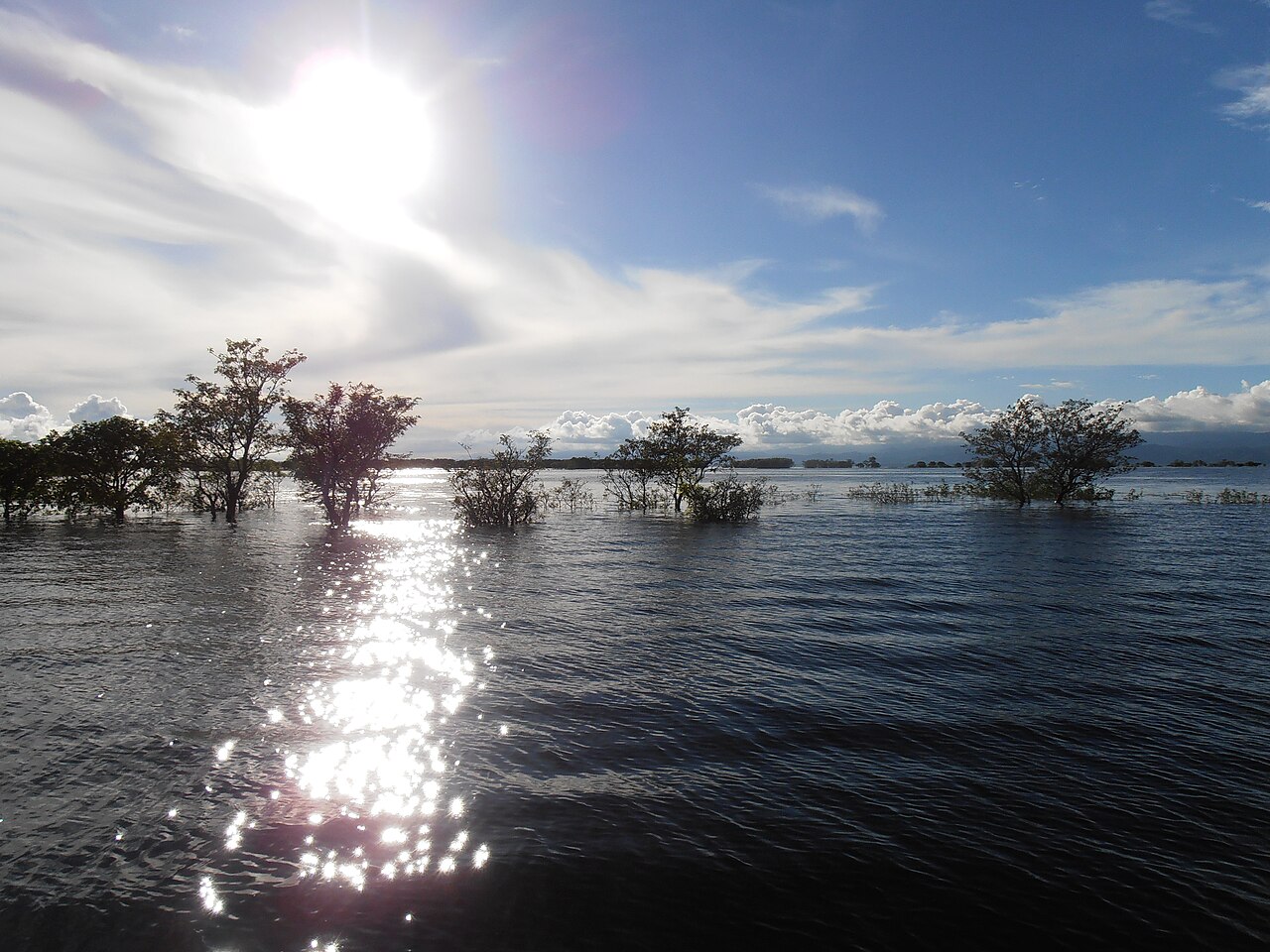
Banglapedia describes the Sundarbans as the largest single block of tidal halophytic mangrove forest in the world, lying on the Ganges-Brahmaputra delta where it meets the Bay of Bengal. About 200 years ago the forest measured about 16,700 square kilometres; after the partition of India about two-thirds of the remaining forest fell within Bangladesh, which now holds about 6,000 square kilometres, of which about 1,700 square kilometres is water. The forest contains about 200 islands separated by about 400 interconnected tidal rivers, creeks and canals.
The Sundarbans was declared a Reserve Forest in 1875. It is administered under two forest divisions and four ranges, Chandpai, Sarankhola, Khulna and Burigoalini, with 16 forest stations. Three wildlife sanctuaries, Sundarbans West, South and East, were established in 1977. UNESCO inscribed the Bangladesh Sundarbans on the World Heritage List in 1997 under natural criteria (ix) and (x); the property covers 139,500 hectares and adjoins India's Sundarbans World Heritage site, inscribed in 1987. UNESCO notes the forest's 260 bird species, the Bengal tiger and threatened species such as the estuarine crocodile and the Indian python.
BSS reported in December 2023, citing an official document, that the protected area of the Sundarbans had been increased to about 3,180 square kilometres in 2017, that five stretches of canal covering 40.52 kilometres had been declared dolphin sanctuaries, and that the government had banned tree felling in the forest until 2030. Local people may harvest only secondary resources such as fish, crabs, honey and golpata leaves, on a seasonal basis.
Banglapedia counts about 50 species of mammals, about 320 species of resident and migratory birds, about 50 species of reptiles, eight amphibians and about 400 species of fish in the forest. It calls the Sundarbans the last stronghold of the Bengal tiger and states that deer and wild boar are the tiger's main prey, and a conservationist quoted by UNB in July 2023 made the same point, saying deer are the main food of tigers and that all animals are needed to keep the forest's ecosystem in balance.
A record of deer-meat seizures before November 2025
The Mongla raid followed a long series of similar cases reported in the Bangladeshi press. In July 2023 the news agency UNB, in a report carried by the Dhaka Tribune, quoted Koyra upazila administration sources in Khulna as saying that police had seized 532 kilograms of venison in three months, that ten cases had been filed and that 50 poachers had been arrested in the first six months of that year.
Reports from early 2025 show how often deer meat was being found in the area around Mongla:
- On 3 January 2025, according to the Dhaka Tribune, a resident of Koyra was caught with 30 kilograms of deer meat.
- On 7 January 2025 the Coast Guard detained six people near the Mongla ferry ghat with 11 kilograms of deer meat found in a Dhaka-bound microbus; The Daily Star reported that the meat, the vehicle and the detained people were handed to the Chandpai Range of the Sundarbans East Forest Division.
- On 15 January 2025, the Dhaka Tribune reported, forest officials of the Kashiabad Forest Station intercepted poachers who escaped but left behind 80 kilograms of venison in three sacks; UNB reported that forest officials seized 30 kilograms of venison, two heads, seven legs and a trap from the Sundarbans on that day.
- On 19 January 2025, UNB reported, forest officials seized 25 kilograms of venison, a deer skin, a head, a trap and a boat in the Jongla area under the Chandpai Range, about two kilometres from the forest; the poachers fled.
- On 17 April 2025 the Coast Guard West Zone found 31 kilograms of venison, a deer head and four legs in an abandoned sack at the Joymonirghol silo jetty area in Mongla upazila, The Daily Star reported; the items went to the Chandpai Range Forest Office.
In early November 2025, weeks before the Kanainagar raid, the Dhaka Tribune reported that an assistant conservator of forests had been injured in an attack by deer poachers at Dimer Char in the Dublar Char area during the Ras festival, that the Forest Department had arrested three people, seized the boat used and recovered 18 deer traps from the forest.
The press also reported the prices behind this trade. The Dhaka Tribune in January 2025 and bdnews24.com in February 2025 said deer meat sold for Tk 500 to Tk 600 a kilogram in villages near the forest and Tk 1,000 to Tk 2,000 in district towns, and that it was in demand because it was cheaper than beef or mutton. bdnews24.com quoted residents naming villages of Mongla, among them Chila and Joymoni, as places where deer hunters were active.
Views differed on how serious the problem was. The executive director of the Sundarbans Academy in Khulna told bdnews24.com that the number of deer poached was several times greater than the meat and hides seized, and that mostly the carriers of meat, not the main culprits, were caught. The chief conservator of forests in Khulna told the same outlet that poaching was less widespread than in earlier years, that deer move more in the dry season as water sources shrink, and that limited manpower made a vast forest hard to police.
Patrols, rewards and the Coast Guard's role
The Forest Department has used SMART (Spatial Monitoring and Reporting Tool) patrolling in the Sundarbans since 2015, according to the BSS report of December 2023. Forest Department data in that report showed that 2,498 people were arrested and 1,169 boats and other vessels seized through SMART patrolling between January 2018 and June 2023.
To draw in local information, the government offered rewards of Tk 20,000 for information on crimes inside the forest and Tk 10,000 for crimes outside it, as reported by the Dhaka Tribune and bdnews24.com in early 2025. In July 2023 a divisional forest officer of the Sundarbans West division told UNB that patrols by RAB, the Coast Guard, BGB and forest officials had reduced deer poaching, while resources remained poor.
The Bangladesh Coast Guard, which led the Kanainagar raid with the police, was formed under the Coast Guard Act of 1994 and began work as a paramilitary force on 14 February 1995, according to the force's own website. It describes its duties as including the security of ships at the Chittagong and Mongla seaports and of tourists, honey collectors (mouals), shrimp farmers, boatmen and others in the Sundarbans, as well as the prevention of smuggling by sea and river.

What the 2012 Wildlife Act says
Because the raid took place in November 2025, the law in force was the Wildlife (Conservation and Security) Act, 2012, which repealed the Bangladesh Wild Life (Preservation) Order of 1973. Its main provisions on hunting and on wildlife meat are these:
- Section 6 says no person shall hunt any wild animal without a licence or permit under the Act.
- Section 12 bars the transfer of any wild animal, meat, trophy or part of a wild animal by gift or sale without a registration certificate; the Act's definition of a trophy includes the antlers and bones of deer.
- Section 32 lets an authorised officer seize wild animals, meat and body parts held without a licence, along with the weapons, articles and tools used in an offence; seized goods are liable to confiscation, and perishable items may be disposed of under the rules.
- Section 34 makes it an offence to buy or sell any wild animal, its parts or its meat without a licence or permit, punishable with up to one year in prison, a fine of up to Tk 50,000, or both; a repeat offence carries up to three years, a fine of up to Tk 2 lakh, or both.
- Section 39 sets the penalty for breaking section 6 or section 12 at up to one year in prison, a fine of up to Tk 50,000, or both, rising to up to two years or Tk 1 lakh for a repeat offence.
- Section 41 gives anyone who abets or instigates an offence the same penalty as for the offence itself.
Under section 43, only offences under section 36 (the killing of a tiger or an elephant) are cognisable and non-bailable; other offences under the Act are non-cognisable, bailable and compoundable subject to compensation. Under section 44, a court takes cognisance of an offence under the Act on the written complaint of an authorised officer or an affected person. This summary is taken from the English text of the Act; under section 53 the Bengali text prevails in case of conflict. The original report did not say under which sections any case against the detained man would be filed.
Photo: Ashis Kumar Datta / Wikimedia Commons (CC BY-SA 4.0)
Sources: Jagonews24, Banglapedia (Asiatic Society of Bangladesh), UNESCO World Heritage Centre, Animal Diversity Web (University of Michigan), BSS via Dhaka Tribune, Dhaka Tribune, UNB, The Daily Star, bdnews24.com, The Financial Express, Bangladesh Coast Guard, Wildlife (Conservation and Security) Act 2012
Comments
(0)