
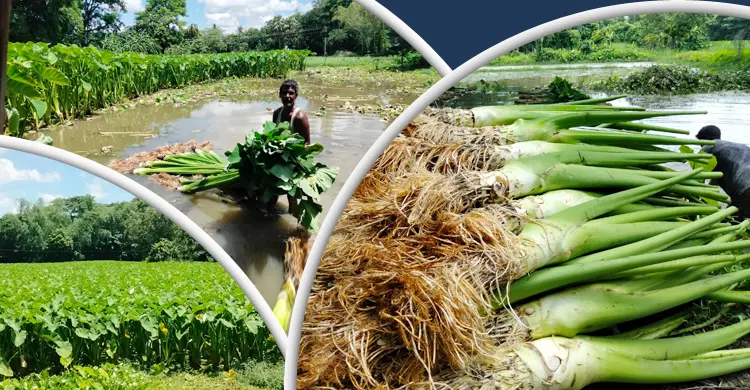
Md Harun Or Rashid, a farmer in Mirsarai municipality, has been growing taro (kochu) for about 22 years. Because his farmland is low-lying and other vegetables do not grow well there, he has stuck with taro for a long time.
This year he again grew taro on 100 decimals of his own land, and bought the standing crop on a further 70 decimals from someone else. He has already sold the taro from 120 decimals, for Tk 2,20,000, and will be able to keep selling for another month.
Harun is not alone. Many farmers in Mirsarai upazila of Chattogram grow taro and have become quite self-reliant from it. Taro has been cultivated on 150 acres in the upazila this year.
Growers in Kochua
In the Kochua area of No 11 Moghadia union in Mirsarai, farmer Nur Hossain said: "This time I grew taro on 60 decimals. I have already sold Tk 1,32,000 worth and can sell for another 15 days." He said taro farming is hard work but profitable, and the flower (locally called ponpa) and stolons (loti) can also be sold.
"Every few days we lift taro from the field and take it by pickup to Sitakunda, Baraiyarhat, Mithachhara, Abutorab and other markets to sell at wholesale. From there wholesalers take it to Dhaka, Chattogram, Feni and other cities," he said.
Another grower, Abul Hossain, said their village grows the most taro in Mirsarai upazila. "Taro has been grown here since our fathers' and grandfathers' time, and we are still growing it." Asked whether Kochua village got its name from taro farming, he said it might have, but he could not say for sure.
Work for labourers
Several farm labourers are earning well from lifting taro, and since not everyone can do the work, they are in demand among farmers. One of them, Md Faruk, said he had grown taro on 25 decimals and sold Tk 22,000 worth of flowers and stolons.
"Then I sold the field to someone else for Tk 65,000. My cost was Tk 40,000. Now I work on other people's land. I get Tk 700 for lifting 150 taro plants and making them ready for sale. If I start at 6am, I finish by 11am. Our family is getting by well on this work," he said.
Kazi Nurul Alam, sub-assistant agriculture officer in Mirsarai upazila, said taro had been grown on 150 acres in the upazila this year. Although it is grown in various unions, the largest areas are in Mirsarai municipality and Moghadia union, and farmers there have done well with the crop.
Source: Jagonews24. First published in Bengali on The Agro News.
Comments
(0)