
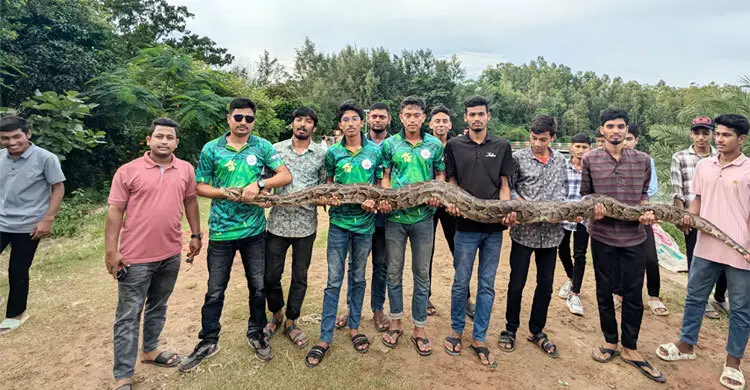
Shrinking habitat and a shortage of food are driving pythons and many other reptile species to travel long distances from the hills into villages in Mirsarai, Chattogram, where they get trapped. More than 15 pythons have entered villages and been trapped in various unions of the upazila in the past year. Most were caught in nets protecting crop fields on farmland near the hill areas. This year three pythons have been trapped in Karerhat union alone.
Most recently, on 16 October, members of the Wildlife and Snake Rescue Team rescued a 12-foot python caught in a net in the yard of a house in the Thakurdighi area of Durgapur union. The python was released unharmed in the forest at Mohamaya, the country's second-largest lake. Earlier, on 9 September, officials of the Karerhat range rescued another 13-foot python from the Chhattarua area of Karerhat union and released it in the forest.
Inquiries found that more than five hundred snakes have entered villages in the past year and a half. Forest department and rescue team members have rescued 165 snakes from villages and released them in the forest. Zoologists say that because of climate change, the areas where reptiles roam are increasingly short of water as well as food. In the hill areas of the Chattogram Hill Tracts in particular, streams and waterfalls stay dry for most of the year. Animals entering villages in search of food are losing their lives.
Snakes rescued
According to the Mirsarai unit of the Wildlife and Snake Rescue Team in Bangladesh (WSRTBD), more than 150 snakes have been rescued alive in Mirsarai in the past year, 15 of them pythons. Venomous snakes among them include the monocled cobra, greater black krait, banded krait and green pit viper. Non-venomous species include the python, rat snake, dudhraj, ghorgini, green vine snake, checkered keelback and bet anchra. Most snakes were rescued in three unions: Karerhat, Zorarganj and Durgapur.
According to Mirsarai upazila health complex, nearly 400 people in the upazila's 16 unions and two municipalities have been bitten by snakes in the first 10 months of this year. The most recent death was Simanta Nath, a class seven student from Zorarganj union.
Mirsarai forest department range officer Shahanshah Noshad said pythons and other snakes, short of food, come at different times to farmland near the hills and to the yards of people's homes, and get trapped. "In the past year 15 pythons have entered villages in Mirsarai. All of them were released in the hill forest with the help of the snake rescue team," he said.
Rescuers' appeal
Md Naimul Islam Niloy, a senior rescuer and the Chattogram district representative of the Wildlife and Snake Rescue Team in Bangladesh, said: "We do the snake rescue work as volunteers at our own expense to protect biodiversity. We get no help from the forest department or the government for this. If we got support, the work would go faster."
Upazila livestock officer Dr Zakirul Farid said the rescued pythons and other snakes had no wounds or major injuries. "Usually, if an animal is injured, it is kept under observation and treated. As there were no injuries, no treatment was needed," he said.
On pythons coming into villages, he said any wild animal comes out into human settlements when its habitat is under threat and food is short. "In the case of pythons, too, shrinking habitat is causing a food shortage. So they travel long distances to populated areas in search of food. In the process they often enter villages and cannot get out," he said.
Source: Jagonews24. First published in Bengali on The Agro News.

Comments
(0)