
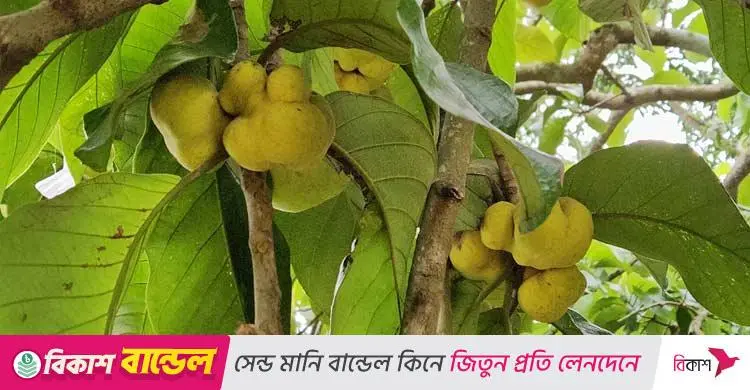
The dewa, a fruit once familiar across rural Bengal, is dwindling day by day in Mirsarai, Chattogram. Its trees were once seen in many parts of the upazila's 16 unions and two municipalities, but they are now rarely seen, and the fruit no longer appears in local markets as before. Familiar and loved by older people, it is almost unknown to the young.
A few dewa trees can be seen on one side of the field of Aburhat Monirul Islam Madrasa in the upazila, with fruit hanging among the green leaves. Broken open, the inside of a dewa looks like small jackfruit segments, but it is not jackfruit: it is the sweet-and-sour dewa.
The dewa is a fruit of traditional Bengal, rich in nutrients and valued for its medicinal properties, yet out of ignorance it is disappearing from our diet.
Nutrition and medicinal value
Experts say there are many native fruits rich in nutritional and medicinal qualities that we know little about. The leaves, fruit, bark and roots of the dewa tree have medicinal properties. It aids digestion, relieves constipation and is useful in skin and hair care.
Its antioxidants help boost immunity, and the fruit helps reduce anaemia. Eating raw dewa ground and mixed with hot water clears the stomach. It helps cure various liver ailments, and it removes wrinkles and keeps skin fresh.
Locals call for planting
Sukumar Chandra Nath of Middle Wahedpur village in Wahedpur union said: "Dewa is an excellent fruit. Almost every house in the area used to have a dewa tree; now they don't. It is largely unknown to the new generation."
Maulana Shahidul Islam, muhtamim (principal) of Aburhat Monirul Islam Madrasa, said: "As a child I saw so many dewa trees. Today's generation doesn't know this fruit. There are a few trees beside the madrasa field. They fruit in the rainy season, and the madrasa's students and teachers eat them."
Schoolteacher Nurul Huda said: "Dewa trees need to be planted more as medicinal trees. It is a traditional fruit of rural Bengal, and it is disappearing because of indiscriminate tree felling."
Mirsarai Upazila Agriculture Officer Pratap Chandra Roy said: "It is true that dewa trees are not seen in rural areas as before. We should plant more saplings of this fruit tree. Dewa can be planted in any type of soil. If one dewa tree is planted in each mixed orchard, cultivation will increase."
He said: "Dewa fruit contains zinc, copper, iron, manganese, vitamin C and beta-carotene. It also has anti-viral, anti-inflammatory and anti-bacterial properties. Not only the fruit, but dewa seeds are also good for health."
Source: Jagonews24. First published in Bengali on The Agro News.
Comments
(0)