
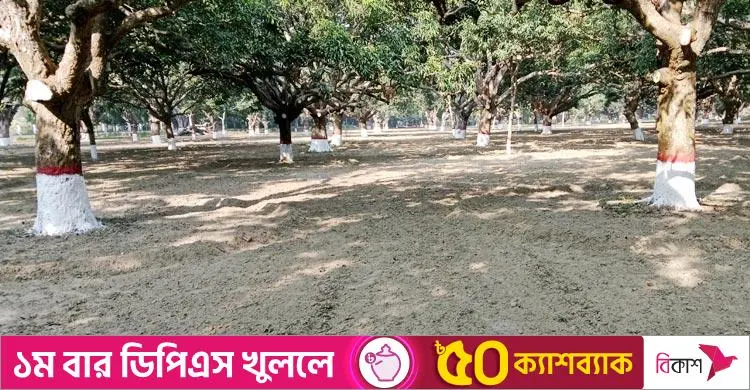
The Mujibnagar mango orchard in Meherpur seems to have come back to life. This vast orchard, of historical and environmental importance, was on the way to vanishing for lack of care. Under the care of the Horticulture Centre, parasitic plants have been removed from the trees and nutrition provided, and the orchard, a draw for tourists, is looking beautiful again.
For a long time, various media outlets reported on the orchard's run-down state, while people from all walks of life in the district demanded government action to save it. As part of this, an initiative was taken to rejuvenate the mango trees under the Department of Agricultural Extension's "Nutrition Improvement through Year-round Fruit Production Project". Under the supervision of the Meherpur Horticulture Centre, parasitic plants were removed and diseased branches pruned over about a year.
Soil, roots and new saplings
Because the orchard had not been cultivated for a long time, the soil and roots had been badly damaged. Irrigation, fertiliser, pesticide and various organic materials were applied step by step, and other secondary nutrients supplied according to the trees' needs. Diseased trees received extra care, and new saplings were planted in the gaps, surrounded by iron fencing to let them grow. New shoots are emerging from the branches, and the orchard has been transformed, green wherever one looks.
Every tree has been tagged to keep count. After the work, the total number of trees, old and new, is 1,200, of which 1,040 were old trees.
In British times, the orchard was the mango-pickle garden of the wife of zamindar Kedarnath Chowdhury. Over time it became the ground where the oath of the birth of the Bangladesh state was taken. Although the orchard earned a proud place in history, nothing was done to protect it. The district administration leased out the fruit every year and collected revenue but did little to care for the orchard. The century-old trees were dying one by one, their branches full of parasitic plants. Branches broken in storms dried out and left wounds on the trees, and many trees died without the irrigation and fertiliser they needed. Kedarnath Babu's mango orchard, a living witness to history, was steadily thinning out.
Residents and visitors pleased
Afzal Hossain, a Mujibnagar resident, said the upazila administration leases out the orchard's fruit every year. The government earns revenue, but the lessees damaged the orchard in various ways. "The Horticulture Centre has brought the dead orchard back to life. The rows of mango trees are fresh and green. This is how we want to see the trees," he said.
Al Helal, a tourist from Dhaka, said: "We are delighted with the orchard as it is now. I came here once five years ago and was disappointed to see its run-down state. The necessary measures to protect the orchard should continue."
Dr Mehedi Masud, director of the nutrition improvement project, said the loss of trees has had an adverse effect on the climate, and orchards like this one must be preserved to keep the environment favourable. Just as the trees have been rejuvenated through care, the local environment has benefited. The well-known agriculturist said he hopes those concerned will keep up this effort to protect the orchard.
Habibul Islam Khan, deputy director of the Meherpur Horticulture Centre, said anyone would be heartened to see the orchard's present state, the result of the tireless efforts of the centre's staff. "Preserving the orchard is everyone's responsibility. We hope everyone will keep a caring eye on it from their own position," he said.
Source: Jagonews24. First published in Bengali on The Agro News.
Comments
(0)