
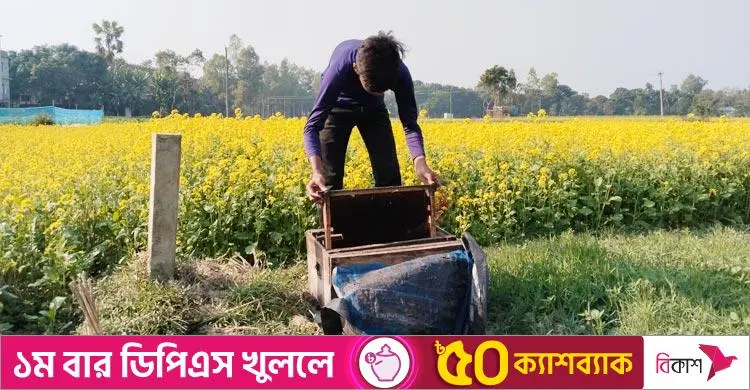
The fields of Manikganj are now a sea of yellow mustard flowers. Swarms of bees move from flower to flower collecting nectar and storing it in hives placed nearby. This helps pollinate the mustard, so mustard production rises along with honey production, and both farmers and beekeepers are profiting from integrated mustard and honey farming.
Honey collectors are earning well from the mustard flowers, and mustard output is rising too. Every three to four days the bees are driven out of the boxes with smoke. Each box holds seven to eight frames of comb, which are placed in a steel drum and spun in a rotating machine to extract the honey. The honey is then filled into plastic drums and marketed.
12,000 hives across seven upazilas
According to the district Department of Agricultural Extension (DAE), mustard is grown in all seven upazilas of Manikganj. This year mustard has been sown on 63,002 hectares in the district. Across the seven upazilas, 120 beekeepers have placed about 12,000 bee boxes this year, with a target of collecting 1,80,000 kg of honey. Honey is selling at Tk 250-300 a kg.
Beekeeper and honey collector Selim Reza came to Dighi village in Manikganj Sadar upazila from Kaliganj in Satkhira a month and a half ago. He has placed 100 bee boxes beside a mustard field and has already collected and sold honey at a good price.
"I have been keeping bees and collecting honey in Manikganj since 2008. Last year I collected about 60 maunds of honey in four months and sold it at Tk 300 a kg to the companies Dabur, AP and ACI. Each box gives one and a half to two kg of honey a week, and the taste and quality are very good," he said.
Moslem Uddin, who came to buy honey, said: "Every year I buy 7-8 kg of honey straight from the field like this. Depending on the time and type, they charge Tk 300-400 a kg. This honey is good quality. I keep it at home all year, eat it myself and give it to relatives."
Dr Rabiah Nur Ahmed, deputy director of the district DAE, told Jagonews: "Beekeeping raises crop production by 25-30 per cent through pollination, and a large amount of honey is produced as well. We are working to link beekeepers with wholesalers and companies so they can market the honey easily and get a fair price."
Source: Jagonews24. First published in Bengali on The Agro News.

Comments
(0)