
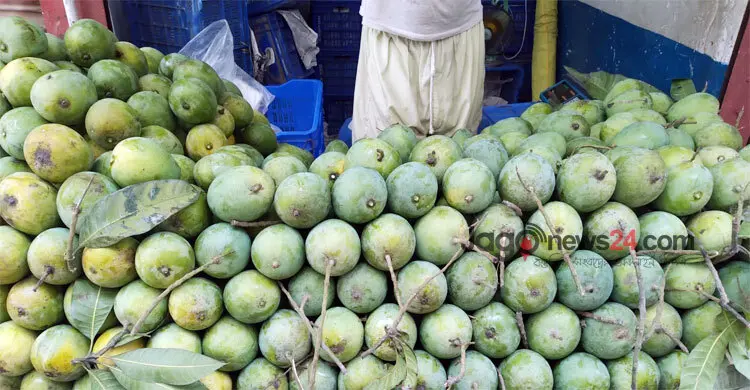
The mango market is somewhat abnormal this peak season, with prices double last year's. No variety, whether Himsagar, Langra, Amrapali or Fazli, can be found for less than Tk 120 a kg, and good-quality fruit costs even more at retail. Packaging and air freight costs have also risen this year. High domestic prices have cut exporters' profits, putting the export target in doubt.
The rise in mango prices is also reflected in data from the government's Department of Agricultural Marketing (DAM). It says a kg of Himsagar cost Tk 41 wholesale in June last year, against Tk 79.32 this year. Langra has risen from Tk 39 to Tk 80.86 a kg, and Amrapali, Tk 43 a kg last year, is selling wholesale at up to Tk 72.58.
The same picture was seen on Monday (24 June) in markets and neighbourhoods across Dhaka. Retail prices of Himsagar ranged from Tk 140 to 180 a kg depending on quality, Langra Tk 100 to 140, Amrapali Tk 120 to 140 and Fazli Tk 120 to 140 a kg.
Dhaka wholesalers say prices are double last year's, and have jumped further at the various trading hubs since Eid. Instead of falling in the peak season, prices at the hubs rose by nearly Tk 1,000 per maund before and after Eid.
Why output fell
Besides wholesalers, mango growers, government officials, market watchers and researchers say prices are high mainly because production is lower this year. A long winter delayed flowering, then an intense heatwave began in April, causing blossoms and young fruit to drop in various areas. Finally, because there were no hailstorms or storms this year, whatever mangoes there were survived. Overall, the yield is much lower than last season.
The Department of Agricultural Extension (DAE) says yield is 15 to 20 per cent lower than last year, but orchard owners say it has fallen by more than a third.
Late flowering and lack of rain have also pushed up production costs considerably. Many orchards in Naogaon, the largest mango-producing area, had no mangoes this year. Sirajul Islam, a grower in Sapahar in that area, told Jago News: "Production in my four orchards is half of last year's. Many trees did not fruit. Fruit came at first, then dropped."
"Because of the intense heatwave, irrigation cost Tk 2,000 to 2,500 more per bigha than last time. Fertiliser and other farm inputs have become more expensive. And because of overall inflation, labour cannot be found cheaply. Mango prices have risen because of low production and high costs," he said.
Dr Md Mehedi Masud, project director of the Year-round Fruit Production for Nutrition Improvement Project, told Jago News: "The problem this year is lower mango production. The first reason is that this is an off-year for mangoes. Naturally, when mangoes are plentiful one year, there are fewer the next; that year is called the off-year."
"Second, the adverse weather. A lot of mangoes dropped in the intense heatwave. Then there was no rain, so the remaining mangoes did not grow large. The mangoes are smaller this year too. Yield has fallen by up to about 20 per cent. This year even ordinary trees at homes and along roads (non-permanent orchards) bore very few mangoes, because it was bitterly cold when flowering was due. So they put out shoots and leaves, not blossoms," he said.
Conflicting production figures
The Bangladesh Bureau of Statistics (BBS) says 14.82 lakh tonnes of mangoes were produced from 1,23,998 hectares in 2022-23, an average yield of about 12 tonnes per hectare. The DAE, however, claims that 24.5 lakh tonnes were produced on 2 lakh hectares last year.
The two agencies do not differ on the fact that mango production has risen steadily in recent years; both say output grows every year. By BBS figures, 1.87 lakh tonnes were produced from 50,626 hectares in 2000-01, an average yield of 3.77 tonnes per hectare. Over the past 23 years, the area under mangoes has grown 2.45 times, production nearly 12 times and average yield per hectare 3.17 times.
As production rose each year, prices gradually fell, giving low-income families the chance to eat mangoes, more so than fruits such as jackfruit, banana, litchi and guava, it is thought. According to the BBS Household Income and Expenditure Survey 2022, a person in Bangladesh ate an average of 95.4 grams of fruit a day in 2022, up from 44.7 grams in 2010.
Export target at risk
With production rising in recent years, Bangladesh has been doing well in mango exports, and exports have begun this year too. The target is 3,100 tonnes, and the Ministry of Agriculture hopes to export to 38 countries. Gopalbhog, Himsagar, Amrapali, Fazli, Surma Fazli and BARI-4 mangoes are going to countries including England, Germany, Italy and France. Last year 3,092 tonnes were exported to 38 countries.
Leaders of the Bangladesh Fruits, Vegetables and Allied Products Exporters' Association think high domestic prices may cause problems for exports. The association's adviser, Md Monjurul Islam, told Jago News: "Mango prices are high in the local market this year, and that will affect exports. Packaging and air freight have become more expensive. For these reasons exporters' profits are falling."
"Exports may be lower than last year. Shipments are not happening so far the way they were at this time last year, although the government and we are trying to export as much as possible," he said.
Mohammad Arifur Rahman, director of the DAE's Exportable Mango Production Project, told Jago News: "The bigger problem this year is air freight, more than mango prices. But there is strong demand for mangoes abroad this year, and the number of exporters has also grown. That is why I do not think exports will fall."
Source: Jagonews24. First published in Bengali on The Agro News.
Comments
(0)