
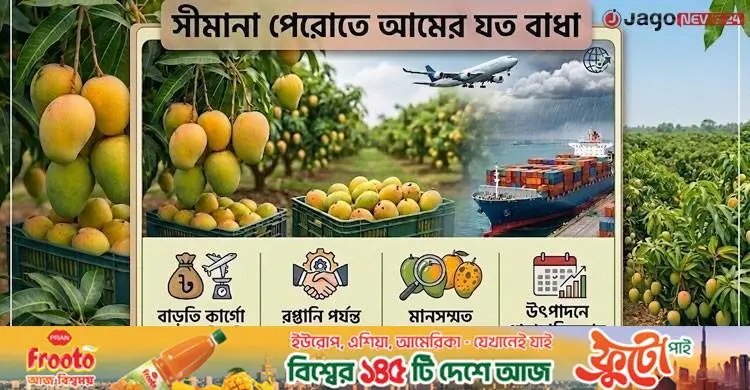
Bangladesh's mango is the honeyed fruit of the season of honey, and it is becoming more commercially important in the domestic market every day. Yet despite huge potential, mango exports are not growing as expected. The domestic market is worth more than Tk 13,000 crore, but because of administrative, financial and technical constraints, mango exports have earned less than Tk 100 crore.
Last year the country produced 2.662 million tonnes of mangoes on 207,000 hectares. The domestic mango market is estimated at Tk 13,000 crore.
By contrast, Bangladesh exported 2,194 tonnes of mangoes to 29 countries last year, earning less than Tk 100 crore in all. Exports are a tiny share of the overall market.
Seventh-largest producer, marginal exporter
India is now the world's largest mango producer, followed by Indonesia, China, Mexico, Brazil and Pakistan, with Bangladesh seventh. When the Food and Agriculture Organization (FAO) published these figures in 2024, the Bangladesh Bureau of Statistics (BBS) put mango production at 1.842 million tonnes. Adjusting for the agriculture department's current production figures, Bangladesh would probably rank in the top five.
But despite being in the top ten producers, Bangladesh does not feature on any top list of exporters. Exports have hovered at just 2,500 to 3,000 tonnes for several years, while the world mango market is worth $4.19 billion, leaving Bangladesh's share tiny.
Exporters say that with some government initiatives Bangladesh could export more than about 100,000 tonnes. In South Asia, neighbouring India and Pakistan, and in South-East Asia, Thailand export large quantities of mangoes of similar taste and quality to Bangladesh's, and several Bangladeshi varieties are tastier. But because those countries have taken steps to produce quality, safe mangoes, their exports have risen rapidly and they lead the trade.
According to the agriculture department, Bangladesh exported 2,194 tonnes of mangoes last year (2025), up from 1,321 tonnes in 2024. The record is 3,100 tonnes in 2023, compared with just 309 tonnes in 2017.
Bangladesh has so far exported mangoes to 38 countries, including the UK, Italy, France, Canada, the UAE, Qatar, Saudi Arabia, Germany and Sweden. Mangoes were exported to China for the first time last year, and this year Malaysia, Japan and Australia have shown interest in importing Bangladeshi mangoes.
Quality and coordination gaps
Exporters say Bangladeshi mangoes are unmatched in taste, aroma and nutrition and are in demand in many countries, but the export market is now very competitive. Consistent production of quality mangoes to importing countries' standards is not being maintained, and too little quality, safe mango is produced through planned contract farming following good agricultural practices, which is the first condition for export.
A lack of coordination among quarantine officials, growers, extension officers, researchers and exporters is also raising the cost of producing exportable mangoes. The country also lacks proper grading and packing facilities and accredited laboratories.
Air freight the biggest obstacle
The biggest problem is that even the exportable mangoes produced by following all the rules cannot be exported because of excessive air freight. Air freight for mango exports from Bangladesh is more than about Tk 500 a kg, so sending mangoes to another country costs around Tk 700 a kg after production, and exporters cannot send the quantities they hoped.
Kawsar Ahmed Rubel, chief executive officer (CEO) of Global Trade Link, one of the country's top mango and agricultural produce exporters, told Jagonews24 that the company had aimed to export mangoes on a large scale last year too, but air freight prevented it. "This year the situation is getting even worse. We are very frustrated," he said.
He said they began exporting to Switzerland, Germany and the UK a few days ago, but air fares broke all records at the start. Private airlines are charging Tk 505 a kg to send mangoes to the UK, and a bigger problem is that the state carrier Biman Bangladesh Airlines charges Tk 580 for the same distance. With fares this high it is impossible to recover costs, certainly not on Biman, and even private airlines' fares are up by about Tk 100 to Tk 150 on last year.
Other exporters said collecting exportable mangoes from orchards alone costs Tk 120 to Tk 130 a kg this year. Sorting, cleaning, packing, domestic transport and other costs bring the total above Tk 150 a kg, and then air freight adds more than Tk 500 a kg. One said that with higher production and export costs, Bangladeshi mangoes are more expensive in foreign markets than those of competitors India and Pakistan, a key reason the country is falling behind. Exporters said the total cost was within Tk 500 last year and Tk 300 to Tk 350 about three years ago.
Minister promises a solution
Air freight for mango exports has become a concern for the government too. At the opening ceremony for this year's mango exports a few days before Eid, Agriculture Minister Mohammad Amin Ur Rashid said exporters have to pay high air fares to send goods from Bangladesh.
"Before becoming minister I shared this sorrow too," he said. "There was nowhere to take my complaint. Go to one official and he says it is not his job, run to another. I have lost count of how many pairs of shoes I wore out chasing these officials."
He told exporters: "I know this reality. That is why I promise you that, Inshallah, this problem will be solved while I am agriculture minister." There is no way to reap the benefits of exports without cutting air fares, he said, agreeing that cargo fares in Bangladesh are higher than in any other country, and adding that he would find a solution. Biman Bangladesh has signed deals to buy several aircraft, he said; exports will grow further before they arrive, and cargo flights will then certainly be launched.
The agriculture department's exportable mango production project is also working to make air freight affordable. The project has played an effective role in solving other production problems over the past few years, and the mangoes that are exported are largely thanks to it.
Project director Arifur Rahman told Jagonews24 that the necessary steps to increase exports have been taken since the start of the project and are bearing fruit. These include identifying the main mango-growing areas and raising production, producing mangoes through contract farming with good agricultural practices, and making good progress in ensuring germ-free, hygienic working conditions.
He said production is good this year, and if exports are disrupted growers will not get fair prices. Exports were also poor in the past two years because of various complications, and a big initiative is needed this time to remove the obstacles. Stronger research and modern pack houses have increased the use of modern technology in harvesting, post-harvest handling and transport in commercial mango areas, he added.
Mangoes are now grown commercially on a large scale in 14 districts. Varieties including Gopalbhog, Himsagar, Khirsapat, Langra, Amrapali, Fazli, Haribhanga and Gourmoti are reaching the market in phases from 5 May to 15 August.
With no major natural disaster so far, production is normal and growers do not fear losses. They say that even if exports are low, they will make a profit if local prices stay good.
Source: Jagonews24. First published in Bengali on The Agro News.
Comments
(0)