
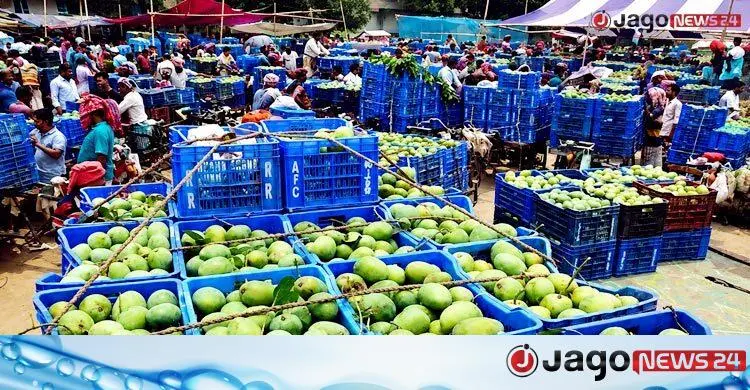
When summer comes, the north of Bangladesh takes on a different kind of busyness. Orchards smell of ripe and unripe mangoes, markets are crowded with buyers and sellers, and truckloads are being prepared for every corner of the country. The Rajshahi region is now in the middle of a mango festival, but it is not only about a fruit: it involves an economy worth thousands of crores of taka, the livelihoods of lakhs of people and a wide trading chain.
According to the Department of Agricultural Extension (DAE), the four districts of Rajshahi, Chapainawabganj, Naogaon and Natore have a target of about 1.255 million tonnes of mangoes this season. Those involved estimate that production, marketing, transport, packaging, courier, banking, the basket industry and exports together could generate about Tk 10,000 crore of economic activity in this season of a few months.
Mango was once just a seasonal fruit, but over the past two decades it has become one of the most important agro-based industries in the north. New varieties, expanding commercial orchards, modern care and online marketing mean mangoes are no longer confined to local markets and contribute significantly to the national economy.
Papia Rahman Mouri, additional deputy director (horticulture) of the DAE in Rajshahi, said local guti and Gopalbhog mangoes have already begun reaching the market, to be followed by Khirsapat, Langra, Fazli, Amrapali and Ashwina. If the weather stays favourable, the yield will be good.
Professor Dr Md Farid Uddin Khan of Rajshahi University's economics department said mango is now an important part of the north's farm economy after rice and potato, and that building mango-based industry in a planned way would create employment all year round.
Chapainawabganj and Kansat
Chapainawabganj again leads in production, with mango grown on about 37,487 hectares and a production target of about 459,000 tonnes. The district is known especially for Fazli, Khirsapat, Langra and Ashwina, and its Kansat market becomes one of the country's largest mango trading centres every season.
Mangoes worth Tk 15 to Tk 20 crore are traded at Kansat every day, and Tk 25 to Tk 30 crore across the district. Over the two to two-and-a-half-month season, total trade in the market exceeds hundreds of crores, and the district's mango business for the whole season is worth more than Tk 5,500 crore.
At Kansat, mangoes are now selling for Tk 800 to Tk 2,100 a maund depending on variety and quality. Himsagar (Khirsapat) sells for Tk 1,700 to Tk 2,100 a maund, and Lakshmanbhog and guti mangoes for 1,000 to 1,400 a maund. Growers are angry that the Kansat wholesalers count a maund as 54 kg instead of 40 kg.
Naogaon, Rajshahi and Natore
Mango has been grown on about 30,000 hectares in Naogaon, and the agriculture department expects about 387,000 tonnes this year. Amrapali covers 76 per cent of the orchard area, Ashwina 7 per cent, BARI Aam-4 6 per cent, Fazli 3 per cent, Langra 3 per cent, Khirsapat 2 per cent, Gourmoti 1 per cent, Katimon 1 per cent and other varieties 1 per cent. With a target of 12.5 tonnes a hectare, about 368,435 tonnes could be produced.
Local traders say Naogaon alone could see trade of about Tk 3,000 crore. Last year about 100 tonnes of mangoes were exported to the Middle East and Europe, and the target is to double that this year. Farmers are being trained to grow exportable mangoes, and steps have been taken to cut chemical use to maintain international standards.
This year mangoes are to be exported to eight countries: the UK, Italy, Sweden, Germany, Kuwait, Saudi Arabia, the UAE and Oman, where there is demand for 100 tonnes. Last year 15 tonnes were exported. In previous years the district exported an average of 200 to 250 tonnes a season: about 200 tonnes in 2022-23, 225 tonnes in 2023-24 and 227 tonnes in 2024-25. This year 250 tonnes could be exported, it was said.
In Rajshahi, mango has been grown on about 19,062 hectares this year, with a production target of about 244,000 tonnes. Bagha upazila is the district's largest mango area, and cultivation is also expanding fast in Charghat, Godagari, Puthia, Bagmara and Durgapur. At the Baneshwar and Bagha markets, mangoes are bought and sold from morning until late at night, with traders from various districts staying there.
Abdur Rahim Sagar of Godagari has grown mangoes on 50 acres and hopes to sell Tk 1 crore worth this year. "The yield is good," he said. "If market prices are favourable, I hope to make a profit this time."
Another grower, Abdur Razzak, told Jagonews24: "The yield is relatively good this season because the weather was favourable. With production costs up, I hoped for good prices, but there are no prices in the market."
In Natore, mango has been grown on about 5,693 hectares this season, with a target of about 68,000 tonnes. Commercial mango growing is expanding fast in Lalpur, Bagatipara and nearby areas, and those involved estimate trade of about Tk 400 crore in Natore this year.
Jobs for about three lakh people
A vast seasonal economy grows up around the mango season in Rajshahi and Chapainawabganj. Traders say orchard workers, basket makers, truck drivers, transport workers, courier staff, commission agents and packaging workers together make up about three lakh jobs.
Workers picking, sorting and packing mangoes earn Tk 1,000 to Tk 1,500 a day, and thousands more in the basket and packaging industry, transport and courier services earn extra income in the season. Mango is not just a fruit but one of the main drivers of the region's rural economy.
Nirjar Rahman, an orchard worker in Godagari upazila, told Jagonews24: "We have plenty of work in the mango season. We don't get regular work all year, but in mango time we earn well picking, sorting and packing in the orchards. Much of our family's spending depends on this season's income."
Growers say middlemen take the profit
Although mangoes generate thousands of crores of taka in the north every year, farmers often do not get the real benefit. They complain that the dominance of middlemen and commission agents deprives them of fair prices.
Growers say producing a maund of mangoes costs Tk 600 to Tk 800 on average. Orchards need spraying five or six times a year against pests and diseases, costing Tk 25,000 to Tk 30,000 a bigha, and fertiliser, irrigation and labour add more. A bigha yields 40 to 50 maunds on average, but when supply rises in the season prices fall, and many do not get the profit they expected. Counting 54 kg as a maund also forces farmers to hand over extra weight.
Godagari grower Nazrul Bhuiyan said a bigha of mango costs Tk 25,000-30,000 and yields 40-50 maunds a bigha. Because 54 kg is counted as a maund, farmers have to give an extra 14 kg, which sometimes leads to losses, and prices are often poor because of a market syndicate, he said.
Mangoes pass through several layers of traders from orchard to consumer. Usually a faria or collector buys from the farmer, and the fruit is then sold through commission agents, wholesalers and retailers. This long chain creates a wide gap between orchard and retail prices, and consumers often pay double or more what the farmer received.
Farmers say they have no say in setting prices when supply rises early in the season. Because mangoes rot if not sold quickly, they are forced to sell cheaply, while middlemen and agents profit from market conditions, storage and buyer networks. Various studies have found that retailers and middlemen earn higher profit margins than farmers in the mango value chain.
Traders in Chapainawabganj and Rajshahi say that even when orchard prices are low, transport costs, commissions, market charges and several changes of hands raise retail prices considerably in Dhaka and other big cities. The farmer bears the whole production risk, but a large share of the final price goes to intermediaries.
Export barriers
Agricultural experts say that although international demand for Bangladeshi mangoes is growing, exports are still low compared with the potential. Raising them requires international standards at every stage, from production to harvesting, storage, packaging and transport.
Rajshahi's mangoes are now exported to the UK, Germany, Italy, Saudi Arabia, Qatar, Bahrain, the United States and China, among others, but volumes remain very limited despite huge production. Those involved say the main barriers are a lack of international-standard cold chain facilities, few Global GAP certificates, poor packaging and grading, high transport costs and difficulty meeting phytosanitary conditions. Removing these would let Rajshahi and Chapainawabganj mangoes take a bigger place in the world market.
Professor Dr Md Faridul Islam said that building international-standard storage and marketing would give growers fair prices and raise export earnings significantly.
Agriculturists say the weather has been favourable so far, but hail, nor'westers or excessive rain in the rest of the season could cause major damage. Dr Shafiqul Islam, chief scientific officer at the Rajshahi Fruit Research Station, told Jagonews24: "Heatwaves, nor'westers and sudden heavy rain are the biggest risks in the mango season. Storms and rain at the marble-size and mature stages can make fruit drop. But if the weather stays favourable, production is likely to be good this year."
Mango is now not just a seasonal fruit but one of the north's largest agro-based economic sectors, keeping farmers, workers, traders, transport and many services going for a few months. Those involved say planned production, modern storage, better market management and export expansion could give it an even bigger role in the region's development, and if there is no natural disaster they hope for new records in production and trade this season.
Professor of economics Farid Uddin Khan said: "The mango-based economy is now an important driving force of the north's farm sector. With proper planning, modern storage and effective market management, it can play an even bigger role in raising farmers' incomes and regional economic growth."
Source: Jagonews24. First published in Bengali on The Agro News.


Comments
(0)