
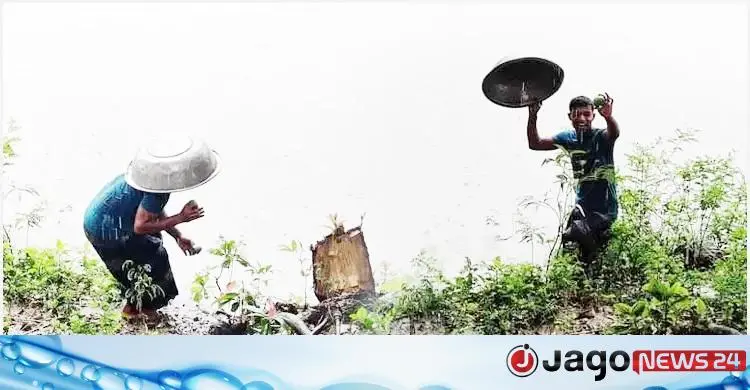
For Bengalis, the scorching heat of summer brings the end of a curious wait, and at the centre of that wait is the juicy mango. In Bengali literature the mango is not just a fruit; it is an inseparable part of Bengali childhood, nostalgia and rural nature. Turning the pages of literature, every stage from mango blossom to ripe fruit has been vividly portrayed by writers.
Childhood rhymes and verse
A Bengali childhood begins with the rhyme "Aam pata jora jora" (mango leaves in pairs). In the poetry of Pallikabi Jasimuddin we find the familiar face of the Kalbaishakhi storms: his line "Jhorer dine mamar deshe aam kurate shukh" (the joy of gathering mangoes at an uncle's village on a stormy day) has remained a sweet childhood memory for generation after generation. In Sukumar Ray's "Aam pake Boishakhe, kul pake Phagune" (mangoes ripen in Boishakh, jujubes in Phagun), the mango appears as a symbol of the pure joy of rural life. Compared with today's generation, confined within four walls, the joy of gathering mangoes in childhood now sounds almost like a fairy tale.
In Rabindranath Tagore's writing, the fragrance of mango blossom comes up again and again in descriptions of nature. Our national anthem too contains the line "Phagune tor amer bone ghrane pagol kore" (in Phagun the scent of your mango groves drives me wild). The striking botanical change as trees come into blossom at the end of winter has found its place in literature as the herald of spring, and the sweet smell of the blossom seems to banish nature's harshness in an instant.
Pather Panchali and mystery tales
In Bibhutibhushan Bandyopadhyay's novel "Pather Panchali", the mango is ever-present in the childhood of Apu and Durga. The picture of young mangoes falling in the Kalbaishakhi storm, and of the brother and sister secretly stealing green mangoes to eat mixed with spices, is a living record of traditional rural Bengal. The sour taste of green mango seems another form of their mischief.
In Bengali children's stories and thrillers, the mango orchard makes a fine backdrop. The eerie atmosphere of walking through a vast orchard at night always thrills readers. In the adventures of teenage detectives, they are often seen unravelling some mystery hidden in the mango orchard behind an old zamindar's house. The shady, secluded mango orchard is thus an ideal canvas for mystery and thriller stories.
Writers have also often used the mango tree and its fruiting cycle as a metaphor for human life. The whole process of blossoming, setting fruit and finally turning into a full, juicy mango has been beautifully matched with human growth and maturity.
This many-sided presence of the mango in Bengali literature shows that it does not only satisfy our palate; it also enriches our minds, memories and imagination.
Source: Jagonews24. First published in Bengali on The Agro News.
Comments
(0)