
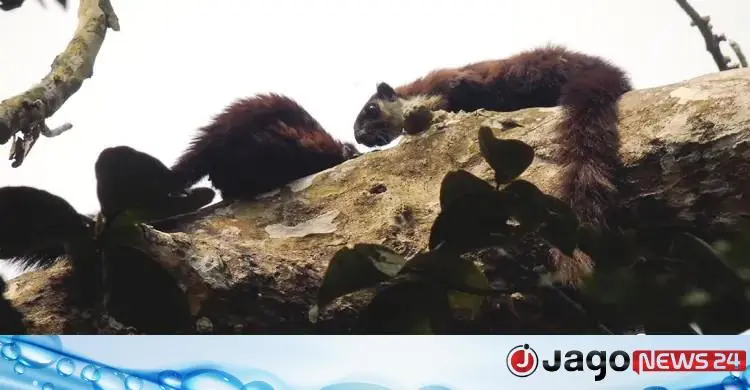
Most of us learnt about squirrels as children, and we were amazed to watch one dash across the yard and vanish behind a tree. The squirrel is small but restless and clever, and almost impossible to catch: it seems within reach, then is gone in the blink of an eye, leaping from tree to tree.
Squirrels are among the many small and medium-sized mammal species of the family Sciuridae in the order Rodentia. The name mainly refers to the genera Sciurus and Tamiasciurus, bushy-tailed tree squirrels found in Asia, the Americas and Europe.
Flying squirrels, chipmunks, prairie dogs and woodchucks also belong to the Sciuridae family. Squirrels are found everywhere except Australia and Antarctica. Some tropical squirrels have black-and-white stripes. Their front legs are short and hind legs long, which lets them jump easily, and in flying squirrels a furry membrane joins the front and hind legs.
Vanishing from Bangladesh's villages
Squirrels were once found in almost every district of Bangladesh; now they survive in only a few. Like the country's other wildlife, they are endangered by habitat destruction and by hunting for meat and for sport. A lack of habitat and food, pesticide use and climate change are reducing the number of these harmless animals day by day.
The 10 to 12-inch animal was once seen everywhere in the branches of village trees. It has a long body, short front legs and a long tail covered in dense fur. With sharp eyesight and sharp claws, it curls its tail and shoots to the top of any tree in a moment, moving almost as fast as a bird.
It uses its front paws like hands to lift fruit, date palm sap and seeds, its favourite foods, to its mouth, and the way it eats catches people's eye. As squirrels become scarcer, children now know them mostly from books; many, especially in cities, never see one. Still, in the dense trees of some towns and villages, the animal survives and adds to the beauty of the natural surroundings.
The Malayan giant squirrel of Rema-Kalenga
The squirrel described as the world's largest lives in the forests of Chunarughat, at Rema-Kalenga in Habiganj, the country's second-largest forest. The Malayan giant squirrel's head and body are about 60 cm long, and its tail can reach 60 cm.
It is commonly said that this rare animal is found in Bangladesh only in the Rema-Kalenga Wildlife Sanctuary, although wildlife experts say it lives in other forests too, in numbers so small that it is rarely seen. Bangladesh has eight squirrel species in all, of which the Malayan giant squirrel is the largest, and it is called the world's largest squirrel.
It does not look like an ordinary squirrel. It is much larger, and with its very long tail and big ears it can be mistaken for a kind of monkey. The IUCN has listed it as a threatened species. Continuous deforestation, damage to the forest's natural ecosystem, the felling of old and tall trees, new settlements in the forest and secret hunting of wildlife by communities living there have put the species at risk. If the forest environment cannot be protected, it will soon disappear.
An adult can be about one and a half metres long in all and weigh about two kilograms. Its head, ears, tail and back are black or maroon and its belly white. It builds nests of twigs and leaves at the tops of trees, and breeds from March to August. Besides Bangladesh, it is found in the deep forests of China, Nepal, India, Myanmar, Laos, Cambodia, Vietnam, Thailand, Malaysia and Indonesia. Mainly herbivorous, it eats wild fruit, seeds and young leaves. Among the squirrel species of this forest, the rare and largest one lives in Rema-Kalenga, which the article calls good news, and it is not seen in other forests.
Researchers call for protection
Researchers say that of the country's eight squirrel species, the largest, the Malayan, lives in Rema-Kalenga. Such a large squirrel is now rare throughout the world. It may live in other forests but is not usually seen there; only in Rema-Kalenga is it easily seen, and its condition there is good. Because it lives only in natural forest, it will be lost from Bangladesh unless steps are taken now to protect the forest's natural environment.
Animal researchers say that of the eight species found in Bangladesh, the five-striped and three-striped squirrels are seen most often near people. Experts say squirrels are beneficial to the environment, that everyone needs to work for their welfare, and that protecting them is everyone's responsibility.
Source: Jagonews24. First published in Bengali on The Agro News.
Comments
(0)