
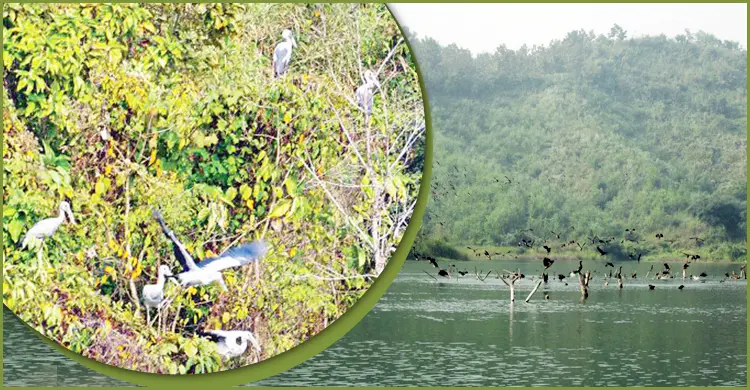
Mahamaya, the country's second-largest artificial lake, is alive with the arrival of migratory birds. At the tourist spot, the chirping of birds has added extra joy for visitors.
The arrival of migratory birds has added a new dimension to Mahamaya's beauty, and lovers of nature are coming from different parts of the country to enjoy the birds and the scenery.
Nearly 11 square kilometres of the lake are now occupied by migratory birds. They began arriving at the start of winter, and the whole area now rings with their calls.
Visitors to Mahamaya are enjoying the birds' flight and calls to their hearts' content. Many are busy photographing the birds roaming freely, spreading their wings in flight or floating in flocks on the water.
Why the birds come
With the turn of the seasons, winter has arrived, and with it the migratory birds. At this time heavy snowfall in the polar regions, Europe, Siberia, parts of Asia and the areas around the Himalayas drives them to Bangladesh, where the winter is comparatively mild, in search of food and safe shelter.
That is why in winter the haors, baors, canals and beels of Bangladesh fill with the movement and calls of birds. They do not go everywhere in the country, but to places with plenty of food and large bodies of water.
Flocks of migratory birds have begun flying in from the North Pole region. As in other years, various species have come and taken shelter at the Mahamaya artificial lake project in Mirsarai upazila, as at other places in the country.
The migratory birds have begun coming from across seven seas and thirteen rivers, and the whole area rings with the calls of many species. But those involved believe that hunters' keen eyes and environmental pollution have gradually reduced the birds' visits to the area.
Fewer birds at the Muhuri project
The vast beels and water bodies of the Muhuri project area in Mirsarai once became a bird sanctuary without any government declaration. Now fewer migratory birds are coming to the area.
Local people believe hunters' eyes and the use of pesticides in artificial fish projects have begun to reduce the numbers of birds coming from different countries of the world.
Going by dinghy to the Kaftali area of the lake, the migratory birds come into view. At the click of a camera, flocks rise into the sky, chirping. Looking around the lake, countless birds of many species, large and small, can be seen.
Sabbir Hossain, a visitor and bird lover at Mahamaya, said: "I have always been a bird lover. I used to keep birds at home, but now I have set them free."
"Last year I came to Mahamaya on a winter morning to see birds, but did not see flocks like these. This time I really enjoyed seeing them fly in flocks across the sky and hearing their calls."
Mostafa Hakim, a visitor who came from Halishahar in Chattogram city to see the birds, said: "I had never come to Mahamaya in winter before. With the migratory birds, Mahamaya in winter looks truly beautiful."
Abu Sufian Biplob, chairman of the local Durgapur union parishad, said Mahamaya becomes a bird sanctuary every year and attracts many tourists. If a favourable environment could be created in consultation with bird researchers, it too could become a large bird sanctuary.
At one time, when winter came, the canals, beels and water bodies across about 20 km from the upazila's coastal Muhuri project to the Shaherkhali area rang with the calls of birds of many colours and shapes.
Now the arrival of migratory birds has begun to decline. Countless migratory birds, including lesser whistling ducks, cormorants, white-breasted waterhens, pond herons, lenja, sorali, kingfishers and gulls, once came here.
Local people said that now no species other than gulls and lenja is seen here. They blame hunters and the use of pesticides (poison) harmful to birds in artificial fish projects.
Kamal Uddin, a resident of the Muhuri project area, said that at one time flocks of migratory birds arrived at the start of winter, and in the afternoons the villages rang with their chirping. But now that has declined.
Abdul Gafur Molla, range officer of the coastal forest department in Mirsarai, said: "We have already conducted drives at various times against bird catching and hunters. We remain alert. If anyone gives us information about such crimes, we will take immediate legal action."
Source: Jagonews24. First published in Bengali on The Agro News.

Comments
(0)