
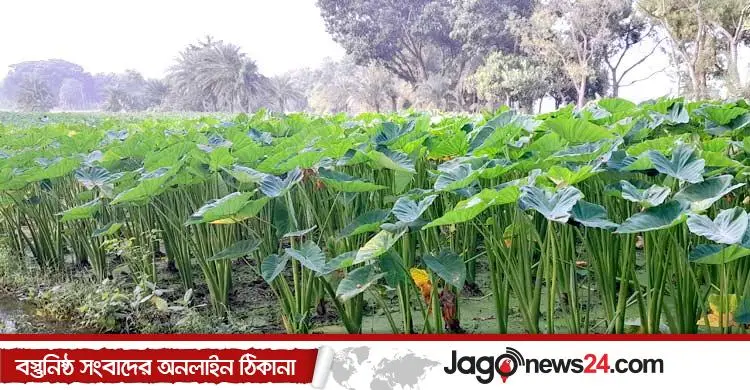
Rafiqul Islam of Kushkhali village in Talkhari union, Shalikha upazila, Magura, has seen a turn for the better from growing lotikochu (a stolon-producing taro). He hopes to sell about a lakh taka or more worth of lotikochu this year.
The smallholder said he grew lotikochu on 73 decimals of land this year and is very happy that the yield has met his hopes. The land must be ploughed well and lotikochu planted in the Bengali months of Boishakh and Joishtho. After two months, when the seedlings have grown, the field must be irrigated. Lotikochu does best in muddy loam soil and needs plenty of water; if there is too little water, the plants do not grow. So besides regular irrigation, it needs a lot of water.
Costs and hoped-for returns
"Last year the weather was not favourable, and farming was hampered in many ways," he said. "Because the yield was poor compared with the cost of production, I did not succeed. This year I have farmed 73 decimals, and the total cost of production has been Tk 60,000. I hope to sell Tk 80,000-90,000 worth of lotikochu this year."
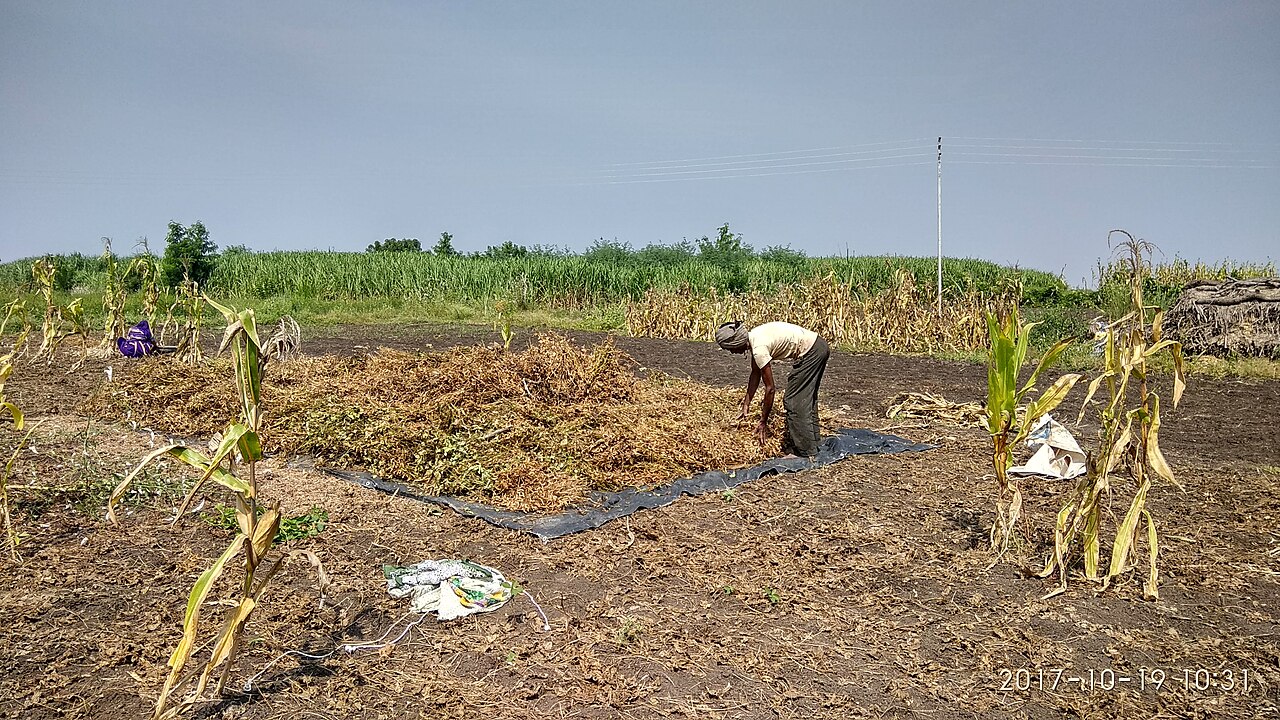
On the work involved, Rafiqul said: "Growing lotikochu is hard work. At harvest the field needs five or six labourers. Because the land is muddy, the plants have to be pulled out from under the soil. Often I can't harvest because I can't find labourers; many don't want to dig them out of the mud. After harvesting, the dirt has to be cleaned off and they must be washed well in water. The stolons (loti) on the upper part have to be separated. Then I sell the kochu and the loti separately. I harvest the kochu towards the end of the month of Kartik."
No help from the agriculture department yet
He added: "I haven't received any help from the agriculture department so far. I farm through my own effort and hard work. Most farmers in the village are not very interested in growing kochu, though many in the village are now growing it. Kochu stolons are very tasty and healthy. We sell wholesale to traders at various markets in Magura. Often traders come to the field and collect the loti and kochu themselves."
Md Alamgir Hossain, deputy director (crops) of the Department of Agricultural Extension (DAE) in Magura, said: "Lotikochu farming is very limited in the district, but it is grown more in Sreepur and Shalikha upazilas. We are trying to encourage farmers to take it up, and at the same time we are providing all-round support."
Source: Jagonews24. First published in Bengali on The Agro News.
Comments
(0)