
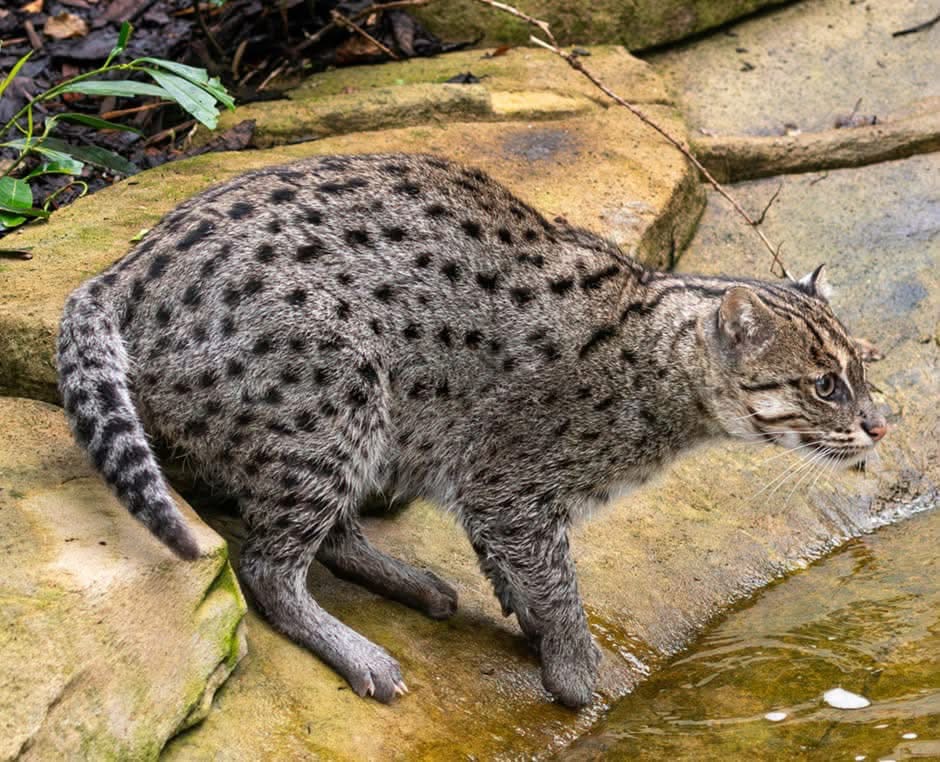
Fear gripped villagers in the Majhipara area of Jagdal union in Magura Sadar upazila in the last week of June 2026 over a wild animal seen beside a village road. The animal was spotted in roadside bushes at around 11pm on Saturday 20 June, and on Sunday 21 June a video of it, about seven seconds long, spread on Facebook. Many people took it for a tiger or a leopard. Magura district forest official Tapendranath Thakur reviewed the footage and said the animal was neither a tiger nor a leopard but a fishing cat, known locally as mecho bagh. Jagonews24 and Prothom Alo reported the episode on 22 June.
An animal on the village road, then a video
According to Jagonews24, a local young man was returning home from the bazaar on Saturday night when a wild animal suddenly came out of the roadside bushes in front of him. He told Prothom Alo that it jumped down from a tree beside the road. Though frightened, he switched on his phone's flashlight and recorded a video of about seven seconds. He said the animal looked very much like a leopard.
He then went to the local bazaar and told people what he had seen. Many did not believe him until they watched the footage, and the area was soon in uproar. Prothom Alo reported that villagers went out with sticks to search for the animal but found no trace of it in the dark. On Sunday night, residents again went out with sticks to look for it.
Speculation ran through the village, some calling it a leopard and others a fishing cat. Majhipara resident Idris Ali told Jagonews24 that he had not believed his nephew at first; after seeing the video, they went to the spot and saw the animal but could not catch it. He also claimed that four chickens had gone missing from a neighbouring house that night, and that villagers believed the animal had eaten them. No authority confirmed any link between the animal and the missing birds.
Concern was greatest among school and college students and their parents, because several educational institutions stand near the spot where the animal was seen. Resident Rahima Begum told Prothom Alo on 22 June: "It is the rainy season now. The bushes grow thick all around. Hearing this tiger story, the children have become somewhat afraid."
What the forest department and the local councillor said
Magura district forest official Tapendranath Thakur reviewed the video and identified the animal as a fishing cat. He told Jagonews24 that fishing cats are still seen in rural areas across Bangladesh and usually live among bushes, water bodies and pond banks. He told Prothom Alo that fishing cats generally stay near water and live on small fish and other small animals; they do not harm people and instead contribute to nature conservation, he said.
The official added that the fishing cat is an endangered animal, so local people were being made aware that no one should beat it or catch and kill it. Higher authorities had been informed so that the animal could be rescued and released somewhere safe and suitable, and the forest department had stepped up surveillance in the area, he said. In Prothom Alo's words, forest officials described the animal as beneficial to the environment, living mainly on fish, globally threatened and protected under the country's law.
Md Kamal Hossain, member for ward 4 of the Jagdal union parishad, told Prothom Alo: "The animal was not seen again after that night. In our area it is known as baghdash. These are seen from time to time." He said he has a fish enclosure in the area where the animal was seen, and that when he went there the next morning, people were going about their work as usual.
What kind of animal the fishing cat is
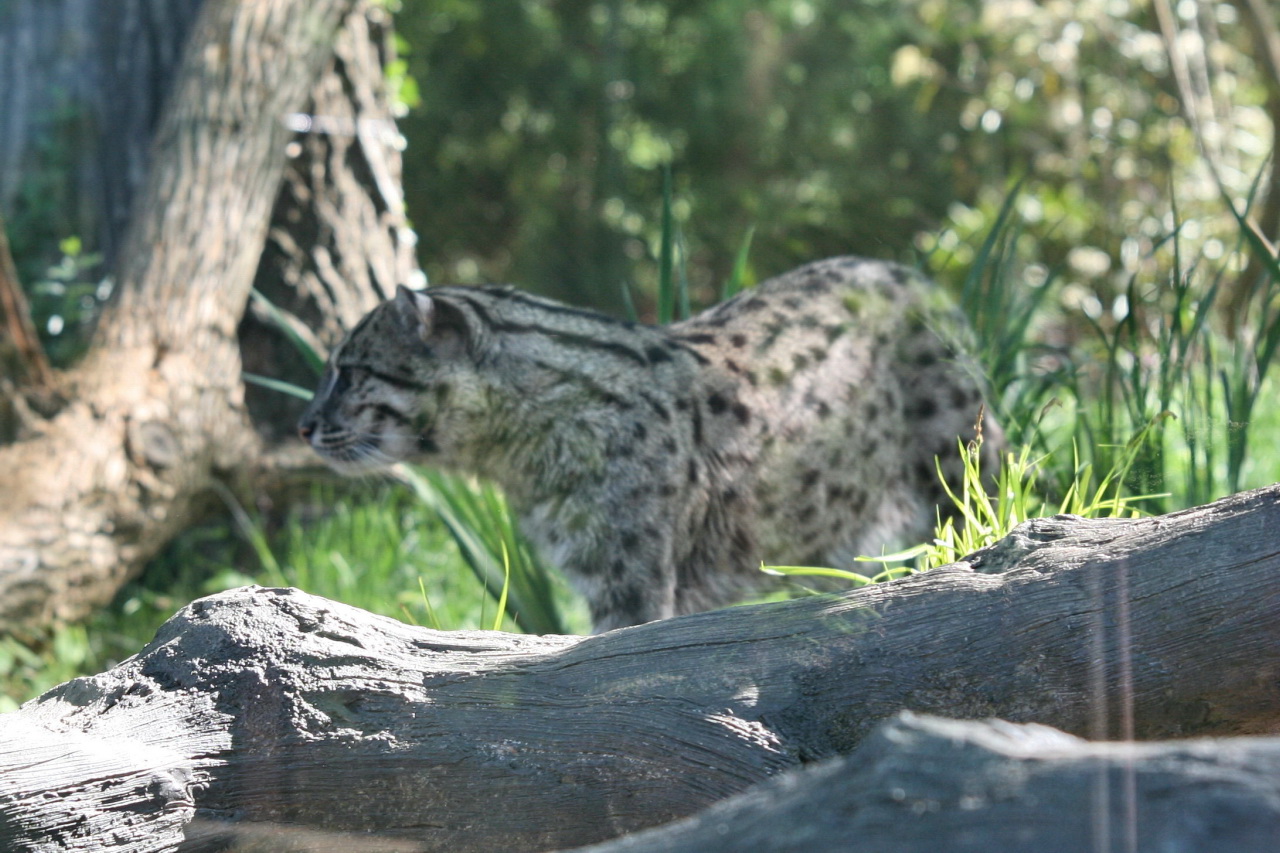
The fishing cat (Prionailurus viverrinus) is a medium-sized wild cat of South and Southeast Asia. Its fur is deep yellowish grey with black lines and spots: two stripes on the cheeks, two running from above the eyes to the neck, long spots on the shoulders and round spots on the flanks, legs and tail. The ears are short and rounded with a white spot on the back, and the tail is short, less than half the length of the head and body. These stripes and spots are why, in dim light or a short phone video, it can be mistaken for a tiger or a leopard.
An adult measures 57 to 78 cm from head to body, with a tail of 20 to 30 cm. Males weigh 8 to 17 kg and females 5 to 9 kg, roughly twice the size of a domestic cat. Its paws are partly webbed, and its short, dense double coat is thought to keep out water and hold in warmth. It is a strong swimmer and can swim long distances, even underwater.
The fishing cat is thought to be mainly nocturnal. It lives in dense vegetation around wetlands: slow rivers, streams, oxbow lakes, swamps, marshes and mangroves. Droppings collected in India's Keoladeo National Park showed that fish made up about three quarters of its diet, with birds, small rodents and insects making up most of the rest; molluscs, reptiles, amphibians and cattle carrion supplement it. It hunts along the water's edge, scooping prey from the water and sometimes diving in after fish.
Wild fishing cats most likely mate in January and February, though mating has been recorded as late as June. In captivity, gestation lasts 63 to 70 days and a litter averages two to three kittens. Adult males, and females without young, live alone; females have been reported to range over 4 to 6 square km and males over 16 to 22 square km.
Where tigers and leopards survive in Bangladesh
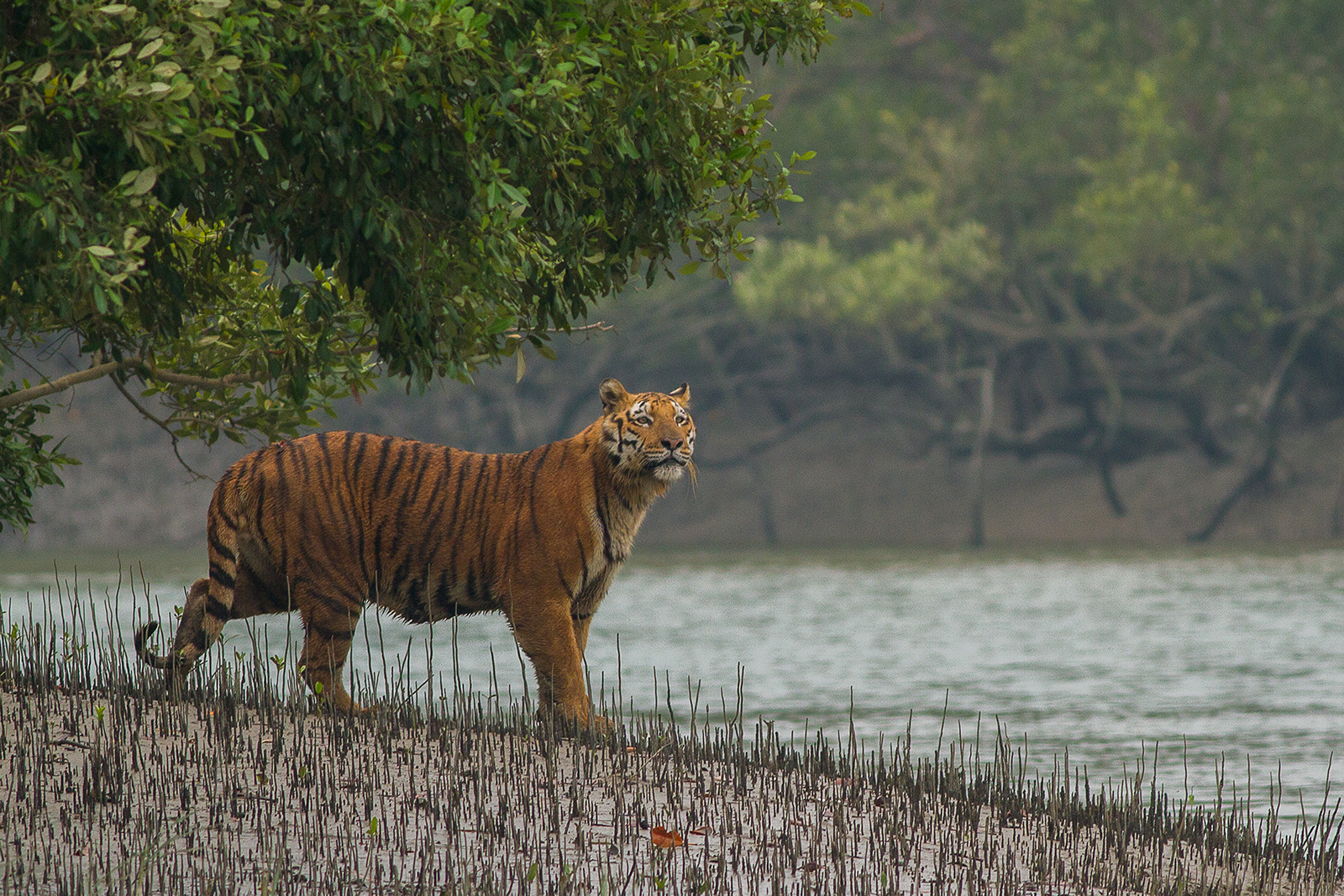
The villagers feared a tiger or a leopard, but both big cats now have a very narrow range in Bangladesh. The 2015 Red List of Bangladesh (mammals volume), published by IUCN Bangladesh, lists the Bengal tiger as Critically Endangered. The assessment says tigers have all but disappeared from most of the country's forests; in the north, the last tiger was shot at Banglabandha in Panchagarh in 1962. The only viable population is in the Sundarbans mangrove forest in the southwest, with very rare sightings in the border areas of the Chittagong Hill Tracts and greater Sylhet.
The latest count of Sundarbans tigers was announced in October 2024. Mongabay reported on 17 October 2024 that the survey placed 1,210 cameras at 605 locations in two rounds between January 2023 and March 2024, and counted 125 adult tigers, a density of 2.64 per 100 square km, up from 114 in 2018 and 106 in 2015. Of the Sundarbans' 10,277 square km, 6,017 square km lie in Bangladesh.
The leopard is in a worse position. The same Red List also lists it as Critically Endangered, because its range has shrunk by more than 90 per cent since 1940. The assessment says the leopard was found all over the country in almost every habitat as recently as 1940, but it no longer occurs west of longitude 90 degrees east, and it was last seen in Madhupur National Park in 1962. It now survives only in a few areas such as the Chittagong Hill Tracts in the southeast and Rema-Kalenga Wildlife Sanctuary in the northeast.
Banglapedia places Magura district between 89 degrees 15 minutes and 89 degrees 42 minutes east, that is, west of the leopard's present range as the Red List describes it. The fishing cat, by contrast, is spread across the country's countryside, homestead groves and wetlands. Against that background, the forest department's identification was a fishing cat, and no authority confirmed that a tiger or leopard was in the area.
The fishing cat's status in Bangladesh
IUCN Bangladesh's 2015 assessment lists the fishing cat as Endangered in the country. It says the species is widely distributed, both in countryside homestead woodlands and in all kinds of natural forests and wetlands. The Sundarbans once held the largest population, but numbers there are falling too. The assessment suspects a decline of more than 50 per cent over two decades, with both the area and the quality of its habitat shrinking, and notes conflict with people when the cats take poultry and livestock near settlements.
Globally, the fishing cat has been listed as Vulnerable on the IUCN Red List since 2016, as its population is thought to have fallen by about 30 per cent between 2010 and 2015. The destruction of wetlands and killing by local people are the main threats. The species is on Appendix II of CITES, the international treaty on wildlife trade, and hunting it is prohibited in Bangladesh and most other countries of its range. It is the state animal of West Bengal in India.
A study of human and fishing cat conflict in Bangladesh appeared in 2015 in CATnews, the journal of the IUCN Cat Specialist Group. Sayam U. Chowdhury and colleagues analysed 82 reports on fishing cats published in The Daily Star, Prothom Alo and some local newspapers between January 2010 and March 2013. They found 30 confirmed deaths, while the fate of 38 animals could not be determined. Almost all deaths were caused directly by people: killing, snaring, or capture followed by starvation.
The researchers wrote that fishing cats are killed mainly because people assume they prey on livestock, fish farms and poultry, and that many are probably mistaken for tiger cubs or other carnivores out of fear or amusement. In their data, 90.6 per cent of reports came from the dry season between November and May. Fishing cats were reported from every division, with 17 reports from Sylhet and 14 each from Khulna and Dhaka divisions. They suggested that degraded wetlands and food shortages push the cats towards human settlements.
Earlier cases in Magura and nearby
This was not the first time a fishing cat had turned up among homes in Magura. Risingbd reported on 29 November 2021 that a fishing cat was caught in a trap set in a pigeon farm in Jashobantapur village, Palashbaria union, Mohammadpur upazila. A local head teacher said then that villagers had been afraid of the animal for some time and alleged it had been taking ducks, chickens and pigeons one after another. The animal was handed over to the upazila livestock office.
Mohammadpur upazila livestock officer Dr Nasir Uddin Sarkar told Risingbd at the time that it was a rare species, called mecho bagh locally but properly known as the fishing cat. He said it was to be released in the Sundarbans through the forest department.
In neighbouring Jhenaidah district, a case ended badly. Bdnews24 reported on 13 November 2024 that villagers in Khandakbaria village, Shailkupa upazila, beat to death a fishing cat that had become caught in a net. Villagers claimed it had entered a farmer's cowshed the night before and killed two goats, and then entered a chicken coop the following night. Shailkupa upazila forest officer Mokhlesur Rahman said that killing wildlife is a punishable offence, and a general diary was filed with the police. Chowdhury and colleagues' 2015 study had also noted reports of fishing cat killings from several upazilas of Jhenaidah.
What the law says
In Prothom Alo's 22 June report, forest officials stated plainly that the fishing cat is protected under the country's law. The legal framework for wildlife had changed shortly before. Prothom Alo reported in December 2025 that the interim government's advisory council had approved the Wildlife Conservation and Security Ordinance, and set out how it differed from the Wildlife (Conservation and Security) Act 2012. Bdnews24 reported that the ordinance was issued in January 2026, and The Business Standard reported on 14 April 2026 that it had since been passed by parliament as the Wildlife (Conservation and Security) Act, 2026.
According to Prothom Alo, the new framework splits Schedule 1 into three parts: tigers and elephants in Schedule 1(a), 250 species in Schedule 1(b) and 127 in Schedule 1(c), with 1,207 species in Schedule 2. In total 1,599 species, including plants, are protected, among them 133 species of mammals. Under the old Act only the killing of tigers and elephants was non-bailable; Section 46 of the new ordinance makes killing any animal in Schedule 1(a) or 1(b) a cognisable and non-bailable offence, and in cognisable cases forest officials and law enforcers can arrest suspects without a warrant.
The earlier penalties for killing a tiger or elephant, two to seven years in prison and a fine of Tk 1 lakh to Tk 10 lakh for a first offence, and up to 12 years and Tk 15 lakh for a repeat, were retained. The sources consulted for this report do not state which schedule the fishing cat falls under or the specific penalty for killing one; forest officials, however, have repeatedly said that killing wildlife is a punishable offence.
Magura Sadar and Jagdal: a land of wetlands
Banglapedia gives Magura district an area of 1,039.10 square km, bounded by Rajbari to the north, Jessore and Narail to the south, Faridpur to the east and Jhenaidah to the west. It has four upazilas: Magura Sadar, Mohammadpur, Shalikha and Sreepur. Its main rivers are the Gorai-Madhumati, the Nabaganga and the Kumar. Magura became a district on 1 March 1984. The 2022 census put the district's population at 1,033,115, of whom 426,396 lived in Magura Sadar upazila.
Magura Sadar upazila covers 401.58 square km and has 13 unions, Jagdal among them. The Gorai, Nabaganga, Muchikhali, Kumar and Fatki rivers run through it, and Banglapedia lists Sirijdia baor and the Tarakhal, Baori, Raua, Padma, Kumar, Kashiadanga, Gazar Garia and Hatuda beels among its water bodies. The main crops are paddy, jute, wheat, mustard, gram, lentil, sugarcane and vegetables, and in 2011 agriculture was the main livelihood of 60.52 per cent of its people.
A landscape of rivers, beels, baors, ponds and fish enclosures is just the kind of place fishing cats prefer. Chowdhury and colleagues noted that about half of Bangladesh's land consists of wetlands such as rivers, estuaries, haors, baors, beels, fish ponds and seasonally flooded land, but that nearly 45 per cent of the country's wetlands have been converted to other uses and the rest are under heavy pressure. In Jagdal, the ward councillor himself said he has a fish enclosure where the animal was seen.

What to do if you see a fishing cat
The Magura forest official urged local people not to beat or catch and kill the fishing cat, saying the forest department would see to rescuing it and releasing it somewhere safe. The Shailkupa forest officer had given villagers the same warning in 2024. According to Prothom Alo, the Magura forest official said the animal does not harm people.
The 2015 study made several recommendations to reduce conflict that are relevant to villagers as well:
- Run broad education programmes in villages beside wetlands on the ecology and importance of the fishing cat.
- Reduce losses of poultry through better husbandry.
- Set up ways for villagers to report fishing cat sightings quickly to wildlife authorities and local conservationists.
- Train forest department staff in wildlife management so rescues and releases are prompt and systematic.
The researchers also warned that releasing rescued fishing cats in distant, unsuitable forests rather than the wetlands they were taken from could lead to their deaths, since the species depends on wetlands.
Photo: Sultan Sunnny / Wikimedia Commons (CC BY-SA 4.0)
Sources: Jagonews24, Prothom Alo, IUCN Bangladesh (Red List of Bangladesh 2015, mammals volume), CATnews of the IUCN Cat Specialist Group (2015), Mongabay, Banglapedia, Bangladesh Bureau of Statistics Population and Housing Census 2022, Risingbd, bdnews24, The Business Standard, Wikipedia

Comments
(0)