
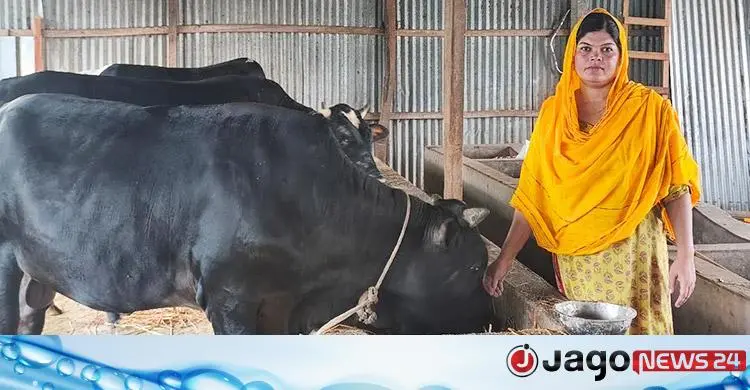
Every year she raises cattle for Eid-ul-Azha, and by selling them she has become self-reliant. Nusrat Jahan Sathi of Madaripur hopes that many more women will take an interest after seeing her.
Nusrat Jahan Sathi, daughter of Samchul Haque Bepari of Rajdi in Kalkini upazila, married Kazi Emarat Hossain of the Syedarbali area of Madaripur town in the same district. After moving to her in-laws' home she saw that her father-in-law kept cattle, and was inspired. In 2019 she started rearing cattle herself, and with her husband's help built a large farm in front of the house, which she named Amira Dairy Farm.
A difficult start
She started with ten cattle. Lacking experience in the first year, she lost several of them and made a loss. But she was not discouraged. The next year she again began rearing cattle ahead of the Eid of sacrifice, and the herd kept growing. The cattle are sold every year when Eid-ul-Azha comes. In 2024 she sold 35 cattle for Eid, each for Tk 2 lakh to Tk 3 lakh. So far she has sold more than Tk 1 crore worth of cattle and made a good profit.
She said her three children are all young, the youngest only two years old, so she cannot give the cattle enough time. With no one to help her with the work, she has fewer cattle this year. There are nine on her farm now, three of which she has given to another farmer to rear. She will increase the number again when the children are a little older.
Next to the cattle farm she also keeps ducks, chickens and pigeons: 80 ducks, 40 chickens and 20 pairs of pigeons. She dreams of becoming a big entrepreneur.
"Like my own children"
"When several cattle died in the first year, I was heartbroken, but I didn't give up," Nusrat Jahan Sathi said. "The next year I bought more cattle and started again. They feel like my own children and have to be cared for like children. It takes a lot of hard work. I dream of becoming a big entrepreneur. I hope that seeing me, other women will also take the initiative to become self-reliant, not just do household work."
Mahmuda Akter Kona, retired deputy director of the Department of Women Affairs in Madaripur, said Sathi has become a self-reliant and successful woman entrepreneur through her own hard work and confidence, and many will be inspired by her to set up cattle farms.
Nurunnahar Jui, president of the women's development organisation Nakshi Kantha, said self-confident women like Sathi are rare in society, because rearing cattle is very hard work and success comes only after a great deal of effort. That is why men mostly do this work and women are seldom seen in it. Sathi is an example of a woman entrepreneur in our society, she said, and she hopes more women will be inspired by her.
Source: Jagonews24. First published in Bengali on The Agro News.

Comments
(0)