
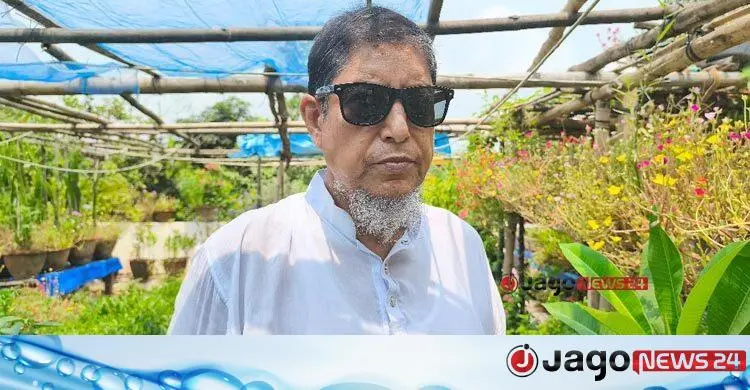
For more than four decades, Rajon Mahmud of Madaripur has been handing saplings to people without taking a single taka. Besides giving away plants raised in his own nursery, he is active in many environmental campaigns: planting trees, protecting bird habitats, and saving ponds and canals. His tireless work has made him known across the district as a devoted environmentalist.
Rajon Mahmud lives in the No. 2 Shakuni area of Madaripur Sadar upazila. He is the eldest son of Anwar Hossain Khan and Sultana Rizia, and has loved trees since childhood.
A nursery since 1980
Out of that love, around 1980 and with his father's help, he set up a small nursery at home. Fruit, timber and medicinal saplings from it were given free to local people; nobody who asked for a plant was turned away. The family also regularly gave saplings to schools and colleges.
In 2001, inspired by an international environmental publication, he set out to organise the work and founded "Friends of Nature". It is now one of Madaripur's best-known environmental organisations, working on sapling distribution, environmental awareness, protecting water bodies and conserving birds.
He worked for years to protect the heritage Shakuni Lake in the heart of Madaripur town and openly opposed plans to cut old trees in the name of development. Locals say that because he stood up against felling more than a hundred old trees for a lake development scheme, some old trees still survive on its banks.
Under the former Awami League government, the local MP wanted to fill in a heritage pond next to the town's No. 1 police outpost. Rajon Mahmud staged the first protest under his organisation's banner, and with the help of the then municipal mayor and local people the pond was saved.
Nests for birds, fry for the beels
He also works for wildlife. He has hung clay nests in trees for birds, and in the monsoon he buys fish fry with his own money and releases them into beels. He speaks out against canal filling, waterlogging, blocked drainage and anything else that harms the environment.
His home, "Mayaban", is like a small botanical garden. The roof is covered with flowers, fruit trees and medicinal plants, along with many kinds of cactus. Beside the house is a nursery where saplings are raised regularly, with help from Sakhawat Hossain Mamun, who returned from abroad, and local man Nuru Kha. The three of them grow saplings of many species and give them away free.
Many people want to plant trees at home but lack pots or soil, so he prepares pots, soil and saplings and gives them free. Behind the house is a vegetable garden growing seasonal crops. With the help of the agriculture department he is now running a project to grow ginger in 500 sacks; sack-based ginger cultivation has already begun.
Rajon Mahmud told Jagonews24: "We have lost faith in the herbal plants that are our great friends and have turned entirely to allopathic and homeopathic treatment. Yet in our grandparents' time people depended wholly on plants and herbal remedies. That is why they enjoyed good health and lived long, disease-free lives."
At one time 20 to 25 monitor lizards lived in his pond, and mongooses and jackals in his mahogany grove. To keep them there he bought fish and chicken from the market to feed them. As the neighbourhood grew many animals left, but three or four monitor lizards and some mongooses remain. His personal library holds about 4,000 books and magazines, which local people borrow.
He says his struggle aims to make every person aware of the environment, health and nutrition, and free of corruption. He hopes that one day young people across the country and the people of the district will join the movement, and that Madaripur and all of Bangladesh will become beautiful and prosperous.
What neighbours say
Many people in the district have benefited from his free saplings, and his work has encouraged tree planting and built environmental awareness.
Mithila Mohsin of Hajir Hawla village in Madaripur Sadar said she needed some pots for her home. Rajon Mahmud learned of it through Facebook, contacted her and gave her 20 pots, potting soil and several plants free. "These days nobody wants to give anything without money, yet he gave plants and pots completely free. Seeing his love for trees, we have been encouraged to plant too," she said.
Rabeya Sultana of the Shakuni area told Jagonews24: "I asked for a few cuttings of flowering plants. He not only gave cuttings but several plants with pots. People like him are rare now."
Garden lover Mehedi Hasan Rakib said: "Most people now see plants as a business, but Rajon Mahmud is different. He has given away plants free for years, and seeing him many people are becoming interested in planting trees."
His long-time associate Sakhawat Hossain Mamun said he was impressed by the work when he came home from abroad and joined in. "I started as a hobby, but now I feel this is not just giving away plants; it is a social movement to protect the environment."
Ten herbal plants for every home
Of his plans, Rajon Mahmud told Jagonews24 that through Friends of Nature he will make sure, within two years, that every household in Madaripur district receives 10 herbal plants free. They will include neem, ulatkambal, patharkuchi, basak, tulsi, kalomegh, dudh akon, gandhabhadali, aloe vera, amloki, arjun, agnishwar, telakucha, marigold, periwinkle, hibiscus and aparajita.
He said these plants grow without any care and are directly useful for everyday common ailments, adding that, above all, herbal treatment has no side effects.
Al-Amin, sub-assistant agriculture officer for Madaripur Sadar upazila, said he has known Rajon Mahmud for a long time. "With our help he has taken up a project to grow ginger in 500 sacks, and the planting is already done. He also gives plants away free from time to time. It is a very good initiative. Even if one tree survives, it works to protect the environment. Others will be encouraged to plant trees by seeing him."
Source: Jagonews24. First published in Bengali on The Agro News.


Comments
(0)