
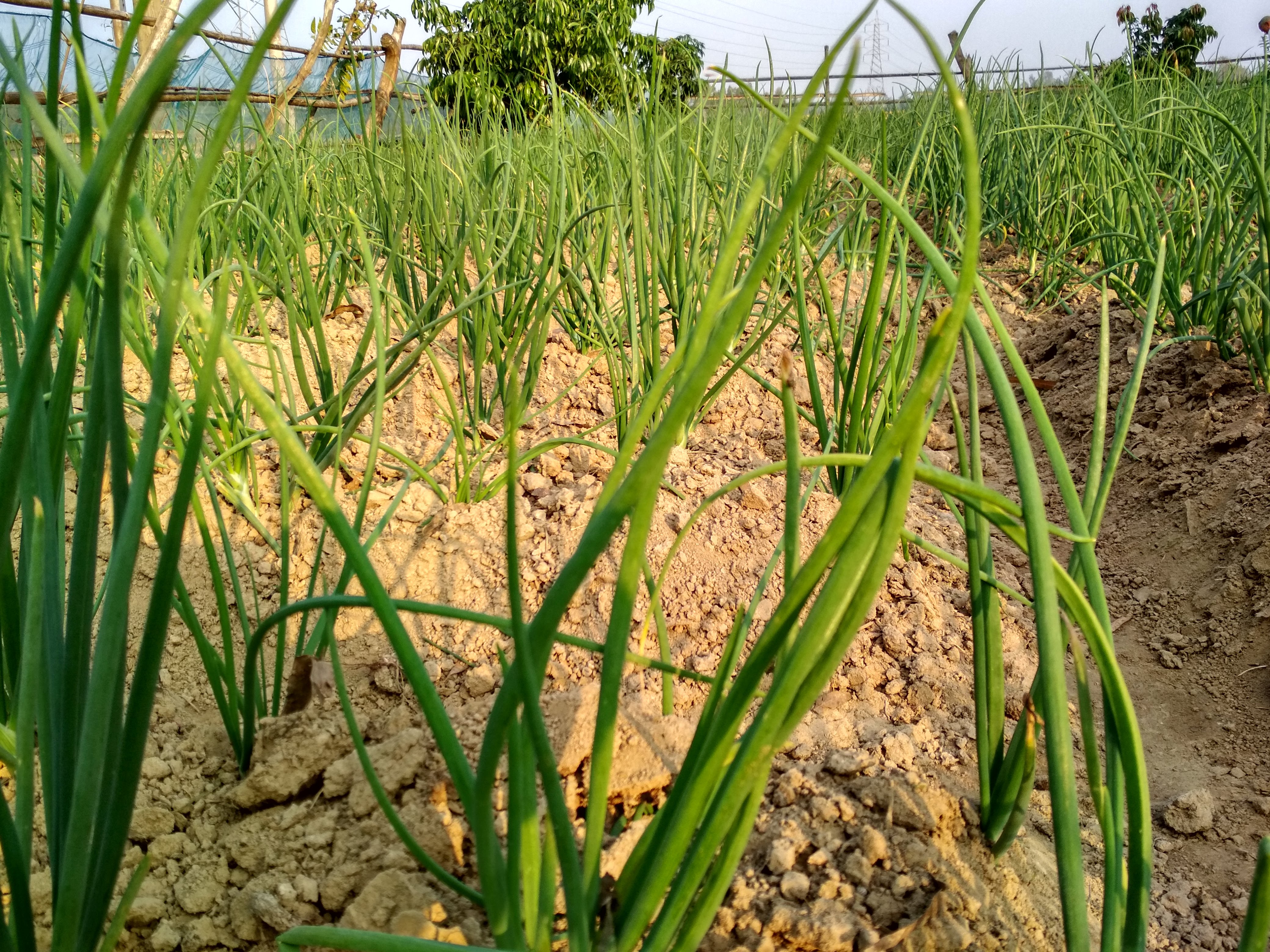
Farmers in Madaripur district planted bulb onion, hali onion and onion seed on more land than the Department of Agricultural Extension (DAE) had targeted this season, Jagonews24 reported at the start of April 2026, citing the district DAE office and farmers. Across the district's five upazilas, bulb onion covered about 4,262 hectares against a target of 4,050 hectares, and the seed crop reached about 74 hectares against a target of 42. Kalkini, Dasar and Shibchar were named as the upazilas with good yields. Growers said they were pleased, and those who spoke to the paper singled out the seed crop, which they call "kalo sona", or black gold.
What the district's figures show
The district DAE office and farmers gave three pairs of figures, one for each way the crop is grown:
- Bulb onion (kanda): target 4,050 hectares, about 4,262 hectares planted.
- Hali onion: target 673 hectares, 694 hectares planted.
- Onion seed: target 42 hectares, about 74 hectares planted.
All three pairs measure land, not harvest. The report published no tonnage for the district, so the figures show that the planted area went past the target in each form of the crop; they do not show how much onion Madaripur produced. The report did say that yields were good, particularly in Kalkini, Dasar and Shibchar, and the deputy director of the district DAE spoke of output above target, but no production figure was given with either statement. The report put the wider area down to the interest and hard work of farmers.
The figures also show how the district divides its onion land. Bulb onion took by far the largest part, and hali onion stayed under 700 hectares. Pabna's Santhia upazila, one of the country's best-known onion areas, shows the opposite pattern: its upazila agriculture office told Prothom Alo in February 2026 that of a target of 16,690 hectares for the year, 1,610 hectares were under the early muri-kata crop.
The fields, and what a grower and an official said
In different parts of the district, the report said, rows of bulb onion stood in the fields, freshly lifted bulbs lay in others, and elsewhere the seed heads moved in the wind. By then a large part of the crop had already been sold. The report said farmers were happy with the prices they had received, and that interest in growing onion in Madaripur was rising day by day.
Anwar Hossain, an onion farmer from Dakshin Ramjanpur village in Kalkini upazila, explained why seed had caught growers' attention. "Onion seed is very expensive in the market now, and our profit is higher from onion seed. That is why we fondly call it 'kalo sona' (black gold). One kilogram of onion seed sells for about Tk 7,000 to 8,000, and sometimes for more. So interest in growing it is rising among farmers here, and we are happy," he said.
Dr Rahima Khatun, deputy director of the Madaripur district DAE, credited the support given to growers. "Farmers are being given all-round support for onion farming, including incentives. Besides supplying seed and fertiliser on time, onion growers are being given all kinds of help and advice. That is why onion output has exceeded the target this time. Many people in the district are also becoming interested in onion farming," she said.
She had spoken of the region's suitability for such crops six months earlier, in a report by the national news agency BSS on winter vegetables in the chars. "Not only vegetables, but various spice crops also grow well in Madaripur region," she told BSS in October 2025, adding that the department was continuously giving farmers technical advice and assistance.
Bulb, hali and seed: three ways of growing one crop
The three lines in the district's figures are three different farming systems, each with its own calendar. Bulb onion, called kanda here and muri-kata in many other places, is the early crop. Farmers plant small bulbs rather than seedlings. Pabna's growers plant it in October and November and lift it from late December into March, Prothom Alo reported in February 2026. The Daily Star described kanda in October 2024 as an early-season type grown so that markets have supply before the main crop arrives.
The early crop's cost depends on the price of the bulbs used for planting. In October 2024 a Pabna farmer told The Daily Star that a maund of planting bulbs cost up to Tk 8,000, against Tk 3,500 to Tk 4,000 a year earlier, and growers in major districts said that was pushing up production costs.
Hali onion is the main crop. Seedlings are raised first and transplanted in December and January, and the crop is lifted in March and April. Upazila agriculture officers in Pabna told Prothom Alo in January 2024 that this is the main onion and the kind that can be stored for a long time. Banglapedia, the national encyclopedia, notes that onions grow in all soil types in Bangladesh and gives December or early January as the best time for transplanting.
The bulbs used to plant the early crop are themselves grown from seed, and the Spices Research Sub-Centre of the Bangladesh Agricultural Research Institute (BARI) at Faridpur has studied how to do it. In a field trial in 2021-22, published in the Bangladesh Journal of Agricultural Research in December 2023, its scientists tested BARI Piaz-1, BARI Piaz-4, BARI Piaz-6 and a commercial variety, and concluded that BARI Piaz-4 and BARI Piaz-6 were suitable for producing onion sets with good yield.
Bangladesh can grow only certain onions. A study by BARI scientists in the Bangladesh Journal of Agriculture in 2022 explained that because the plant is highly sensitive to day length, only short-day types suit the country's conditions. The same paper named a lack of high yield in existing varieties and limited variation in the available breeding material as the main drawbacks in production. Banglapedia lists Taherpuri and Faridpuri among the important local varieties. BARI also developed BARI-5, a summer variety, in 2008, which researchers told The Business Standard in 2022 could yield 30 tonnes per hectare.
Madaripur: a river district that lives by farming
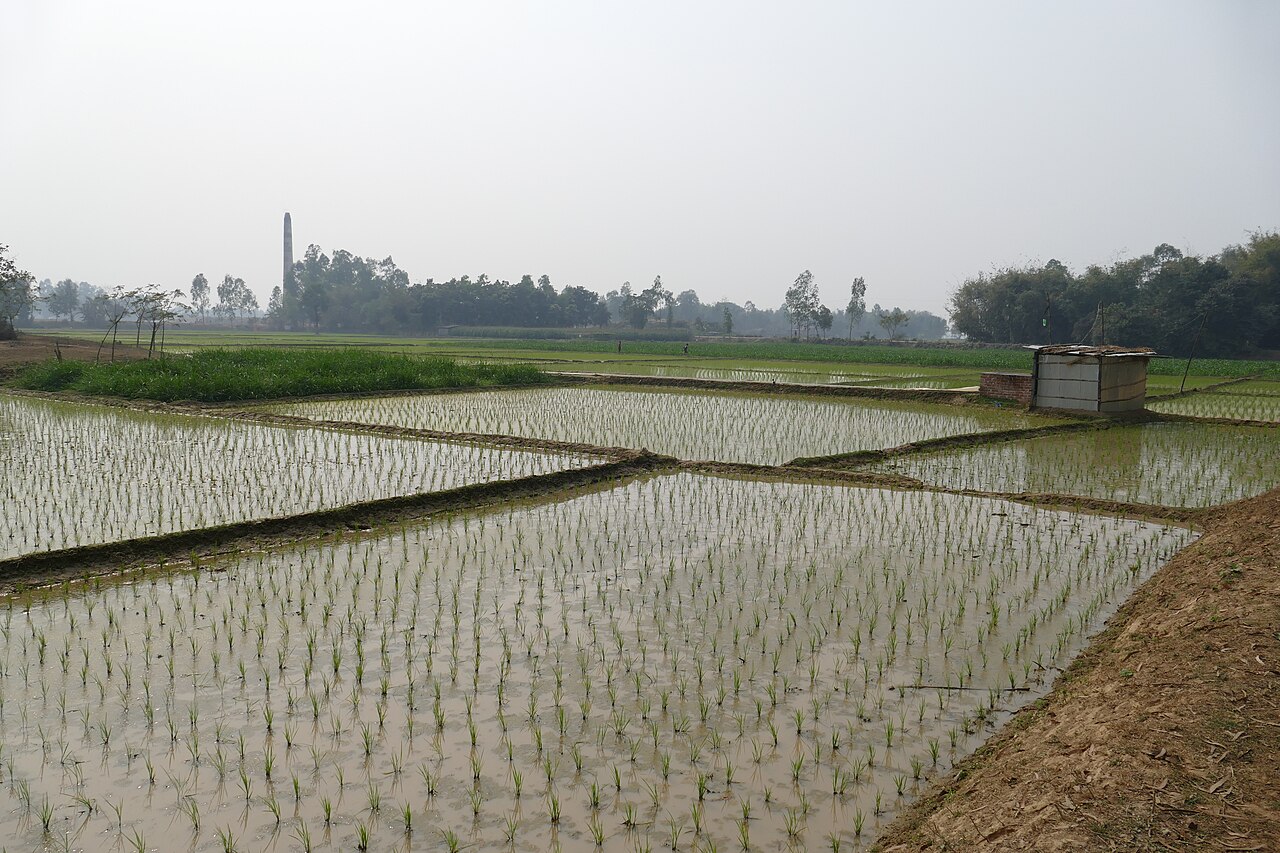
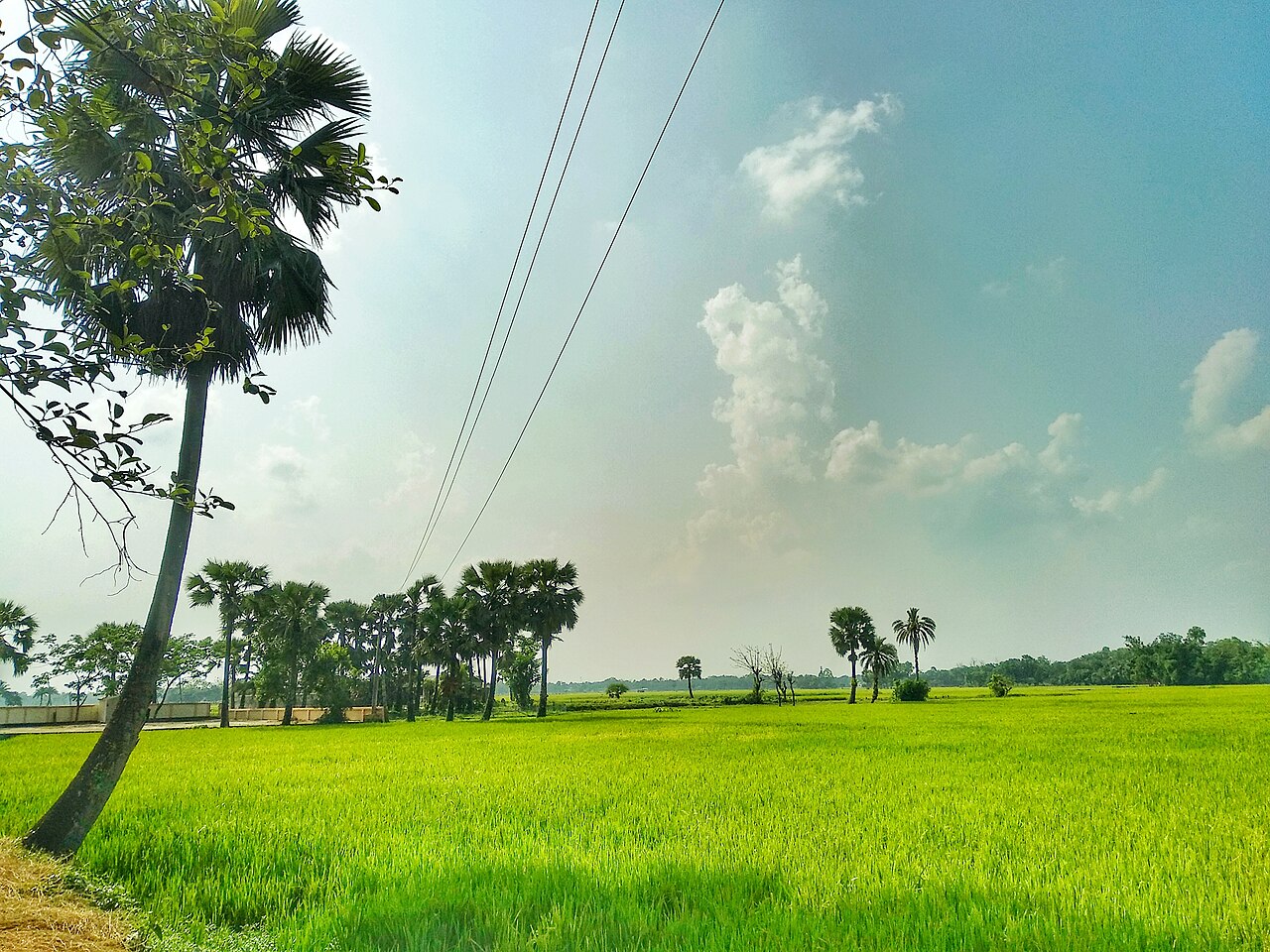
Madaripur lies in Dhaka Division. Its rivers include the Padma, the Arial Khan and the Kumar, according to Banglapedia. The Arial Khan, a branch of the Padma about 160 km long, flows through Faridpur and Madaripur, and Madaripur town stands on its right bank. The 2022 census counted 1,293,027 people in the district. Agriculture is its largest main source of income, at 61.33 percent in Banglapedia's entry based on the 2011 census.
The district had four upazilas when those entries were compiled. Dasar, the fifth, began as a police station formed in 2013 from five unions of Kalkini and was approved as a full upazila on 26 July 2021. That is why the April 2026 report speaks of five upazilas: Madaripur Sadar, Kalkini, Rajoir, Shibchar and Dasar.
Onion has been part of the district's farming for some time, though not everywhere. Banglapedia's upazila entries list onion among the main crops of Shibchar and Madaripur Sadar, and Shibchar's also list it among the upazila's main exports, along with garlic, pulses, groundnut, betel leaf and mustard. The entries for Kalkini and Rajoir name paddy, jute, sugarcane, mustard, pulses and sweet potato but not onion, although Kalkini is among the good-yield upazilas in the 2026 report. Kalkini's rivers are the Arial Khan, the Ghagar and the Tarki, and Banglapedia gives agriculture as the main source of income for 70.23 percent of its people; Shibchar's figure is 63.95 percent.
The char lands along the rivers are central to the dry-season crop. BSS reported in October 2025 that the DAE recorded winter crops expanding every year on the Padma and Arial Khan chars of the district, with growers saying that improved seed and pest control were lifting yields, and that produce was going to other parts of the country. Neighbouring Shariatpur shows the same pull: BSS reported on 10 January 2026 that onion there covered 4,652 hectares against a target of 4,352 hectares, with the silty and loamy chars of Jajira and Naria particularly suitable.
"Black gold": why onion seed pays and what it demands
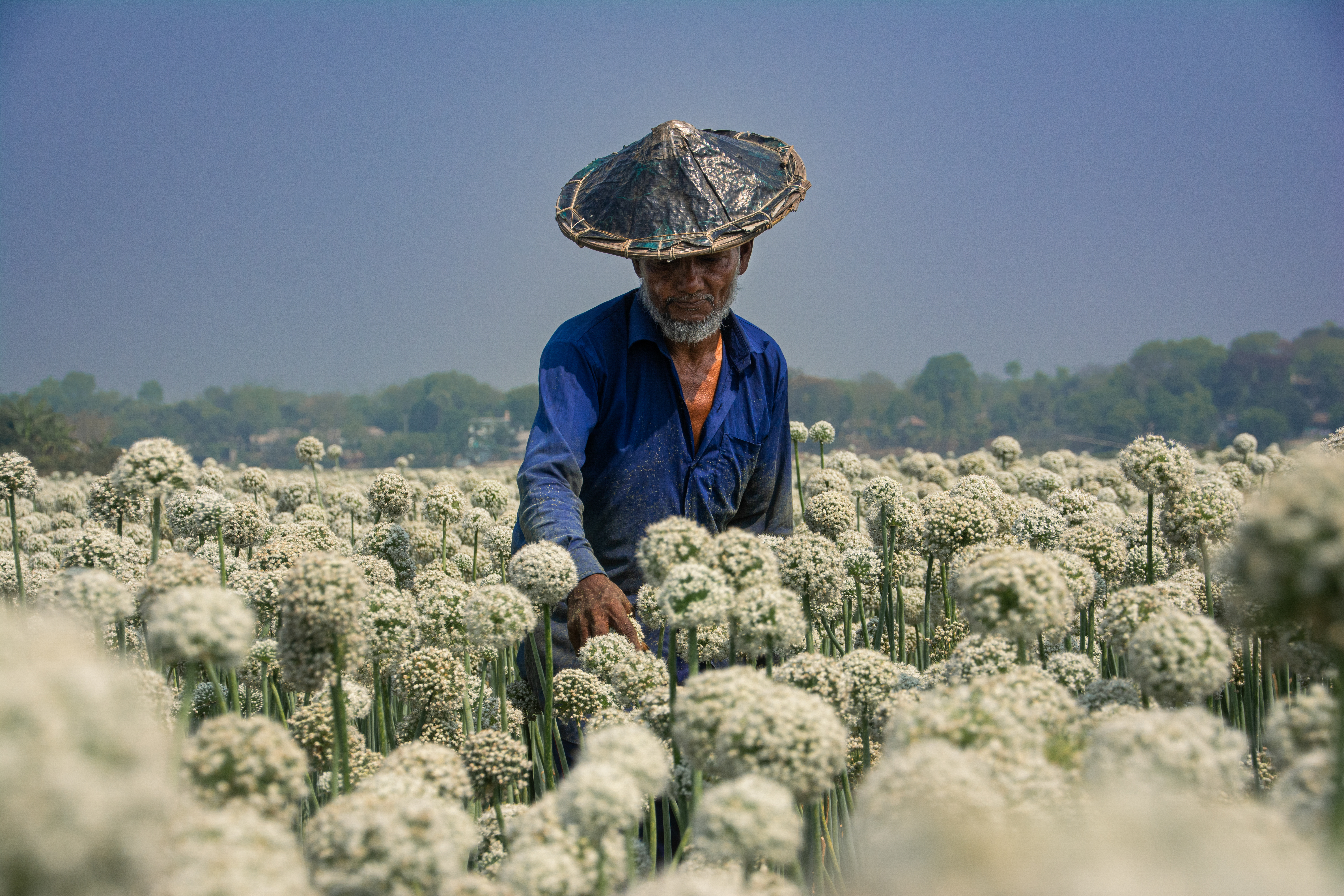
The onion is a biennial grown as an annual. Left to its second stage, the plant sends up a tall hollow stem topped by a rounded head of white flowers, and those heads ripen into glossy black, three-sided seeds. The seeds are short-lived, and fresh seed germinates best. In Bangladesh, seed growers plant bulbs for this crop, The Daily Star reported in March 2021, naming varieties such as Rajshahi Tahirpur and BARI-4. These are the white heads the Jagonews24 report described moving in the wind, and the black seed is the reason for the name.
The name is used across the country's onion belt. Dhaka Tribune reported in March 2022 that the seed was known as "kaloshona" in Faridpur, and The Financial Express quoted the Magura DAE's deputy director in November 2024 saying it had once been called the "black pearl" of that district. Prothom Alo found growers in Thakurgaon calling it "black diamond" on 30 March 2026.
Madaripur's 74 hectares are small beside the established seed districts. Faridpur has long been the centre: Dhaka Tribune reported onion seed on 1,854 hectares there in March 2025 and said the district had covered more than half of the country's demand for government-certified onion seed over the past decade. Magura's seed area rose from 65 hectares to 185 hectares in 15 years, according to its DAE office in November 2024. Thakurgaon has risen fast: the DAE there recorded 119 hectares in 2022-23, 547 hectares in 2024-25 and 1,125 hectares in 2025-26, with a production target of 1,237.5 tonnes.
Seed prices vary widely by report, place and year. The Kalkini farmer's figure of Tk 7,000 to Tk 8,000 a kilogram was his own account of the market. In Thakurgaon, by contrast, Prothom Alo reported that seed had sold at Tk 2,000 a kilogram the previous season. In Faridpur, a grower told The Daily Star in December 2022 that he had sold two kilograms for Tk 7,000 in all.
The crop is slow and labour-hungry. In Thakurgaon, Prothom Alo reported, planting usually starts between 15 and 30 November and seed is collected between 25 March and 15 April, which fits the flowering heads seen in Madaripur at the end of March. One Thakurgaon grower with five acres said hand pollination has to go on for 25 to 30 days, that an acre costs about Tk 3.5 lakh and yields seed worth Tk 7 lakh to Tk 8 lakh, and that disease can destroy a whole field. Workers there were paid Tk 250 to Tk 300 a day.
Growers say hand pollination has become necessary because bees are scarce. The Thakurgaon DAE's deputy director told Prothom Alo that bees are the main pollinators of onion flowers and that overuse of pesticide had reduced them, with growers making up much of the gap by hand. Dhaka Tribune saw the same work in Faridpur in March 2025, and The Business Standard reported in March 2024 that manual pollination may not be as fruitful as the natural process.
High prices have not always meant safe sales. The Daily Star reported in December 2022 that Faridpur seed growers were left with unsold stock, which they blamed on cheaper Indian seed; the district's DAE deputy director said the office had been told of farmers being cheated into buying poor-quality seed, and that it always advised them not to buy loose onion seed. The same report described bulb growers who had to sow again after seed failed to sprout.
State support and the bodies behind the crop
The incentives Dr Rahima Khatun mentioned are part of a national pattern in which the DAE, an agency of the Ministry of Agriculture, hands inputs to small and marginal growers. In Madaripur itself, BSS reported in February 2026 that 25 farmers in Shibchar upazila received onion seed, chemical and organic fertiliser and pesticide at the upazila agriculture office, one kilogram of seed each, under a 2025-26 agricultural rehabilitation scheme aimed at summer onion in the kharif season. Officials said they hoped it would raise production in the area and cut farmers' costs.
Other bodies work on the same crop. BSS reported in November 2025 that the DAE, BARI, the Bangladesh Agricultural Development Corporation (BADC) and the Bangladesh Institute of Nuclear Agriculture were providing seed, training and technology to onion farmers in the Rangpur region. BARI breeds the varieties, and BADC deals in seed. The DAE also issues the import permits for onions.
A national crop above target
Madaripur's result matched the country's. The DAE told The Business Standard in March 2026 that onion cultivation had reached roughly 302,000 hectares against a national target of 286,000 hectares, and the agriculture department forecast about 4.3 million tonnes of onions for the year, against demand the paper put at 2.6 to 2.7 million tonnes.
Output has been climbing. DAE sources gave Prothom Alo these figures in December 2025: 34.17 lakh tonnes in 2022-23, 37.90 lakh tonnes in 2023-24 and 42.50 lakh tonnes in 2024-25, with annual demand of 25 to 30 lakh tonnes. The same report noted that part of each harvest is kept for seed and part rots, so supply tightens at the end of the season.
That tightening was visible just months before Madaripur's harvest. Retail onion passed Tk 150 a kilogram in Dhaka in early December 2025, and on 7 December the DAE gave 50 importers permits for 1,500 tonnes from India, at no more than 30 tonnes each, valid until 31 March 2026. Imports had once been far larger: Bangladesh brought in 7.27 lakh tonnes in 2022 according to National Board of Revenue data, the most of any country that year, Prothom Alo reported in December 2023, even as the Food and Agriculture Organization ranked it seventh among producers.
Prices: the other side of a large crop
The Jagonews24 report said Madaripur's farmers were happy with prices, but it quoted no price for bulb onion in the district, and reports from the main growing areas that season were very different. In Pabna's Santhia upazila, muri-kata onion fell from Tk 1,800-2,000 a maund to Tk 1,000-1,200 within four days in February 2026, Prothom Alo reported, while farmers put their production cost at about Tk 1,600 a maund. Traders blamed heavier arrivals as the crop matured, weaker demand at the start of Ramadan and the approach of the new hali crop.
By 17 March 2026 The Business Standard, citing the Department of Agricultural Marketing, put farm-level onion prices at Tk 20 to Tk 25 a kilogram against production costs of Tk 38 to Tk 40. The paper linked the fall to a harvest well above demand, and reported that heavy rain and hail had raised fears for crops still in the ground. In Shariatpur next door, BSS reported in January that retail prices had already fallen to about Tk 50 a kilogram and that growers feared for their returns as new onions arrived.
Why storage shapes what farmers earn
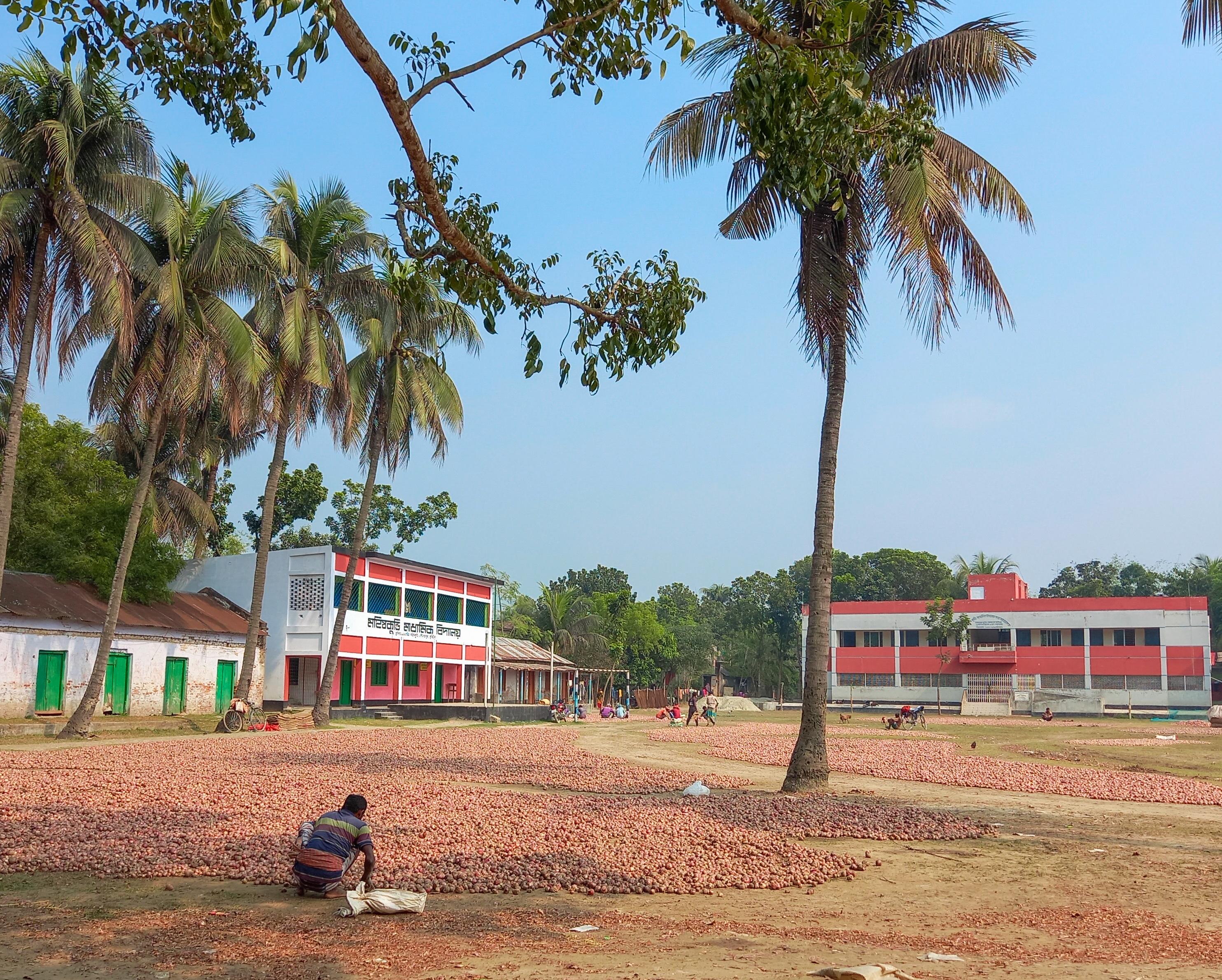
A large part of Madaripur's crop had been sold by the time of the report, and storage decides how long a grower can wait. A regional manager of the development organisation ASA told Desh Rupantor in May 2023 that prices usually fall once new onions reach the market, so growers who cannot store for some time make no profit. DAE information cited by Prothom Alo in June 2023 put the loss at 30 to 35 percent of onions for want of proper storage or because of adverse conditions.
Reports from Pabna in 2023 described growers keeping onions on bamboo racks in tin or semi-brick rooms, where the crop rots and loses weight. A trial in Sujanagar, reported by The Daily Star's Bengali edition in May 2023, tried a different way: ASA set up an electric air-flow machine costing Tk 20,000 to Tk 22,000 in a 10-by-10-foot chamber that could hold about 300 maunds. The organisation's engineer said the machine must run at least six hours a day to clear heat from the pile, and a participating farmer said his electricity bill rose by Tk 300 in a month. Desh Rupantor reported the same month that growers in the trial had good results and had named the machine "the farmer's AC".
Photo: RockyMasum / Wikimedia Commons (CC BY-SA 4.0). The top picture shows an onion field in Bangladesh, as background.
Sources: Jagonews24 (Madaripur report, April 2026), The Business Standard (17 March 2026; 20 March 2024; 28 February 2022), Prothom Alo (30 March 2026; 21 February 2026; 7 December 2025; 11 December 2023; 4 June 2023; 27 January 2024), BSS (February 2026; 10 January 2026; 6 November 2025; 10 October 2025), The Daily Star (31 October 2024; 27 December 2022; 16 March 2021; Bengali edition, May 2023), Dhaka Tribune (7 March 2025; 16 March 2022), The Financial Express (17 November 2024), Desh Rupantor (28 May 2023), Bangladesh Journal of Agricultural Research (December 2023), Bangladesh Journal of Agriculture (2022), Banglapedia, Wikipedia.
Comments
(0)