
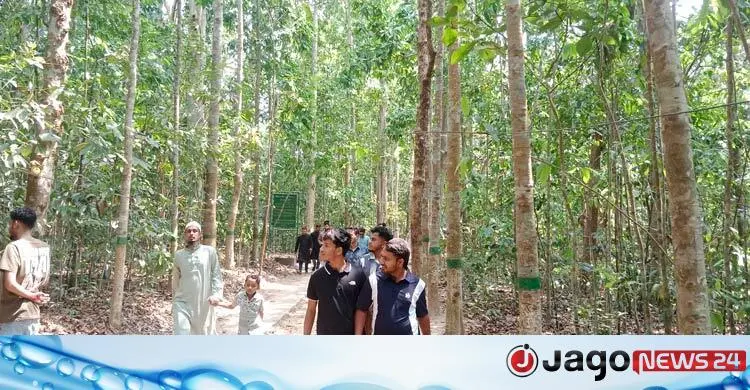
The protected forest is open on all sides, with a road and a railway running through it and a main gate in the middle. Although only ten per cent of visitors buy tickets to enter, in reality several thousand people walk into the forest every day unhindered. With so many people suddenly entering such a small forest at once, its animals are frightened.
Visitors sit on the railway line inside the forest or pose for group photos. When a train comes, hundreds stand up to take pictures with the moving train. Visitors also dump rubbish wherever they like inside the forest, and when a VIP guest arrives, the car drives straight in through the main gate. This was the scene at Lawachhara National Park in Kamalganj, Moulvibazar, during the Eid-ul-Fitr holiday.
Far more visitors than the forest can hold
Animals are supposed to move about safely in the 1,250-hectare Lawachhara National Park, but the number of visitors has risen excessively over the past few years. From Saturday, the day of Eid-ul-Fitr, to Tuesday, the pressure of visitors from the area and around the country caused long traffic jams along the Bhanugachh-Sreemangal road through the forest. Visitors are spoiling the forest environment, and with more people entering than it can hold, conditions inside have deteriorated. The animals are fleeing in fear. The forest is supposed to be kept quiet, but visitors' shouting and littering are destroying the animals' food and habitat.
Lawachhara National Park is home to 460 species of rare plants and animals, including 167 species of plants, 4 of amphibians, 6 of reptiles, 246 of birds and 20 of mammals. Lawachhara was declared a national park in 1996.
The Wildlife Management and Nature Conservation Division says about 6,000 visitors entered the park with tickets from Saturday, Eid day, to Tuesday. But because the forest is open on all sides, about 90 per cent of visitors enter without a ticket. Several signboards give visitors instructions, but most who read them do not follow them. Many think of Lawachhara as something like the Gazipur Safari Park before they enter, but it is entirely different. Visitors leave behind crisp and chocolate wrappers, food packets, water and soft-drink bottles and other rubbish, which is never acceptable. Protecting both the forest and tourism together is becoming very difficult.
Warnings from environmentalists and officials
Environmentalists say that although forests are called the lungs of the earth, Lawachhara's natural environment has been battered for several years. The forest is beset by many problems: trees and bamboo are being cleared, the forest has thinned and the number of animals has fallen considerably. Now excess tourists have become a headache. The number of vehicles on the road through the forest has also multiplied compared with a few years ago, a very bad sign for the forest. Unless the forest department tackles these problems firmly, Lawachhara will keep its name but lose its forest, they say.
Marjan Ahmed, who came from Narsingdi with friends, said: "We came all this way to Lawachhara only to see wildlife. We saw many species of trees here but no wild animals. There are far too many visitors for the size of the forest." He thinks visitor numbers need to be controlled.
Mohammad Kazi Nazmul Haque, range officer of the Wildlife Management and Nature Conservation Division, said visitor numbers at Lawachhara National Park have risen and the environment inside the forest is being damaged. Many visitors come from around the country to see the forest and its animals, and it is very hard to control them all at once. The forest department has also issued instructions several times on controlling the road and railway through the forest, but no one follows them.
Md Abul Kalam, Sylhet divisional forest officer of the Wildlife Management and Nature Conservation Division, said countries such as Ukraine, Russia, Canada and Australia have among the lowest population densities in the world, about 5 to 10 people per square kilometre, while Bangladesh has about 1,200. With so many people, visitors lose control of themselves when they see natural surroundings outside the cities, and many damage the forest and its animals without realising it.
"I don't think anyone anywhere in the world would take the risk of a selfie with a moving train," he said. "Yet whenever a train passes through the park, hundreds of visitors come right up close to it for selfies, which is very dangerous. Visitors have had accidents taking such selfies before. We have an acute shortage of staff, but there is no lack of effort on our part to protect the forest environment."
Source: Jagonews24. First published in Bengali on The Agro News.
Comments
(0)