
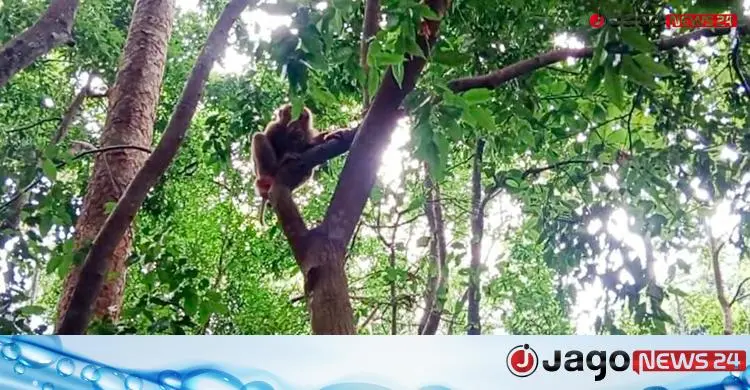
Lawachara in Kamalganj upazila of Moulvibazar was declared a national park 30 years ago, in 1996. But for various reasons this important 1,250-hectare forest is losing its character. Theft of valuable trees, bamboo and cane is now an everyday event, the forest is less dense than before, much of its land has been encroached on, animal numbers have fallen and a food shortage has emerged.
There is no control over the roads and railway through it, and the forest department does not even know where the forest's boundary lies. After all this time, the department is in practice unable to control Lawachara.
According to sources, Lawachara National Park is one of the country's seven wildlife sanctuaries and 10 national parks. It is a reserved forest, home to 460 species of rare plants and animals: 167 species of plants, four of amphibians, six of reptiles, 246 of birds and 20 of mammals. These are listed in forest department records, but nobody knows how many animals actually remain.
No boundary, open to theft
One of the park's biggest problems is that its boundary has never been fixed. Thirty years after the declaration, the forest department has tried several times to have it demarcated through the Zonal Settlement Office, without result. Many people with land next to the forest have occupied forest land, and some have planted gardens on it. When the department occasionally tries to recover the land, the lack of boundary markers gets in the way. Many others have taken forest land along with their privately owned plots.
Since the forest was declared protected, its open surroundings and the road inside have made it easy to steal trees, bamboo, cane and other valuables. Theft has risen alarmingly in the past two decades, destroying the forest's density and the animals' habitat.
There are roads and a railway inside the forest. The maximum speed on them has been set at 20 kilometres, but this is not enforced in practice. With vehicles and trains running 24 hours a day, animals are regularly crushed under wheels, and many are electrocuted by power lines.
The food shortage for animals has also worsened. In the dry season, the streams dry up and water runs short along with food. Many animals then come into villages in search of food, and some are killed by people. Yet the forest department has taken no steps on this.
Tourists and others say the forest was once the largest sanctuary of the endangered hoolock gibbon, which was easy to see on entering. It is no longer seen as before; the animals now seen are mainly monkeys, pythons and wild boar.
Tourists and litter
Shahan Ali, a tourist from Chattogram, told Jagonews: "A few of us friends came to visit Lawachara forest, but its condition is terrible. Apart from monkeys, no other animal can be seen. Tourists are dumping rubbish everywhere. The forest department must take strict steps to bring the forest under proper rules."
Locals Abid Hasan and Musa Ahmed said: "As time goes on, the forest's condition gets worse. Animals are dying all the time on the railway and roads inside the forest. Trees and bamboo are regularly cleared. The forest's old environment is gone."
In recent years, extra tourists have come to the park during holidays, especially Eid. Some buy tickets, but most enter without one, since the forest is open on all sides. Many ignore the forest department's instructions, dump rubbish everywhere and make noise inside the forest, disturbing the animals' natural environment.
Asm Saleh Sohel, a member of the executive council of Bangladesh Poribesh Andolon (BAPA), told Jagonews: "Lawachara's natural environment should be restored as soon as possible. It is very necessary to recover the occupied land and mark the forest's boundary. Whatever the animals need must be done, but nothing should be done that causes them suffering." He added: "Trees and bamboo are being cleared from the forest and its density has fallen. Protecting these is the forest department's responsibility. Tourist entry must be stopped for six months a year."
What officials say
The Wildlife Management and Nature Conservation Division says there is no food shortage in the forest; herds of boar sometimes go into paddy fields when the rice is ripe. It says a letter has been sent to the Sylhet Zonal Settlement Office to fix the boundary, and that a 20-kilometre speed limit has been set for vehicles and trains on the roads and railway, but nobody wants to obey it. Several signboards give instructions to visitors, and most read them but do not follow them.
Mohammad Kazi Nazmul Haque, range officer of the division, said everything necessary was being done to protect the animals. "Too many people are entering the forest, which is very hard to control. The forest department has issued instructions several times to keep the roads and railway through the forest under control, but no one follows them," he said.
Md Abul Kalam, Sylhet divisional forest officer of the Wildlife Management and Nature Conservation Division, said: "Because of population growth, the number of vehicles on the roads has risen. The number of tourists has also risen, and it cannot be controlled." He said a letter had been sent to the Zonal Settlement Office to fix the boundary, that tourists inside the forest could not be controlled and were damaging the environment with litter. Claiming that the animals face no food shortage, he said they generally survive by eating leaves and creepers.
However, Sonia Sultana, acting charge officer of the Sylhet Zonal Settlement Office, said she had received no letter about a forest survey. "I have not received any letter from the forest department about surveying Lawachara forest. If a letter has come, I will have to check at the office. If an application is made to us, steps will be taken for a forest survey," she said.
Source: Jagonews24. First published in Bengali on The Agro News.
Comments
(0)